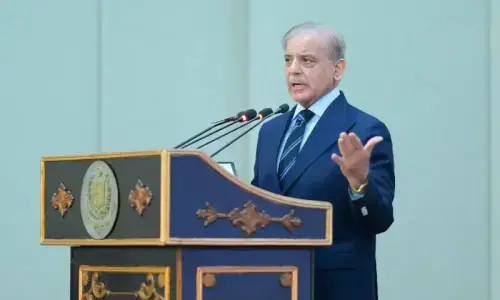
LAHORE: Pakistan’s endorsement of a 20-point peace plan and praise for President Trump’s role drew sharp criticism from opposition parties on Tuesday.
Opposition parties went as far as to say that the move amounted to “legalising war crimes, violating international law, ignoring the UN resolutions and defying the Quaid-i-Azam’s instructions.”
The main opposition PTI led the wave of criticism, saying it was deeply concerned that the plan seeks to determine the future of Palestine without ensuring the free will and consent of the Palestinian people.
“The recognition of Jerusalem as Israel’s capital and the acceptance of the occupied Syrian Golan Heights as Israeli territory are clear violation of international law and the UN resolutions, and they undermine global efforts for a just and lasting peace,” a PTI spokesperson stated.
JUI-F says excluding Hamas makes plan illegitimate; Jamaat rejects PM’s stance
“The PTI recalls the vision of Quaid-i-Azam Mohammad Ali Jinnah, who categorically declared that Pakistan would never recognise Israel until the Palestinians are given their legitimate rights and a free homeland. This vision continues to guide Pakistan’s foreign policy and reflects the voice of its people,” he said.
Meanwhile, speaking at a press conference in Lahore, JUI-F chief Maulana Fazlur Rehman rejected the plan, calling it a formula for Israel’s expansion rather than for recognition of a Palestinian state or the liberation of Jerusalem.
“The Palestine issue can never be resolved without Hamas,” he said, adding that President Trump sharing a podium with Israeli Prime Minister Netanyahu was an insult to the International Court of Justice.
“How can a war criminal be allowed to dictate terms to innocent people?” he asked, insisting that only Palestinians can decide their future and that outside imposition must be resisted.
The Jamaat-i-Islami also rejected PM Shehbaz’s endorsement. Reacting to the prime minister’s remarks on X, JI chief Hafiz Naeemur Rehman said the party would not accept the statement under any circumstances.
“In accordance with the UN Charter, every nation has the right to resort to armed struggle if its land is occupied. No power can forcibly take this right away,” he said.
Published in Dawn, October 1st, 2025