Food and Agriculture Organisation warns floods in Punjab, KP will affect Rabi cultivation

• Punjab worst hit with 1.3m hectares, including mostly cropland, inundated
• Fodder shortages and rising disease risks reported
• PDMA orders surveys to prioritise public complaints; displaced people told to vacate schools in Jalalpur Pirwala as classes resume
• Met Office forecasts rain, wind, thunderstorms in southeast Sindh till Oct 2
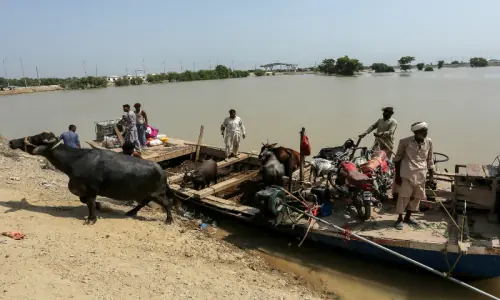
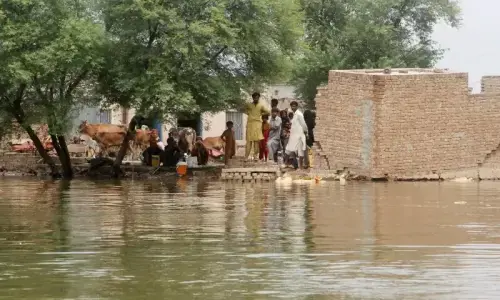
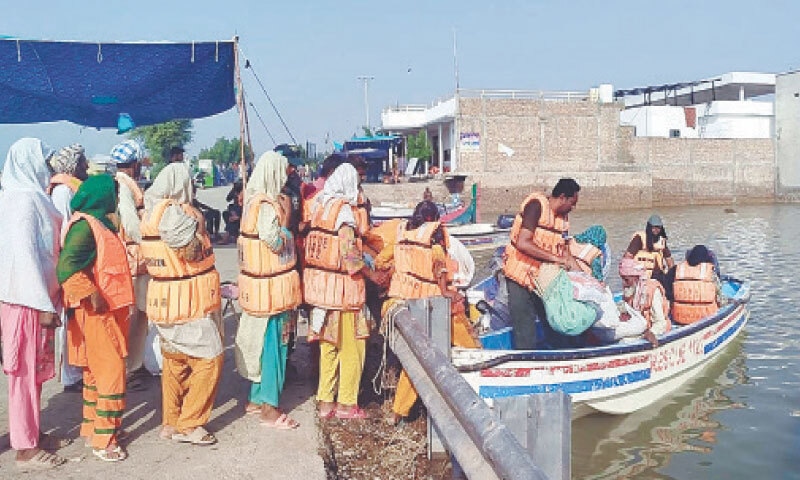
ISLAMABAD/LAHORE: The Food and Agriculture Organisation (FAO) has warned that flood damages in Punjab and Khyber-Pakhtunkhwa will affect upcoming Rabi cultivation, as the Punjab Provincial Disaster Management Authority directed survey teams to prioritise public complaints while assessing losses in affected areas.
Meanwhile, the Pakistan Meteorological Department (PMD) has predicted rain, wind, and thundershowers in south-eastern Sindh till October 2, with occasional gaps.
The recent floods have damaged farmland, standing crops, and agricultural infrastructure in both Punjab and Khyber-Pakhtunkhwa.
In its preliminary assessment report on the impact of floods, released on Monday, the FAO warned that seed availability for Rabi 2025-26 and Kharif 2026 is under threat.
Floods inundated 1.3m hectares, including 0.93m hectares of cropland, with Punjab worst hit.
FAO said half of wheat seed comes from saved grain, much of which was lost in flooded homesteads.
Within the formal sector, 80 to 90 per cent of wheat seed is available, but market pressures may affect this supply. Rising demand and prices may push farmers to sell seed as grain, cutting availability across provinces.
The report said flooding cut fodder supplies, raising costs and limiting access in remote areas.
Many livestock owners are resorting to distress sales, and only 45 per cent of fodder seed is available in the formal market, heightening risks for livestock nutrition. Overcrowded shelters and stagnant water are heightening stress and disease risks for livestock.
The FAO warned that conditions are favourable for outbreaks of lumpy skin disease (LSD), foot-and-mouth disease, peste des petits ruminants (PPR) and other zoonotic infections. LSD outbreaks have already been reported in southern Punjab bordering Sindh and Balochistan and are spreading northwards, with new cases in Pakpattan, Lodhran and Khanewal.
Quantifying crop-wise damage in Punjab, the FAO report said: Rice: 188,837 hectares damaged (7.3pc of total rice area), mainly in the northeast. The worst-hit districts were Sialkot (37,944 ha, 24.67pc), Narowal (20,008 ha, 15.88pc), Gujranwala (10,765 ha, 4.72pc), Bahawalnagar (9,594 ha, 8.60pc) and Sheikhupura (9,364 ha, 4.25pc).
Cotton: 84,182 hectares damaged (5.1pc of total cotton area). The worst-hit districts were Bahawalpur (19,503 ha, 6.10pc), Rajanpur (8,688 ha, 6.75pc), Khanewal (7,724 ha, 8.21pc), Multan (6,917 ha, 7.57pc) and Muzaffargarh (6,477 ha, 7.03pc).
Sugarcane: 23,413 hectares damaged (2.8pc of total sugarcane area). The most affected districts were Faisalabad (2,466 ha, 4.01pc), Jhang (2,254 ha, 4.05pc), Bhakkar (2,201 ha, 6.28pc), Rajanpur (1,512 ha, 2.87pc) and Layyah (1,504 ha, 5.45pc).
In KP, 62,080 hectares of land were flooded, including 50,821 hectares of cropland (2.7pc of total cropland). In Sindh, 74,542 hectares of land were flooded (0.5pc of total land), including 43,140 hectares of cropland (0.8pc of total cropland).
‘Focus on complaints’
In the meantime, the Punjab Provincial Disaster Management Authority has ordered survey teams to focus on addressing public complaints while conducting assessment of flood-damaged areas across the province.
In Jalalpur Pirwala, displaced people were asked to vacate schools being used as relief camps so classes could resume.
PDMA issued water-level data for all rivers in Punjab, showing normal flows and a significant decline in flood-affected areas.
Separately, the PMD has predicted rain, wind, and thundershowers in south-eastern Sindh till October 2, with occasional gaps.
Aamir Yasin in Rawalpindi also contributed to this report.
Published in Dawn, September 30th, 2025