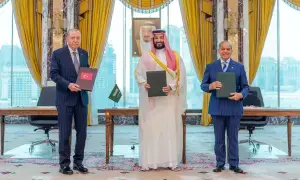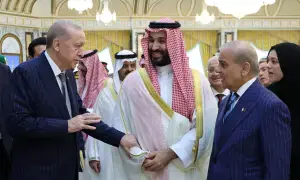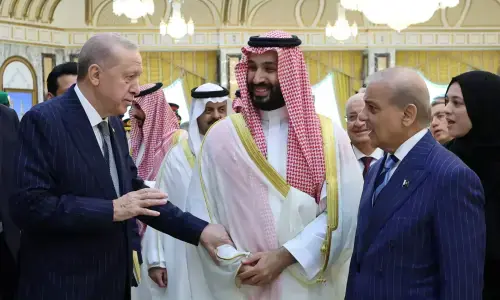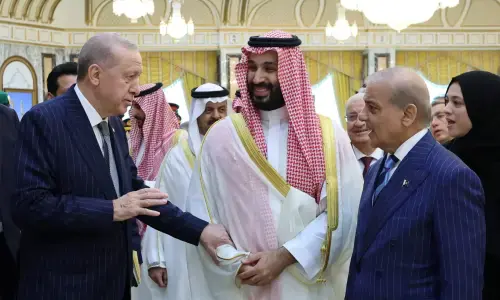


IN 2022, Pakistan’s first national security policy introduced the concept of geo-economics, arguing that the country’s security and prosperity go hand in hand. Recent geopolitical and regional shifts have led our country’s relevance to rebound, as seen in the meetings between its prime minister and army chief with US President Donald Trump last week, and in the Pakistan-Saudi defence pact announced earlier. Pakistan’s resurgent strategic relevance to greater powers will proffer economic and political safeguards, and test the validity of our geo-economic play. But to what extent will all Pakistanis benefit?
Other than the nuclear dimension, the pact with Saudi Arabia has raised questions about the extent to which Pakistan could build a defence industrial sector to help meet Riyadh’s needs to localise and diversify defence procurement. Writing for Brookings, Joshua T. White suggests that Riyadh may be interested in military equipment produced jointly by Pakistan and China, or purchasing “directly from the Pakistani industrial base that is developing niche capabilities in several advanced technology areas”.
This, along with moves to position Pakistan as a regional crypto mining hub and a critical minerals play with the US, are examples of geo-economic moves, aiming to extract economic opportunity from geopolitical dynamics and the desire to present as strategically relevant to greater powers. In and of itself, this is a sensible approach, but not necessarily the most inclusive one.
There is debate about the extent to which defence-related industrialisation leads to wider prosperity. Some case studies show that a burgeoning defence industrial sector can lead to economic uplift through the development of local supply chains, investment in value-added manufacturing that can spur multiple sectors, workforce upskilling, and the trickle effects of more disposable cash in the hands of those profiting from the sector’s advances.
Geo-economic gains should benefit all.
But cautionary tales also abound. Defence manufacturing is highly specialised, benefiting a small cadre of suppliers. The ‘closed circle’ nature of defence procurement, where a few firms, often with close links to the defence set-up, are repeat beneficiaries of security contracts also limits positive spillover economic effects. Defence supply chains need not necessarily be local, particularly where advanced components are imported. In these scenarios, an elite profits immensely, while the broader population is left with even less economic opportunity as investment is channelled into key strategic sectors at the expense of others.
Pakistan is at greater risk of the latter scenario, given the close links with China for defence manufacturing that mean many inputs will be imported or offshored. Pakistan also doesn’t have a sophisticated industrial base that can be easily pivoted towards defence or other tech pursuits such as crypto mining that require industrial inputs — as the recent World Bank report on Pakistan’s prosperity points out, most manufacturing in the country remains small-scale and low value-add.
If Pakistan is serious about a geo-economics strategy focused on sectors like defence, crypto and mining, it needs to plan ways in which to make resulting economic growth inclusive. More than 50 per cent of working-age people are not employed, and, according to the World Bank, 37pc of people aged between 15 and 24 years are neither working nor participating in education or training. Women remain largely excluded from the workforce, with our female labour force participation rate below the South Asian average.
Fewer jobs in agriculture, particularly because of climate change, means employment will have to be created elsewhere. As the World Bank report stresses, significant poverty reduction occurred for those who shifted into manufacturing jobs. This means a whole-of-society approach is essential for a geo-economics strategy to be successful.
Take the recent MoU signed between the FWO and US Strategic Minerals for critical minerals extraction. The agreement envisions the setting up of a refinery in Pakistan, which goes some way towards ensuring that locals can also benefit. One hopes future engagement with the US on these topics includes asks for knowledge and technology transfer and education opportunities to help cultivate a highly skilled workforce.
Without a holistic approach, any gains that geo-economic initiatives offer could be undermined. We have seen how local resentments and the failure to uplift all segments has led to challenges to CPEC and other economic initiatives. Let’s take a more inclusive approach. This may also be the best way to insulate our country from the boom-and-bust cycles that accompany our reliance on geopolitical relevance for the dollars to flow.
The writer is a political and integrity risk analyst.
X: @humayusuf
Published in Dawn, September 29th, 2025