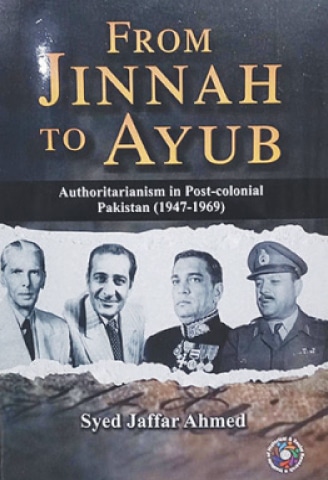
From Jinnah to Ayub: Authoritarianism in Post-colonial Pakistan (1947-1969)
By Syed Jaffar Ahmed
Institute of Historical and Social Research/ Legacy Books
ISBN: 978-627-7706-05-0
219pp.
Originally written as articles in the Karachi University journal Pakistan Perspectives, Syed Jaffar Ahmad’s book, From Jinnah to Ayub: Authoritarianism in Post-Colonial Pakistan, attempts to show how “the past has permeated post-colonial Pakistan.” Governments have largely been “dissociated” with the people’s “interests and urges” and have ruled with the help of two “pivotal institutions” — the military and the bureaucracy.
Syed Jaffar Ahmad, with an impressive academic career, has authored six books and compiled 24 others on history, politics and literature. Chapter Three of this one seems to tell us what the book is about. In brief, it tries to prove how Pakistan finally developed in a manner that was contrary to all those ideals that the Muslim League and its leaders, including Muhammad Ali Jinnah, fostered for the creation of a homeland for the Muslims of the Subcontinent.
Exaggeration there might be, but the author believes Pakistan developed “as an undemocratic and authoritarian structure, without a semblance of popular sovereignty, and as one which decidedly represented the supremacy of the extra-political forces.”
The author is entitled to his views, but “without a semblance” looks a bit odd against one historical truth — the 1973 Constitution is more than half a century old and, though there have been military interventions, with army chiefs meddling with the basic law, the constitution has survived. Both Gen Ziaul Haq (1977-1988) and Gen Pervez Musharraf (1999-2007) made changes in article 58-2b, for example, but elected governments subsequently restored the original.
The book in hand is a virtual history of Pakistan, with emphasis on constitutional deviations by a combination of powerful military and bureaucratic forces that focussed on regional interests and personal ambitions. It dwells at length on problems in the making of the first (1956) constitution. One of the major hurdles was the fact that East Pakistan’s population was larger than that of the western ‘wing’, even though the latter had a larger landmass with a linguistic variety. East Pakistan, on the other hand, was largely unilingual.
A collection of articles focuses on constitutional deviations by a combination of powerful military and bureaucratic forces that determined the political fate of the republic
An assembly elected to frame the constitution would have a ‘Bengali’ majority, and leaders in the west felt their interests would be undermined by default. It was, therefore, decided that the Constituent Assembly (CA) should have 50 members each from the two ‘wings’; and the country should have only two provinces — East Pakistan and West Pakistan, both having an equal number of lawmakers in the CA. Thus was established the principle of ‘parity’. Yet, in spite of what appeared to be a commendable degree of political accommodation on the part of parties and political elements, constitution-making didn’t turn out to be that easy.
Chapter Four seems to contain the essence of the book, for it dwells on the “nexus” between the civil and military forces between 1951 and 1958, to manipulate the evolution of a quasi-democratic system. The 1956 constitution survived less than three years.
The chief character of the 1956 constitution was that it had a strong head of state, even though, in the parliamentary system, it is the prime minister who calls the shots because his party has a majority in parliament. However, that’s not how it happened.
As author Ahmad points out, during this period, the cabinets showed the traditional bias in favour of a strong head of state. The book gives readable details of the political manoeuvring and power-lust that in no way advanced the cause of democracy. When Chaudhri Muhammad Ali, a financial genius, joined the cabinet, it was what the author calls “a cabinet of all talents.” But an indication of the political instability was the fact that, during the period from Prime Minister Liaquat Ali Khan’s assassination to the enforcement of the 1956 Constitution, the country saw seven prime ministers.
The military coup d’état of Oct 7, 1958, led Pakistan into “the third phase of its political history, in which the military and the bureaucracy operated all levels of political power, to the exclusion of the established political parties. The coup was not a revolution. It was essentially conservative in character and its sole purpose was to ensure the continuity and enhancement of the policies [that] the military-bureaucracy alliance had laid down during the first decade of independence.”
Iskander Mirza, who happened to be the Governor-General under the pre-1956 constitution, refused to sign the Constitution unless he was accepted as president. By any standards a great man, Mirza had served the Muslim League on Jinnah’s behest, in what is now Khyber Pakhtunkhwa, even though he was working for the British government.
His biggest contribution to Pakistan’s territorial expansion was the acquisition of Gwadar from Oman. He wrote to the British authorities in Oman that Pakistan would leave what was then called the British Commonwealth if Gwadar were not given to Pakistan. The British obliged. Yet this patriot committed high treason when, as president, he abrogated the constitution to which he had pledged loyalty.
Gen Ayub Khan, who was defence minister in his cabinet, was a co-sharer in this crime. According to the author, Ayub Khan had “high regards for civil supremacy but the country’s deteriorating political situation compelled him to interfere.” The constitution was abrogated in October 1958 and martial law became the law of the country. Twenty days later, Mirza went to London, never to return to Pakistan.
Author Ahmad’s comments on aspects of our history show the originality of his thinking. The military coup d’état of Oct 7, 1958, he says, led Pakistan into “the third phase of its political history, in which the military and the bureaucracy operated all levels of political power, to the exclusion of the established political parties. The coup was not a revolution. It was essentially conservative in character and its sole purpose was to ensure the continuity and enhancement of the policies [that] the military-bureaucracy alliance had laid down during the first decade of independence.”
Dwelling on the break-up of the country, the author says Gen Yahya Khan had already made his ambitions known when he had virtually taken control of the President’s House during Gen Ayub’s prolonged illness in early 1968. His ambitions were realised in March 1969 when Ayub, “finding himself under siege”, invited Yahya “to take control.”
According to the author, Ayub opted for the declaration of martial law because he didn’t wish to be impeached. Only the military could give him such assurances. Ayub thus saved himself; his administrative state, however, withered away. Pakistan began to experience its second spell of direct military rule.
According to the author, the first two and a half decades of the country’s history can be judged as a conflict between political and social authoritarianism on the one hand, and the efforts and struggles of those who stood for their rights on the other. This period ended in the failure of national integration and, eventually, in the break-up of the country.
Unfortunately, it seems, the book was never proof-read and is full of spelling and grammatical mistakes. The book ended, but the proof-readers never got to know the difference between ‘loose’ and ‘lose’.
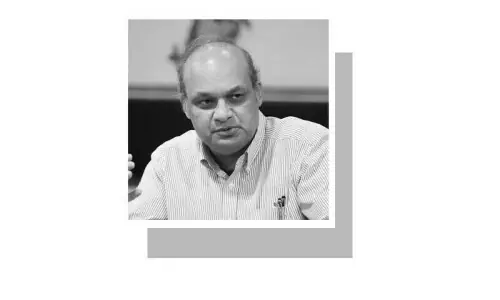
The writer is Dawn’s External Ombudsman and an author
Published in Dawn, Books & Authors, September 28th, 2025