
As living organisms, trees have been providing essential services to humanity for millennia — as oxygenators, as carbon sinks, as shelter and habitat. The reality of a tree is fundamentally altered when it is harvested for wood. In its rawest form, wood is burned for fuel. But when wood is altered by the human imagination into an object of utility or of beauty, the story of wood-based arts and crafts begins.
Artist and academic Naila Mahmood and interior designer Zahra Ebrahim, the co-curators of ‘Ingrained: Wood in a Cross-Section of Time’ at Koel gallery, paired notions of time and beauty with the essence of trees. They invited the viewer “to read the language etched into wood”, although this task is not as simple as it sounds. Can one read this language in a way that is detached from the transformative activities that humans subject wood to?
Overt references to contentious contemporary issues relating to deforestation, lack of sustainable harvesting of timber, decline of forest cover, ecological threats to nature and urban heat island effects were excluded from the invitation. Diversity of form rather than polemics were showcased in this abundant and reassuring survey of botanical drawings, crafted items and installations.
‘Ingrained: Wood in a Cross-section of Time’ is the fourth in a series of five exhibitions at Koel Gallery that take inspiration from Koel-founder Noorjehan Bilgrami’s book The Craft Traditions of Pakistan. The principle of complementarity between craft and art was operative in the curatorial approach rather than the controversial binary hierarchies that divide art into ‘high’ or aesthetic and craft into ‘low’ or utilitarian means of production. The dichotomy is challenged now on many fronts, not least on that of decolonisation. However, the complexity of ethical dilemmas associated with the usage of trees as wood is highlighted in some of the art works.
Koel Gallery’s recent exhibition was a refreshing and reassuring exploration of the extraordinary diversity and utility of wood-based arts and crafts
Arguably, the definition of art versus craft remains fuzzy and manifold. As Japanese philosopher Soetsu Yanagi states: “The world of utility and the world of beauty are not separate realms.” The flautist Ustad Hanif Khan, in his performance (as part of the exhibition), exemplified this spirit by speaking about the intimacy of crafting his own bamboo flutes and making music through them with his breath.
A plethora of art objects made by 17 artists, architects, designers and craftspeople were cleverly arranged across the two floors of the gallery space, in which woodworks had been sliced, carved, cross-sectioned, bent, drawn, painted, filmed, photographed, played on, sniffed, autopsied and planted on.
Works on flat surfaces, whether paints, graphite or photography, were created by Nida Bangash, Madiha Hyder, Fraz Mateen, Anushka Rustomji, Usman Saeed and Zoral Naik.
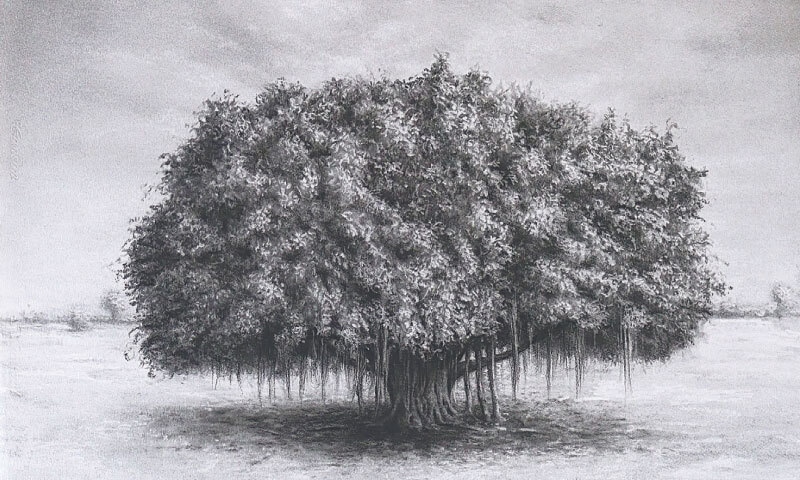
Bangash’s Painted Archives were narrative portraits of trees that have migrated across countries. The Olive Tree is a lush painting of a tree laden with oversized olives. The artist based it on an actual 900-year-old tree still standing in an orange grove in Reeha, Palestine. Oozing fertility, the tree is a poignant call to beauty amidst the unfolding of genocide. Mateen sketched indigenous trees (the Deodar, the Jamun and the Keekar) and paired them with mounted cross-sections of their wood to underscore the identity of the species from which wood is derived, thus rescuing the wood from anonymity.
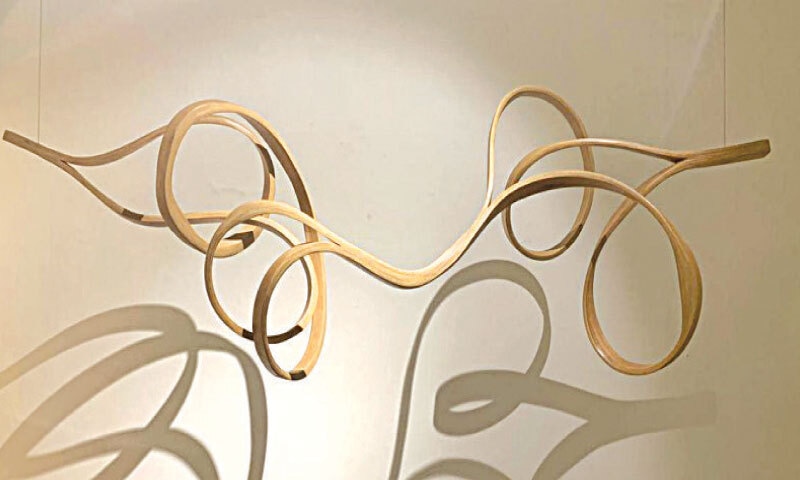
Several architects and craftsmen collaborated on creating furniture or installations to draw attention to the natural grain of wood or, as in the sound installation Echoes of Wood by Khadija-tul-Kubra and Open Doors Workshop, to place the object’s transformation from wood to commodity by an anthropomorphising imagining of the tree as witness to time.
Two documentaries, The Tabla’s Journey by Sarosh Hebatzai and Mulberry Trees of Mariabad by Sibt-e-Hassan Azad, examined solitude and community respectively. Hebatzai revels in the stories that he hears while communing with nature in the foothills of the Nanga Parbat. Azad’s film showed the extraordinary power of community to counter the desecration of nature. Members of the Hazara community of Mariabad in Quetta have been planting fast-growing mulberry trees, resulting in the development of new forests.
Wood is an enduring part of human material culture. Humanity’s greatest art lies in ensuring its compatibility with the thriving of trees and forests.
‘Ingrained: Wood in a Cross-Section of Time’ was on display at Koel Gallery in Karachi from August 12-September 6, 2025
The writer is an independent researcher, writer, art critic and curator based in Karachi
Published in Dawn, EOS, September 21st, 2025