In Pakistan, like some other similar countries, the official narrative takes huge precedence over introducing students and people at large to our true historic trajectory, with its minor gains and major pitfalls over the many years.
It is not just limited to political history, but also to economic, social and cultural histories. However, there are safe places in other countries where an alternative to official narratives is presented and which is not stifled. But even in our places of basic and higher learning, unlike those other countries, the lopsided official narrative is shamelessly put forward, without any critical thinking allowed to be applied by the academia or the students.
We may find that in some classrooms exceptions are there to prove the rule. Nevertheless, even exceptions are increasingly non-existent in state-owned educational institutions. Therefore, in countries like ours, the importance of autobiographies and memoirs of individuals who have challenged the official narrative and objected to anti-people political policies serve two major purposes.
One is the interesting personal story of an eventful life consumed by a struggle, and, the other — more important in our context — is the history told from a different vantage point and an independent lens.
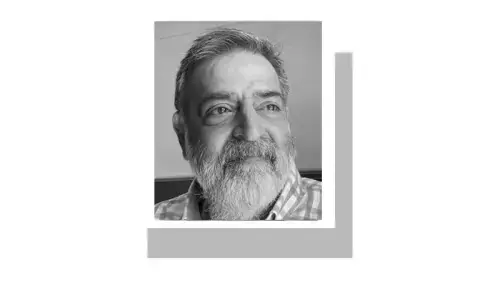
Husain Naqi Sahib’s autobiography, Mujh Se Jo Ho Saka [Whatever I Could Do], published recently by Jamhoori Publications, Lahore, is a significant addition to the chronicling of a people’s history through the relating of what Naqi himself went through — being a part of a larger democratic and political struggle as a student leader, journalist, trade unionist and human rights defender over the last seven decades. He looks at the world around him from the lens of the disadvantaged and the oppressed. Like any other creative writer or a conscientious journalist, he has demonstrated the courage, ability, confidence and skill to articulate the suffering and the struggle of people he witnessed from within the movements he was part of.
Naqi’s story begins in the heart of the former state of Awadh, the city of Lucknow, by the banks of the mostly serene river Gomti. The city was unique in terms of both being dreamy when it came to its decadent culture and sanguine when it came to the independent political nature of its inhabitants — somehow comparable to Prague in Europe.
Naqi says he was perhaps born a year before his officially recorded birthdate, 1936. His great-grandfather had moved to Lucknow from a village in what is now Haryana, in the then-undivided Punjab. It was a well-heeled and well-educated family that flourished in Lucknow over the next few generations. However, Naqi subtly confronted the conservatism of his traditional family from a very young age. Outside, he was not subtle. He began his student activism in secondary school and started taking on the minor establishments of power at a fairly young age.
Heavens had it that Pakistan was waiting for Naqi to arrive, grow up, focus and take on the major establishments of power that suppress fundamental rights through their machinations in both the state and corporate sectors. There were circumstances that led Naqi to move to Pakistan in the early 1950s. He spent a few turbulent years in Karachi before permanently settling down in Lahore — the city that he has long identified with as his own and the city that itself identifies with Naqi as a source of resistance to power.
The whole South Asian Subcontinent and the progressive movements in politics, art, literature and journalism that were waged across the region over the last three centuries serve as the backdrop of the argument Naqi attempts to make. But the social, cultural and political environments of the cities that appear as markers for his life narrated in the book are Lucknow, Karachi and Lahore. The early Lucknow shaped Naqi’s personality, Karachi nurtured his confidence and Lahore gave him the possibility to rise and shine.
There are descriptions of events and people from before the time of the Partition in 1947 to the present day from all three cities in particular and the Subcontinent in general. It makes it an enriching read, where you are introduced to a very large number of formidable personalities, ranging from Syed Sajjad Zaheer and Minhaj Barna to Zulfikar Ali Bhutto and Zafar Iqbal Mirza. The descriptions of each person are short but insightful and incisive.
Naqi has dissected the martial rules in Pakistan and completely overturned the continuous propaganda of ‘Pakistan’s golden years’ under Gen Ayub Khan’s martial rule. At the same time, he challenges civilian despots with equal vigour. He is a hardcore journalist first and foremost. Therefore, his analyses are built on statements of facts. He sees current affairs in a historic continuity and never lets himself decontextualise the decisions taken by either those in power or those resisting power at any stage of our history. His personal struggle for democratic freedoms in general and freedom of expression is located within the larger campaigns for democratic socialism, civic freedoms and an independent press.
Last but not the least, one of the reasons Naqi stands out is his consistent campaign for the preservation and promotion of the Punjabi language in Pakistan — a language of the masses long oppressed by the British colonialists, the bureaucracy that was imported from the neighbouring Urdu-speaking North Indian provinces and, ultimately, the Punjab’s own elite and affluent middle class.
Hailing from Lucknow did not lessen his commitment to the people he chose to live with and their language. Against all odds, he brought out the first-ever daily newspaper in the Punjabi language — Sajjan.
The writer is a poet and essayist. His latest collections of verse are Hairaa’n Sar-i-Bazaar and No Fortunes to Tell
Published in Dawn, Books & Authors, September 14th, 2025