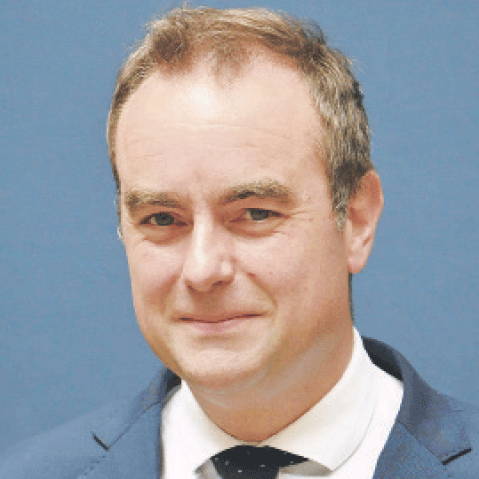
PARIS: French President Emmanuel Macron on Tuesday named Sebastien Lecornu, defence minister and a close ally, as the new prime minister to resolve a deepening political crisis as protests loom in the next days.
In choosing Lecornu, 39, to replace Francois Bayrou as the seventh premier of his mandate, Macron has plumped for one of his closest allies rather than seeking to broaden the appeal of the government across the spectrum.
Macron has told Lecornu “to consult the political forces represented in parliament with a view to adopting a budget for the nation and making the agreements essential for the decisions of the coming months”, the Elysee announced.
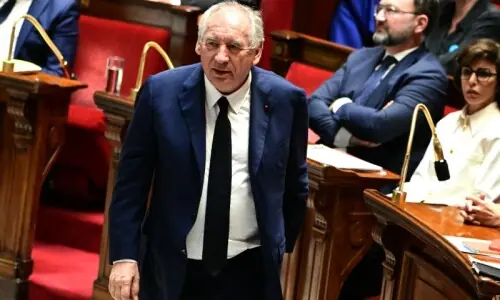
Bayrou, who survived just nine months in office, submitted his resignation to Macron earlier on Tuesday, a day after parliament ousted the government.
Unlike some of his predecessors, Lecornu is not known to have presidential ambition
The formal handover of power between Bayrou and Lecornu is due to take place on Wednesday at midday.
The French president has in the past been notoriously slow in casting a new prime minister. But this time he has taken less than a day given the risk of financial and political instability.
“Emmanuel Macron is now in the front line to find a solution to the political crisis,” said the Liberation daily.
France’s borrowing costs, a measure of investor confidence, surged slightly higher than those for Italy, long one of Europe’s debt laggards.
“The president is convinced that (under Lecornu) an agreement between the political forces is possible, while respecting the convictions of each,” said the Elysee.
Bayrou had blindsided even his allies by calling a confidence vote to end a lengthy standoff over his austerity budget, which foresaw almost 44 billion euros ($52bn) of cost savings to reduce France’s debt pile.
In the end, 364 deputies in the National Assembly voted that they had no confidence in the government, while just 194 gave it their confidence.
Fifth PM in three years
Bayrou was the sixth prime minister under Macron since his 2017 election, and the fifth since 2022.
His predecessor, Michel Barnier, was brought down by a no-confidence vote in December.
The crisis dates back to last year’s legislative elections that resulted in a hung parliament.
“Emmanuel Macron, a vulnerable president,” said the Le Monde daily.
Macron, who has been leading diplomatic efforts internationally to end the war in Ukraine, had faced one of the most critical domestic decisions of his presidency over who to appoint as premier.
Lecornu has been in his post more than three years, for most of Russia’s invasion of Ukraine, and is a staunch supporter of Kyiv.
He is seen as a discreet but highly skilled operator who, crucially for Macron, himself harbours no ambition of becoming president.
Lecornu had been tipped to take the job in December, but in the end Bayrou reportedly strong-armed the president into giving him a chance.
Social tensions
Alongside political upheaval, France is also facing social tensions.
A left-wing collective, “Block Everything”, is calling for a day of action on Wednesday and trade unions have urged workers to strike on Sept 18.
“I hope we can find agreements. I believe there is a possibility of building a project that satisfies what I call the national majority,” said Interior Minister Bruno Retailleau, who is also leader of the main right-wing Republicans Party.
The 2027 presidential election remains wide open, with analysts predicting the French far right will have its best-ever chance of winning.
Macron is forbidden from standing for a third term in 2027.
The hopes of three-time presidential candidate for the far-right National Rally (RN), Marine Le Pen, depend on the outcome of an appeal hearing early next year over her conviction for a European Parliament fake jobs scam that disqualified her from standing for office.
She described Lecornu’s appointment as the “final shot of Macronism”.
The Socialist Party, which had been eying the prime minister’s position for itself, denounced Macron’s decision not to include them and said the president had taken the risk of “provoking legitimate social anger and institutional stalemate”.
But former prime minister Edouard Philippe, who is on the centre-right, was more optimistic. Lecornu “has the qualities” to “discuss” and “find an agreement” with the other parties, he told a television channel.
Published in Dawn, September 10th, 2025