Floods and fertility — a necessary crisis


The magnitude of damages caused by the recent floods in southern Punjab is huge. People of the area are reeling from floods triggered by the release of water from dams by India. Painful scenes are being televised showing human and livestock displacements at a large scale.
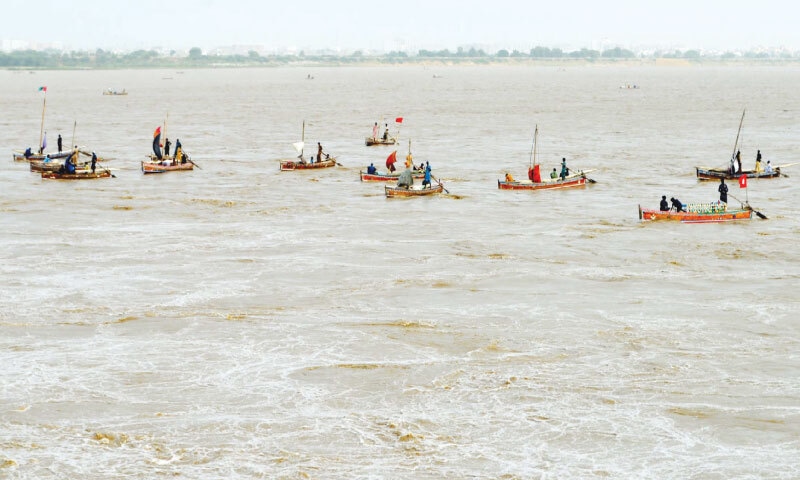
The situation in Sindh, however, is different. Those dependent on the Indus River find themselves in a kind of euphoria. Riverine floods — provided they pass safely from three barrages — are always considered a positive sign by people for their socioeconomic conditions, especially in deltaic regions.
A riverine flood is in fact a volume of water passing safely between two dykes of the river into the Arabian Sea. Such volumes of water are also described as environmental flows necessary for reviving the otherwise dying Indus delta that once used to thrive in terms of agriculture and other resources.
Come every summer cropping season, growers always paint a gloomy picture as far as water flows at Kotri Barrage are concerned for the cultivation of Kharif crops. For most of the period during early summer, water flows remain unavailable till May. It is only in monsoon-cum-flood season when flows start showing improvement and water becomes available.
As Punjab grapples with the harsh reality of urban flooding, Sindh’s riverine dwellers rejoice over the abundance of fish, fertile silt and soil, and a recharged groundwater table
Similar shortages were seen earlier in 2025 when mango orchards were hit by unavailability of water at critical growing times, and water shortages were recorded as high as 65 per cent at Kotri Barrage and 85pc at Guddu barrage. This year Sindh lost 35pc of its cotton acreage, as per agriculture department figures, due to severe water shortages in critical times.
Flows do start improving around June-July when Kotri barrage starts receiving adequate flows in August after the Guddu and Sukkur barrages. Kotri barrage was in low floods until Saturday amidst reports that discharges from eastern rivers would increase flows in Sindh, too.
Such flows are expected to reach Sindh in September’s first week. A discharge of close to 1.1 million cusecs was recorded until August 27 in Punjab at Qadirabad and Khanki barrages over Chenab. These flows would — after spreading within southern Punjab — ultimately enter Sindh to reach the Arabian Sea.
Guddu and Sukkur barrages have already passed high and medium riverine floods in July and August. With the anticipation of more floodwaters by Sindh irrigation minister Jam Khan Shoro and officials — this time generated in eastern rivers — Sindh would again be bracing for a ‘very high’ flood, prompting authorities to make arrangements for flood fighting accordingly.
“Let more water reach us,” says Munawar Baloch, a resident of the Indus delta region Kharrochhan, where the Indus meets the Arabian Sea. According to him, people in his region are rejoicing over these flows that support aquatic life. “We see an increase in fish production besides crabs and shrimps. Not only this, but mangrove forests show impressive growth in their health,” he said, alluding to the coastal trees that serve as natural barriers against cyclones by dissipating tidal waves’ energy.
He pointed out that livestock health improves after drinking the river’s water. Mr Baloch had to relocate to Bagan city, situated around 27km away from Kharrochhan — a victim of massive sea intrusion that has been devouring land in the delta. Baloch himself deals in the crab trade. Crabs are mostly exported to China and other countries.
“Palla fish is mostly caught here [the delta], and, yes admittedly, banned nets are used by the fishing community here to catch plenty of this species for income generation,” he said. Palla, known for its aroma and taste, remains available in the river only for a limited time — flood season. It is found and caught in Kotri barrage’s downstream. Fishermen are always excited for catching Palla during the monsoon, as it gives them an extra buck when compared with the price of other fish.
Floods also inundate riverine area — commonly known in Sindh as katcha. This is considered beneficial for katcha dwellers and the area. These floods bring silt that is deposited in the floodplains to make soil fertile and soak river embankments. Agriculture in katcha areas is common between two dykes of the river. Even large-scale commercial farming of sugarcane, a high delta crop, is performed in the area.
Sindh had witnessed a super flood 15 years back (August 2010) when one-fourth of Pakistan was hit by massive floods and rainfall. The infamous Tori Dyke breach had caused unprecedented displacement of people in upper Sindh in 2010 and then in lower Sindh due to another breach at Kot Almo in undivided Thatta. The two breaches had led to the formation of a Supreme Court-led judicial commission that came up with important findings.
Kotri barrage had then passed a flow of 939,442 cusecs on Aug 27, 2010, after Guddu passed a discharge of 1,148,200 cusecs and Sukkur 1,108,795 cusecs. Later, it was in 2015 and 2022 when the Kotri barrage had passed a high flood in August and September, respectively.
“After a long gap and severe drought, the Indus delta is receiving necessary environmental flows. The [Indus] Delta was once a pristine ecosystem that’s degrading due to persistent water scarcity,” comments Naseer Memon, who regularly writes on Sindh’s water issue. According to him, deltaic communities eagerly wait for monsoon rains and flows below Kotri barrage as the livelihoods of millions of katcha dwellers is linked to groundwater that is recharged after inundation of floodplains.
Floods are also attributable to climate change-induced weather patterns in the country, the impacts of which have become more pronounced in the recent past, especially after the late 90s, when climate change became a point of heated debate.
Statistics on the downstream Kotri barrage flows assessed between the 1956-57 and 2023-24 periods by the irrigation department. A reading of the chart shows that annual Kotri downstream flows were 61.2m acre feet (MAF) between 1956-57 and 1975-76; 40.7 MAF between 1976-77 and 1998-99; 26.8 MAF between 1976-77 and 2023-24; and 14.04 MAF between 1999-2000 and 2023-24. The month-wise Kotri flows record a declining trend between April-March of 1999-2023 when compared with the 1976-1998 period.
Published in Dawn, The Business and Finance Weekly, September 1st, 2025