Trump scraps India visit for Quad summit amid deteriorating ties: report



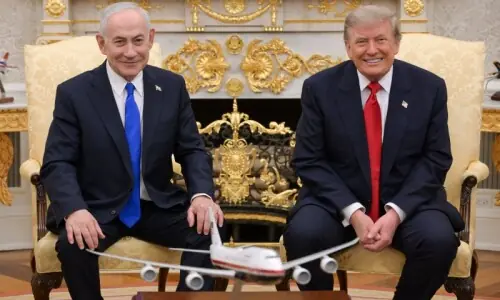
United States President Donald Trump has scrapped plans to attend an upcoming summit of the ‘Quad’ grouping in India amid deteriorating ties between Washington and New Delhi, US newspaper The New York Times (NYT) reported on Saturday.
Relations between the two countries have plummeted, with 50 per cent levies on many Indian imports into the US taking effect this week as punishment for New Delhi’s massive purchases of Russian oil; a part of US efforts to pressure Moscow into ending its war in Ukraine.
As ties between both nations deteriorate, NYT reported on Saturday that the breakdown in relations was caused after a phone call on June 17.
“After telling [Indian Prime Minister Narendra] Modi that he would travel to India later this year for the Quad summit, Mr Trump no longer has plans to visit in the fall, according to people familiar with the president’s schedule,” the NYT reported, citing “interviews with more than a dozen people in Washington and New Delhi”.
The NYT mentioned how Trump’s repeated claims about having ended the recent brief conflict between India and Pakistan reportedly “infuriated” Modi. The paper added that the dispute “dates back more than 75 years and is far deeper and more complicated than Mr Trump was making it out to be”.
India blamed Pakistan for the April 22 Pahalgam attack without evidence, triggering a military escalation. On May 6–7, New Delhi launched air strikes that killed civilians, followed by a week-long missile exchange. A US-brokered ceasefire ended the war.
“During a phone call on June 17, Mr Trump brought it up again, saying how proud he was of ending the military escalation,” the NYT reported.
“He mentioned that Pakistan was going to nominate him for the Nobel Peace Prize, an honour for which he had been openly campaigning. The not-so-subtle implication, according to people familiar with the call, was that Mr Modi should do the same.”
It added that the “bristled” Indian premier told Trump that American involvement had nothing to do with the ceasefire and the conflict had been settled directly between India and Pakistan.
“Mr Trump largely brushed off Mr Modi’s comments, but the disagreement — and Mr Modi’s refusal to engage on the Nobel — has played an outsize role in the souring relationship between the two leaders, whose once-close ties go back to Mr Trump’s first term,” the report reads, adding that the two leaders have not spoken since the June 17 phone conversation and Trump has only doubled down on taking credit for the ceasefire.
Amid this dispute, India has grown closer to Beijing and Moscow. Modi is currently in Tianjin, China, for the Shanghai Cooperation Organisation’s Council of Heads of State summit, where he is expected to meet with Chinese President Xi Jinping and Russian President Vladimir Putin.
“At its core, the story of Mr Trump and Mr Modi is about two brash, populist leaders with big egos and authoritarian tendencies, and the web of loyalties that help keep both men in power,” the NYT reported.
“But it is also the tale of an American president with his eye on a Nobel Prize, running smack into the immovable third rail of Indian politics: the conflict with Pakistan.”
Bloomberg reported earlier this month that Modi turned down an invitation from Trump to visit the White House after a G7 meeting in Canada, over concerns that he would set up a meeting with Chief of Army Staff (COAS) Field Marshal Asim Munir, who was visiting the US at the time.
Reporting the same, NYT said: “Modi declined an invitation from Mr Trump to stop by Washington before he flew home. His officials were scandalised that Mr Trump might try to force their leader into a handshake with Pakistan’s army chief, who had also been invited to the White House for lunch around the same time. It was another clear sign, a senior Indian official said, that Mr Trump cared little for the complexity of their issue or the sensitivities and history around it.”
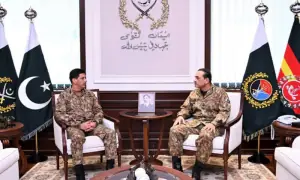
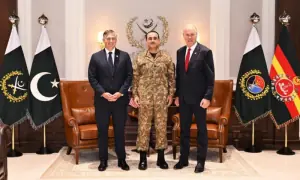
The COAS carried out two visits to the US. The first, in June, saw him meet Trump at the White House for luncheon, making him the first sitting army chief to do so.
The field marshal termed his second visit to the US in just one-and-a-half months a “new dimension” in ties between Washington and Islamabad. During this trip, the COAS engaged in high-level interactions with senior political and military leadership, as well as members of the Pakistani diaspora.
Pakistan and the US also finalised a trade deal at the start of August, lowering tariffs to 19pc from the previously announced 29pc and helping develop Pakistan’s oil reserves while trade talks between the US and India have stalled.