0
0

On August 15, 1975 the world witnessed events that would echo for decades. In Bangladesh, the newly formed nation was shaken by the brutal assassination of its founder, Sheikh Mujibur Rahman, in the early hours of the morning.
In the United Kingdom, the infamous Birmingham Six case marked a dark chapter of injustice as six Irishmen were wrongfully sentenced to life imprisonment for the Birmingham pub bombings — convictions that would only be overturned years later.
In Brazil, aircraft manufacturer Embraer reached a milestone by exporting its first plane to Uruguay.
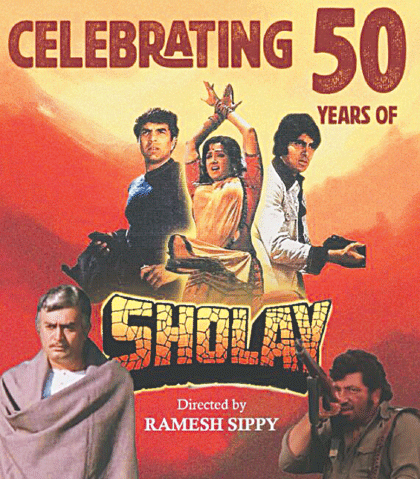
However, in India, something very different happened on that day. A film released in theatres that would change Bollywood. It was seemingly ordinary at first, struggling with poor reviews and weak audience turnout. Yet within weeks, word-of-mouth transformed it into a phenomenon. That film was Sholay. Initially written off, it went on to become a turning point in Indian cinema, reshaping the way stories are told, characters are built, and spectacles are mounted on the big screen.
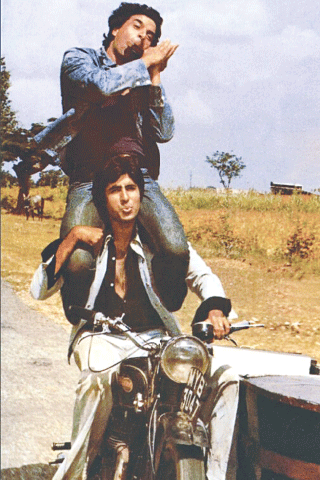
Directed by Karachi-born Ramesh Sippy and written by the legendary screenwriting duo Salim-Javed, Sholay became the first Indian film to be shot in 70mm with stereophonic sound — a technological leap that gave audiences an immersive, larger-than-life experience.
Director Ramesh Sippy’s film, which reshaped Indian cinema and influenced generations, was released this month 50 years ago
At its heart, Sholay was a revenge drama. Thakur Baldev Singh (Sanjeev Kumar), a former policeman who had lost both his family and his arms to the dreaded bandit Gabbar Singh, hires two petty criminals, Jai (Amitabh Bachchan) and Veeru (Dharmendra), to capture Gabbar Singh alive. What unfolds is not just a story of revenge, but one of friendship, sacrifice, love, and the eternal clash between good and evil.
The cast delivered unforgettable performances: Sanjeev Kumar’s dignified gravitas as Thakur, Dharmendra’s mischievous yet heroic Veeru, Amitabh’s brooding intensity as Jai and Amjad Khan’s chilling portrayal of Gabbar Singh.
Even supporting roles achieved legendary status. Mac Mohan’s Sambha, Viju Khote’s Kaalia and A.K. Hangal’s Imam sahib became more famous through their screen names than their real ones. Asrani’s jailer forever remembered for his comic lament of being an “Angrezon ke zamanay ka jailer [a jailer dating back to the days of the British Raj]” and Jagdeep’s Soorma Bhopali, who even inspired a spin-off film, added layers of humour to the otherwise gritty tale.
Then there was Gabbar Singh. Amjad Khan, an unknown actor at the time, immortalised the role with his childlike yet sinister voice, his unforgettable laugh, and his menacing aura. The character grew beyond the film, becoming part of Indian folklore — so much so that, in 1991, he returned in a parody film, Ramgarrh Ke Sholay, billed almost like a sequel and centred on his legacy.
Sholay opened to lukewarm reviews and disappointing ticket sales in its first two weeks. Critics dismissed it as “too violent” or “too long.” Even its marketing struggled, with posters and trailers failing to communicate the epic scale of the film. Fearing disaster, Ramesh Sippy and Salim-Javed debated reshooting certain portions. They speculated that audiences might have rejected the subplot of a widow (played by Jaya Bahaduri) remarrying with her father-in-law’s blessing, or perhaps they were upset by Jai’s tragic death.
However, Sippy decided to wait. Then came the third week — a turning point. By Monday, word of mouth spread like wildfire, largely thanks to the dialogues that audiences repeated endlessly. Overnight, Sholay transformed from a struggling film into a historic blockbuster.
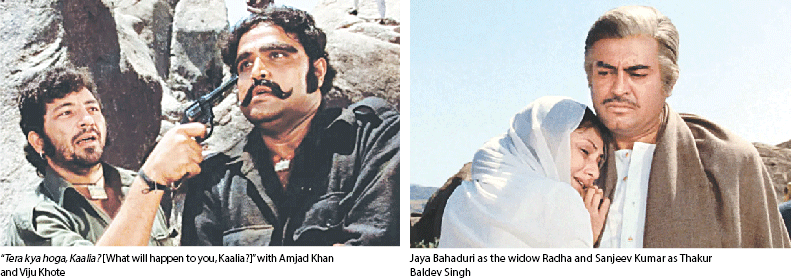
Salim-Javed’s pen turned Sholay into a goldmine of unforgettable dialogues. Immortal lines such as “Kitnay aadmi thay? [How many men were there?]”, “Tera kya hoga, Kaalia? [What will happen to you, Kaalia?]”, “Yeh haath mujhay de de, Thakur [Give me these hands, Thakur]”, the nursery rhyme-like threat “So ja, betay, so ja... nahin toh Gabbar aa jayega [Sleep, my son, sleep... or else Gabbar will come]”, and the evergreen “Jo darr gaya, woh marr gaya [He who is afraid, is dead].” It was not just cinema anymore; it was folklore. Dialogues from Sholay became idioms, used in everyday conversations across India, cementing the film’s place in cultural memory.
The music was another pillar of Sholay’s success. R.D. Burman’s soundtrack blended folk, Western and dramatic elements into unforgettable numbers. ‘Yeh dosti’, picturised on Jai and Veeru riding their motorcycle became the ultimate friendship anthem. ‘Jab tak hai jaan’, where Basanti (Hema Malini) is forced to dance at gunpoint to save Veeru, epitomised emotional intensity.
Perhaps unique was ‘Mehbooba o mehbooba’, sung by R.D. Burman himself. Inspired by Demis Roussos’ 1973 track ‘Say You Love Me’, Burman reimagined it with Indian rhythms and rustic instrumentation, creating a gypsy-style performance that perfectly fit the film’s tone.
The label “curry Western” was coined to describe Sholay’s blend of Hollywood Western tropes with Indian storytelling. The premise of hired guns defending a helpless village clearly echoed The Magnificent Seven (1960), itself adapted from Akira Kurosawa’s Seven Samurai (1954). Gabbar Singh’s theatrical villainy mirrored the stylised outlaws of Sergio Leone’s spaghetti Westerns. The barren landscapes and wide frames recalled Sergio Leone’s Italy-shot classics, while even smaller details — such as Jai’s harmonica — seemed borrowed from Once Upon a Time in the West (1968).
The emotional coin-flip scene, where Jai persuades Veeru to escape while he stays behind, had echoes of Garden of Evil (1954), where Richard Widmark convinces Gary Cooper to leave him behind with a wounded man — except in Sholay, a coin replaced a card. Jai and Veeru’s camaraderie reflected Paul Newman and Robert Redford in Butch Cassidy and the Sundance Kid (1969). Even the famous tanki scene — with Veeru threatening to commit suicide by jumping off from from a high water tank — was lifted from Anthony Quinn’s The Secret of Santa Vittoria (1969).
What many forget is that Amitabh Bachchan and Amjad Khan were not the first choices. Shatrughan Sinha was originally considered for Jai, while Danny Denzongpa was signed as Gabbar before he chose to star in Dharmatma instead. Dharmendra wanted to play Thakur and Sanjeev Kumar wished to be Gabbar. Eventually, Amitabh — then struggling with a series of flops — was brought in, and Amjad Khan was cast despite being unknown. Fate, it seems, played its hand perfectly.
Originally, Gabbar was to be killed by Thakur in a violent climax, but India was under Emergency rule and the Indian censor board objected to excessive violence. The ending was changed so that Gabbar was handed over to the police instead.
Once the film picked up momentum, there was no stopping it. Sholay ran in some theaters for over five years continuously, grossing about 30 crore rupees — equivalent to over $350 million today. It dethroned Mughal-i-Azam (1960) as the highest-grossing Indian film, holding the record until Hum Aapke Hain Kaun (1994).
Many filmmakers tried to ride Sholay’s coattails. B. Subhash’s Aandhi Toofan (1984) brought Dharmendra, Shatrughan Sinha and Mithun Chakraborty into a Sholay-like revenge plot but failed to click. Ghayal, Ghatak and Andaz Apna Apna maker Rajkumar Santoshi tried to recreate the magic with China Gate (1998), a movie that featured a group of ageing heroes taking on a Gabbar-like villain, Jageera, which met with moderate success. Ram Gopal Varma’s Aag (2007), an official remake with Amitabh Bachchan as Babban Singh, turned into one of the most infamous disasters in Bollywood history, damaging RGV’s reputation permanently.
Even Ramesh Sippy himself tried with Shaan (1980), essentially reworking Sholay’s revenge drama with a James Bond-style villain and gadgetry. Despite its scale, it lacked Sholay’s raw emotional intensity and failed to leave the same mark. Even cashing in on the presence of Amitabh Bachchan as well as Shatrughan Sinha could not make Shaan another Sholay.
The influence of Sholay wasn’t confined to India. In Pakistan, as VHS tapes made their way into drawing rooms, filmmaker Shamim Ara created Jeo Aur Jeenay Do (1976), which showed traces of Mother India, Deewar and, yes, Sholay. The Punjabi film Hashar Nashar (1976) was, like its name, a hashar nashar [disaster], where actors who were past their prime played characters unfit for them. The masala template had crossed borders, further embedding itself in South Asian cinema.
Ironically, in the year of Sholay’s release, another Salim-Javed classic hit theaters: Deewar. For many critics, Deewar gave Amitabh a bigger canvas to showcase his “angry young man” persona. At the Filmfare Awards, Deewar swept the honours, leaving Sholay surprisingly empty-handed. Yet, in the court of public memory, Sholay arguably endured longer, becoming a folk epic rather than just a critical darling.
Even 50 years later, Sholay lives on. Its dialogues are memorised by children who weren’t even born when it was released. Its characters have become archetypes — the brave friends, the stoic elder, the tragic lover, the pure-hearted hero and, above all, the unforgettable villain.
More than a film, Sholay became a phenomenon — an experience that has shaped generations, inspired countless filmmakers, and cemented itself as the greatest classic of Indian cinema.
Published in Dawn, ICON, August 31st, 2025