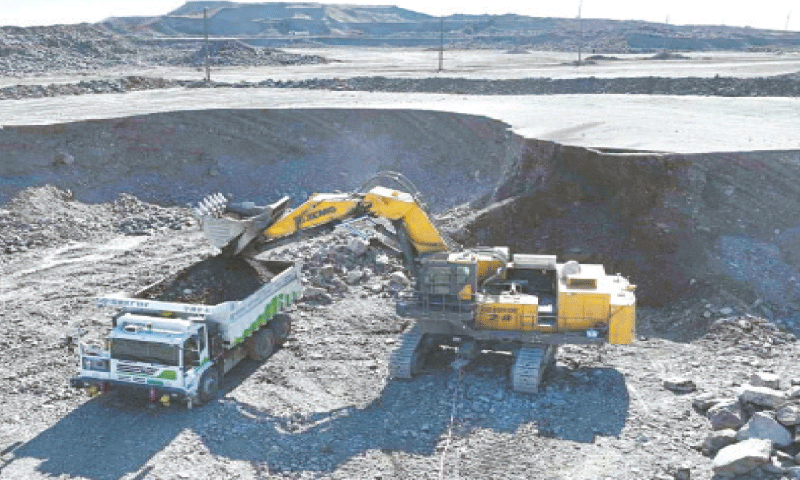

CHINA has announced tightened rules over the mining and processing of rare earths, extending enhanced regulations to imported minerals and requiring enterprises to report the flow of the strategic materials monthly.
The rules were released as guidelines on the implementation of the country’s rare earth management regulations, which took effect in October. The rules, effective immediately, stipulate how government agencies should manage quotas for designated companies and make the flow of rare earth products traceable, according to three departments including the Ministry of Industry and Information Technology.
As the MIIT noted, rare earths are important strategic mineral resources, and changes in the industry mean that earlier rules were no longer suitable for current needs. Despite that, some still try and misinterpret the move as the latest sign of China’s “weaponisation” of the strategic items.
An important reason that they claim this every time the country adjusts its rare earth rules is that they have long taken it for granted that China is “obliged” to sell rare earths for peanuts. That was what China did for decades before the mid-2000s when the country’s rare earth elements’ export prices were so low — a few or a few dozen dollars per kilogram depending on the element — that the prices didn’t even cover the production and environmental costs under higher industry standards and pollution-control requirements.
Rare earth elements, which are called “industrial vitamins”, enable huge technological functions, and they are widely applied in the electronics, automotive, energy, defense, aerospace, healthcare and medical tech industries.
That means China has made tremendous contributions to the high-tech industry’s rise in the United States, Japan, the Republic of Korea and some major European countries, all top rare earth elements importers, since it started becoming a major producer, processor and exporter of rare earth-related items in the early 1980s.
To some extent, it was the large amounts of high-quality rare earth elements China provided at an extremely low price in those years that enabled the fast development of relevant industries that played a pivotal role in these developed countries’ fast development since the 1980s.
Even after China started reforming its rare earths industry about 20 years ago achieving remarkable progress in the refining, separation and purification of rare earth elements and magnet manufacturing, the export price of its rare earth-related items remained markedly lower than that of any other exporters.
In the past, extensive and unregulated development led to the undervaluation of resources and ecological damage. This unsustainable model not only threatened to deplete the country’s natural resource endowment but also posed risks to the long-term stability of the global industry and supply chains.
Currently, with about 40 percent of the world’s known rare earths reserves, China, which holds core know-how on smelting and separating rare earth elements, mines around 70pc of the materials and processes nearly 90pc of the world’s rare earths.
China’s innovations in rare earths processing technology in the early 21st century have contributed to the development of indispensable modern technologies, such as semiconductors, renewable energy and artificial intelligence.
But China’s contribution — be it the historical one at considerable environmental cost to itself or the current one that comes along with its tech breakthroughs — has long been ignored by some.
Instead, they try and hijack China’s reform of its rare earths industry with their “weaponisation” claim as if to ensure the developed economies’ access to high-quality, clean and sufficient rare earth elements is an obligation for China. Not to mention some developed countries have implemented discriminatory restrictive export policies in high-tech products and services against China while trying to contain China’s high-tech progress by attacking its technology enterprises.
Despite that, being well aware of the important role it plays in the world’s rare earths sector, and hence its responsibility to help sustain the global industry and supply chains, China has never “weaponised” its processing or exports of rare earth elements.
The series of actions China has taken in recent years to adjust its rules and policies on rare earth-related items have been driven by the need to keep its rare earths industry sustainable. The series of breakthroughs China has made in rare earths processing technology since the new century and the improved performances of its rare earths industry, which benefit the world, originate from its continual optimisation of the industry.
These moves align with international management standards and underscore China’s sense of responsibility as a key global supplier of the critical minerals and its commitment to advancing shared global development.
Published in Dawn, August 25th, 2025