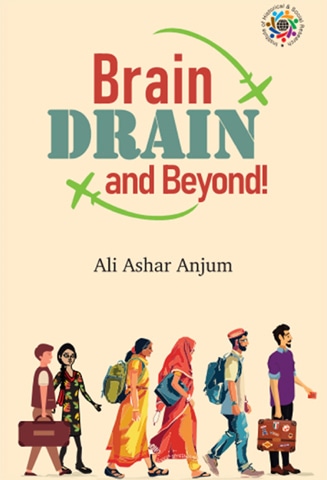
Brain Drain and Beyond
By Ali Ashar Anjum
Institute of Historical and Social Research
ISBN: 978-969-7985-48-7
192pp.
While the migration of skilled workers is a global phenomenon, the flow is mostly from the developing to developed countries. This migration, especially of the skilled work force, or what is called ‘brain drain’, is a growing concern for developing countries such as Pakistan that are losing a lot of talent and expertise due to this.
Ali Ashar Anjum’s book, Brain Drain and Beyond, published by the Institute of Historical and Social Research, takes a look at the phenomenon of brain drain, analyses the reasons behind it and details the consequences the country experiences.
Anjum’s field of specialisation is development and international cooperation. His academic pursuits focus on critical areas such as urbanisation, globalisation, demography and political economy, with a keen interest in the socio-economic challenges of Pakistan. He has authored several monographs, including Commodification of Education in Pakistan: The Case Study of Urdu Bazaar Karachi and Karachi in the Race for World Class Cities: The Social Dilemma.
As mentioned by Anjum, the book, Brain Drain and Beyond, builds upon the research and insights gained during his master’s term project, titled Squeezing Talent Out of Pakistan, which provided him with a foundational understanding of brain drain and served as the starting point of this book.
The book delves into the history and evolution of the term ‘brain drain’, its various interpretations and its complex relationship with globalisation and modernisation. While the term was coined by the Evening Standard newspaper in the UK in a report ‘Emigration of Scientists from the United Kingdom’ — published in 1962 about the emigration of highly skilled scientists from western Europe to the USA post-World War II — in the 1970s, the issue of brain drain became a major concern for developing countries.
A new book looks at the phenomenon of brain drain from Pakistan, analyses the reasons behind it and details the consequences the country experiences
The book explores the multifaceted nature of brain drain, which is Pakistan’s persistent problem, and explores the various reasons that make people leave their country, seek livelihood and settle elsewhere. These include factors such as poverty, economic instability, lack of job opportunities, the energy crisis that severely affects the industrial sector, political turmoil, and terrorism and security, especially for minorities — not just religious minorities but communal minorities as well, such as the violence faced by the Hazara community.
The author describes in detail the era-wise history and pattern of migration from Pakistan, detailing the countries where people migrated to, in which era, and from which part of Pakistan. Even before Independence, people from the areas that now constitute Pakistan migrated to Britain during British rule, primarily as employees of the British East India Company. However, Britain was not the only and earliest destination.
It seems the Gujarati community led the way, as their involvement in maritime trade activities made them one of the first Indian communities to migrate in significant numbers, as they set up trading posts and settlements in distant lands, including East Africa and South East Asia. Migration from Pakistan, irrespective of community, continues for one reason or the other.
An interesting thing that has been mentioned is that, while globally migration is generally for economic reasons, Pakistanis migrate not only for the opportunities foreign lands offer but also as a symbol of prestige and privilege.
Though beneficial to the emigrants, brain drain or the outward migration of talented doctors, engineers, academics and other professionals in search of greener pastures is a loss to their country of origin, as it deprives their homeland of critical skills. The country invests heavily in the education and training of its youth and, when these individuals migrate, significant resources are lost, while the recipient states benefit directly from these migrations without having paid any cost.
While unskilled and semi-skilled workers predominantly migrate to Gulf countries, highly qualified and skilled individuals consistently seem to migrate to English-speaking countries, followed by European countries such as Germany and Italy, because of their welfare-oriented governance systems. Interestingly, among the desired destinations in the non-English speaking countries, Romania has emerged as a leading European destination for Pakistani migrants; though it is not yet a member of the European Union (EU), it is perceived as a strategic gateway to the EU.
The statistics presented by Anjum tell a lot. Since 2000, Pakistan has experienced an 86 percent increase in its migrant population, with approximately 6.3 million Pakistanis living abroad by 2020. In 2021, Pakistan, one of the most populous nations of the world, ranked sixth globally and third in Asia regarding human exports, underscoring its significant role in global migration patterns. In 2023, approximately 862,625 individuals immigrated from Pakistan, marking a 3.6 percent increase from the previous year, indicating a consistent trend in out-migration.
Pakistan receives substantial remittances from its diaspora, which play a crucial role in the country’s economy. Pakistan ranks among the top five countries globally in terms of remittance inflows. “In 2021, total remittances reached approximately $31 billion,” the author reveals. These remittances are not just financial transfers; they are lifelines that sustain millions of households and significantly impact Pakistan’s economic landscape. But “[while] policy makers and think tanks frequently champion migration by emphasising the inflow of remittances, they often overlook the broader implications,” writes Anjum.
The decision regarding where to migrate is influenced by various factors, such as job opportunities, one’s socio-economic status, and available resources for migration and mobility. The author reveals that the desired destination for migration from Pakistan has evolved over time, influenced by factors such as the needs of the era, available skills, qualifications and demographic shifts.
While unskilled and semi-skilled workers predominantly migrate to Gulf countries, highly qualified and skilled individuals consistently seem to migrate to English-speaking countries, followed by European countries such as Germany and Italy, because of their welfare-oriented governance systems. Interestingly, among the desired destinations in the non-English speaking countries, Romania has emerged as a leading European destination for Pakistani migrants; though it is not yet a member of the European Union (EU), it is perceived as a strategic gateway to the EU.
In order to truly benefit from its human capital, it is important that Pakistan invest in skill development, research and innovation at home, and create an environment where migrants who return can thrive and where their skills are recognised and utilised. In fact, our policies should encourage migrants to return after gaining expertise, so the country can benefit from their experience and the young generation can learn from them.
Unfortunately, all those who migrate do not succeed in living their dream. Some fail to get jobs according to their qualifications and skills and end up living below the standards they wanted or were looking for. Worse is the plight of those who do not have resources, as they are often manipulated by human smugglers and traffickers. They spend money, yet often fail to reach their destinations — we have all heard of migrant boats capsizing in the seas. Even those who reach somewhere face a lot of hardships on the way.
The book does not just rely on analysis but also contains stories that illuminate the experiences of irregular migrants in Europe, many of whom have not seen their families for decades. The author has endeavoured to “capture their pain and tragedies, shedding light on their struggles, resilience, and [the] human cost of migration.” This approach also gives a human face to the issue of brain drain.
At places, Anjum has made judicious use of graphs to present his findings in a concise manner, along with discussing them, so that the reader is able to grasp them more readily. The bibliography does not only substantiate his findings but will also help those interested in further reading on the subject and doing their own research.
Another interesting element are the short profiles of the Pakistanis who migrated and made a name for themselves around the globe. It is a sad reminder that, while they have succeeded, the country lost the opportunity to fully utilise their potential.
The reviewer is a freelance journalist
X: @naqviriz
Published in Dawn, Books & Authors, August 24th, 2025