CEJ-IBA tackles AI, censorship threat at 10th anniversary
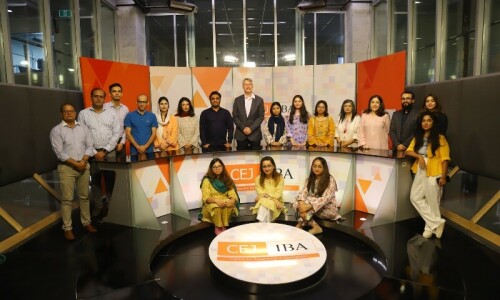
KARACHI: It was time for reflection and appreciation for an institution which thrives as a beacon of truth, innovation and societal impact as the Centre for Excellence in Journalism (CEJ) at the Institute of Business Administration (IBA) celebrated its 10th anniversary at the JS Auditorium in IBA’s City Campus on Saturday.
A decade of work at CEJ-IBA, set up in 2015 under a grant from the US State Department, has seen many trainings and workshops for journalists and media students from across Pakistan in key areas such as data journalism, digital reporting, mobile journalism and investigative techniques besides programmes designed to help organisations strengthen their communication strategies, handle media interactions and respond to crises with clarity and confidence.
In his welcome address, IBA’s Executive Director Dr S. Akbar Zaidi praised CEJ’s work as well as acknowledged those who had worked with the institution over these years and had truly made it what it is today such as its founding director Kamal Siddiqi, Amber Shamsi who picked up from where he left off and Shahzeb Jillani, who is now carrying forward the good work.
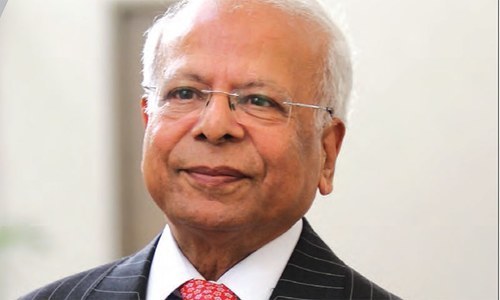
Video messages were played from well-wishers about CEJ’s journey, including former IBA director Dr Ishrat Husain, Professor of Journalism at Northwestern University Craig Duff, and Founding Dean of the Edward R Murrow College of Communication at Washington State University Dr Lawrence Pintak.
Power of journalism promotes transparency, moot told
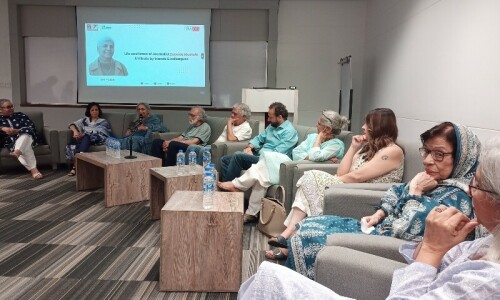
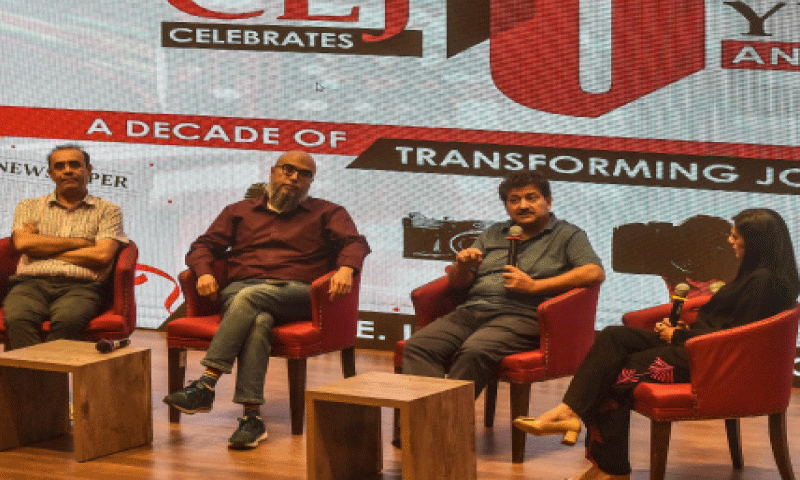
On the occasion, two panel discussions highlighted important issues faced by the media of current times such as “AI and Pakistani Newsrooms” and “Navigating Censorship, Threats and Risks”.
It was communicated by Moaz Bhangu, one of the participants of the first panel, that big newsrooms are afraid to use AI out of embarrassment. “They also don’t know which tools to use, so they need a resource who can educate them about the uses of AI and its tools. They also need to have an AI policy,” he said.
Aleem Bawany was doubtful about the use of AI in fact checking. He also thought that it was getting harder to tell if anything was generated by AI. Fatima Zaidi of Nukta Pakistan said that AI should be embraced for its uses in journalism if one knew how to utilise it.
Meanwhile, Sarah Atiq, the moderator informed that Pakistan was creating its own AI which will be trained on data from Pakistan. “But with the way our textbooks change history, it will surely tell you that General Ziaul Haq was an elected president of Pakistan,” she pointed out.
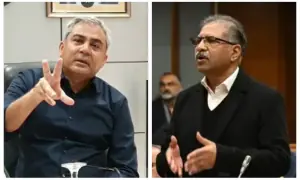
The second panel about censorship turned into an animated discussion between journalists Hamid Mir, Farhan Mallick, Syed Ali Shah and moderator Nadia Naqi.
Speaking about his shows getting pulled off air during transmission, senior anchor Hamid Mir reminded that despite all that the people, his viewers, refuse to be taken for a ride.
“They are smart. They can pick up little things even from my tone. If I resign because I am sick and tired of the censorship, they don’t rest easy until you are vindicated,” he said, adding that this was why he preferred to stand by the people and not any political party in his journalism.
Farhan Mallick of Raftar said that today, the people who had been shot or who had been jailed happen to be on the right side of history. He also said that there were stacks of case files in FIA offices which they could not get to because they were burdened by acts such as the Prevention of Electronics Crimes Act.
Syed Ali Shah, senior journalist from Quetta, said that a free press is like an immune system in a democratic society. He also said that anchors who toed the line of political parties were actually hurting freedom of expression.
Earlier, Chairperson, Social Science and Liberal Arts, Dr Laila Sohail, spoke about the MS Journalism programme, which is also open to practicing journalists, and teaches “responsible and ethical journalism”.
The US Consul General in Karachi, Scott Urbom, lauded CEJ’s work in training the next generation of journalists in Pakistan. “Media creates something extraordinary,” he said while stressing that a free and independent press is critical. The power of journalism promotes transparency,” he said.
Zahrah Mazhar, project lead iVerify Pakistan provided a presentation about ‘True, False or Misleading? — Fact-checking fake news’. The project is a global non-partisan fact-checking initiative by the United Nations Development Programme, launched and operated in Pakistan ahead of the 2024 elections by CEJ.
Finally, Chairperson of CEJ’s Advisory Board Azhar Abbas said that he was glad to see how CEJ built skills but even more than that how it had built courage in journalists. “Therefore, we are celebrating not just an institution, but its spirit that refuses to bow and refuses to break as it upholds the integrity of journalists because countless people rely on us,” he said.
CEJ’s Director Shahzeb Jillani observed that it was not easy to build an institution in this county “as we are good at destroying them”. But he said that there was no other place in Pakistan, which invests in journalists, equips them with multiple skills and tells them about their safety,” he said.
Published in Dawn, August 24th, 2025