0
0

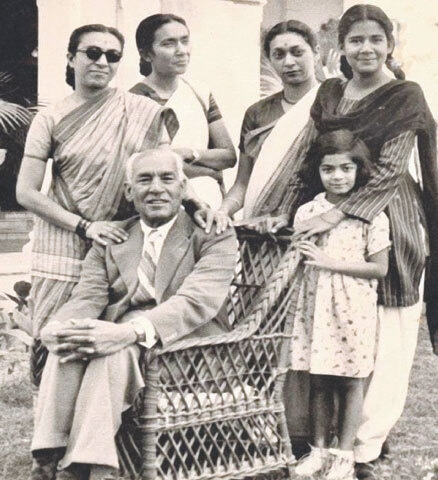
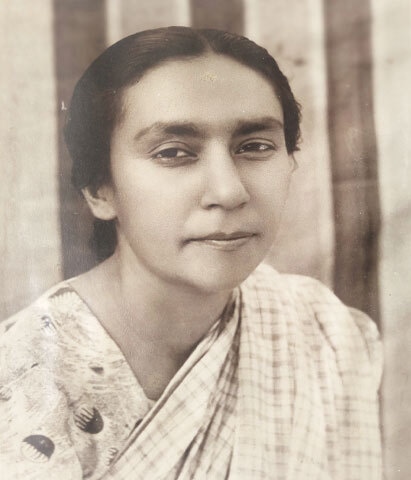
Hajrah Mumtazullah Khan was born in1910 to Natiqa Begum and Mumtazullah Khan in Saharanpur, in the western part of Uttar Pradesh in British India.
Her father was a tehsildar [revenue officer]. She was the second of six siblings, the eldest being Zakaullah Khan (architect Kamil Khan Mumtaz’s father), there was another son, Ikramullah Khan, between her and her sister Zohra Sehgal (the famous performer and actor), and then Uzra Butt (another famous actor and performer), Amina Begum (founder of Happy Dale School in Karachi) and Sabra Begum.
The family traced its lineage to the Rohilla Pathans, and her parents — who were first cousins — were closely related to the ruling nawabs of Rampur.
SEQUESTERED CHILDHOOD
At the age of 10, Hajrah Begum was sent to the Queen Mary College in Lahore, where she was followed by her younger sisters. This was a segregated school for girls from elite households. While the girls were in school, their mother passed away.
Until Hajrah completed her matriculation at the age of 17, the school’s conservative political atmosphere was partially balanced by her interaction with her elder brother, Zakaullah Khan, who was at Aligarh by the mid-1920s. During school holidays, Zakaullah would talk to young Hajrah about how she should not stand up when God Save the King was sung at her school, as the British were not their real masters. It was a confusing time for Hajrah indeed, as at school the Prince of Wales was portrayed as the most charming person in the world, while at home the brother was speaking about freedom from the British.
One of the first female members of the Communist Party of India, a pioneer of the women’s movement in the Subcontinent and a fighter against British colonialism, Hajrah Begum’s life and achievements have received scant attention by historians and archivists alike. This essay is an attempt to correct that…
For a purdah-observing Hajrah Begum, Zakaullah was a godsend, bringing into her life ideas about a future freedom, the anti-colonial struggle, and the struggle for economic and social justice. In contrast, at a school with a strict and segregated English-medium education, the little that came from the outside was what the day-scholars would share, songs related to the stage of the nationalist movement in the 1920s.
Boli amma Mohammad Ali ki
Jaan beta Khilafat main de do
[Exhorted Muhammad Ali’s mother
Son, sacrifice your life for [the] Khilafat [Movement]]
Charkha kaato to berra paar hai
Charkha Swadeshi talwar hai
[Keep on spinning the wheel to get to the other side
The wheel is the sword of self-sufficiency]
CHARTING HER OWN PATH
Soon after she passed her matriculation exams, Hajrah Begum was married to her paternal cousin Abdul Jamil Khan, who was a deputy superintendent of police (DSP) in the British Police Service. She remained unhappy during the three to four years of marriage, unable to adjust to the spousal life of an officer in the elite police service, and started spending time in Meerut, where her father was posted as a magistrate. It was around this time (1929-1933) that the Meerut Conspiracy Case was ongoing against Indian trade unionists, including three Englishmen, for organising an Indian railway strike.
Around the same time, in the early 1930s, she told her husband that she wanted to separate, as she did not see herself in a world where she would be entertaining wives of high British officials. She had also become interested in the cause of the people who were being tried in the conspiracy case. Her brother Zakaullah suggested that, if she wanted to end the marriage, she needed to be economically independent.
After her separation, rather than stay with her father, she went to live with her brother in Aligarh, where Dr K.M. Ashraf (the future communist leader) was a frequent visitor and would offer her books to read, such as the Intelligent Woman’s Guide to Socialism and Capitalism by George Bernard Shaw. On the advice of her brother and Dr Ashraf, Hajrah decided to train as a Montessori teacher from England. She sold some of her jewellery and, with partial financial support from her family, left for the UK with her son.
TO LONDON AND BEYOND
Hajrah’s arrival in London in 1933 meant a lot of adjustments, including the care of little Sami — later, Lt Gen Sami Khan, a decorated officer in the Indian Army — who was around 18 months old at that time. While in London, she was received by Syed Sajjad Zaheer — a family friend and one of the founders of the Progressive Writers’ Movement — the leader of the underground group of left-oriented students in London, Cambridge and Oxford.
Through Sajjad Zaheer, she reconnected with Dr K.M. Ashraf, who had returned to the UK to complete his PhD. Others in the group were Shaukat Omar (father of late journalist Kaleem Omar), and Dr Z.A. Ahmad (eldest brother of the film producer and studio owner W.Z. Ahmad).
Hajrah Begum was the only female member in this small group. There were weekly study groups and conversations, along with attempts to bring out newsletters to politically influence the Indian student population residing in the UK. It was during her stay in London that Hajrah Begum visited the Soviet Union, after answering an ad in the left-oriented journal the Daily Worker. She also travelled to Brussels as part of the delegation of students to the conference on the struggle against war and fascism.
In 1935, the Seventh International Congress of the Communist International in the Soviet Union directed Indian communists to collaborate with all progressive forces and anti-imperialist/nationalists, while retaining their distinct identity, and to work among workers and peasants. With this understanding, most members of the student group returned to India after completing their studies.
RETURN OF THE PROGRESSIVES
On her return, Hajrah Begum took a job in the junior section of Karamat Hussain Girls College in Lucknow. A few months after reaching India, Sajjad Zaheer called a meeting of the “London Group.” After this meeting, Hajrah Begum joined the underground Communist Party of India (CPI) full-time and started to work in the CPI office in Lucknow — typing, preparing notes, documentation — under the supervision of the party’s secretary general, P.C. Joshi, whose identity was not known to her.
Hajrah Begum and Dr Ahmad had known each other in London and, eventually, returned on the same ship from Britain. The growing understanding and common political commitments led to their marriage on May 20, 1936.
Soon, the couple moved to Allahabad, as Dr Ashraf and Dr Ahmad, along with other progressives, such as Rammanohar Lohia, were given positions in Jawaharlal Nehru’s kitchen cabinet when he was the president of the All-India Congress Committee. While working with Congress was in keeping with the political line of underground CPI members (Lohia, a socialist, was not a member of the CPI), Hajrah Begum became active in organising railway coolies and press workers.
By the late 1930s, Hajrah Begum had started to work with the unions of birri [Indian cigarette] workers, hawkers, shop workers and tin workers in eastern UP (Azamgarh), and used this experience to organise tannery and textile workers in Kanpur. She was also one of the first women from the Communist Party to work among peasant women.
In her published interviews, she narrates how she would walk miles in rural areas, travel the lowest class on trains, and sleep in mud huts on the floor with a single sheet. She always wore khaadi [hand loom] saris, and lived and experienced the life of the people she was politically linked to, the underclass of towns and villages of British India.
Speaking about women working on looms in villages of eastern UP — belonging to the Muslim julaha [weaver] caste — she mentions that, even though these women were the breadwinners of the family, like any other woman, they had to cook, take care of the children, attend to the demands of their husbands and in-laws, and suffer all kinds of social oppression. It is these women she organised for domestic rights, for better compensation of their products (saris) and for linking them with other women workers — industrial and rural — across the province.
STRUGGLE FOR JUSTICE AND EQUALITY
In 1940, Hajra Begum became the organising secretary of the All-India Women’s Conference (AIWC), an organisation founded by educated and elite women who were committed to educational reform for women and children, and to struggle for women’s rights. This was due to Hajrah Begum’s commitment to the cause of equal rights for men and women, rights for women in marriage and divorce, and for equal compensation for working women.
As the editor of the Urdu/Hindi language organ of AIWC, Roshni, she raised issues related to the vagaries of housework and the provision for crèches in work spaces, along with maternity benefits for women workers. To further advocate for these goals, Hajrah Begum wrote in CPI publications such as Qaumi Jang [People’s War] to argue for an all-India organisation for women that may not be a communist women’s organisation, but consist of women from the working classes, the peasantry, the lower-middle classes, teachers and ordinary people.
For Hajrah Begum, such an organisation was formed during the Bengal famine, in the shape of Mahila Aatma Rakhsha Samiti [Women’s Self-Defence League, or MARS] in Bengal. She travelled to Bengal and reported on the relief work done by MARS, incorporating all classes of women — housewives, older women, unmarried girls, the Calcutta elite and peasant women. The famine and the ensuing death and destruction in Bengal in the mid-1940s had opened the question of social justice and equality for these women and they were also ready to participate in the anti-colonial struggle.
After the partition of British India, Hajrah Begum and her husband did not migrate to Pakistan and continued to work with the CPI in India. It was a very difficult period for her, as many close friends and family members did migrate (along with her elder brother whom she was very close to). Dr Ahmad became the secretary general of the UP CPI and, later, represented the party in the Indian parliament, from the 1950s onwards for many years.
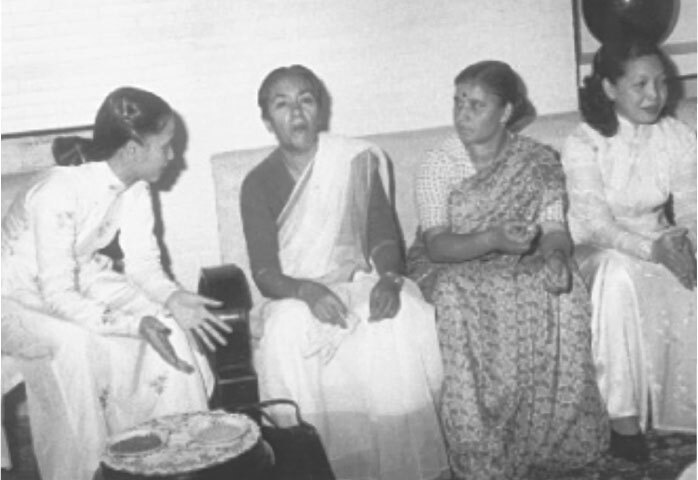
In the mid-1950s, Hajrah Begum ran for a position in the Central Committee of the CPI. She eventually served for many years as a member of the Central Control Commission of the party — the top committee that deliberated on all complaints of anti-party behaviour. As a member of the party, she was a participant at the World Peace Conference in Vienna in 1952 and became one of the founders of the National Federation of Indian Women (the women’s wing of CPI) and served as its general secretary from 1954 to 1962.
AN EVERLASTING BOND
The life of a revolutionary couple is never easy. Throughout the late 1930s and the 1940s (even after Independence), both Hajrah Begum and Dr Ahmad were either organising peasants and workers, conducting party work or were being persecuted by the authorities.
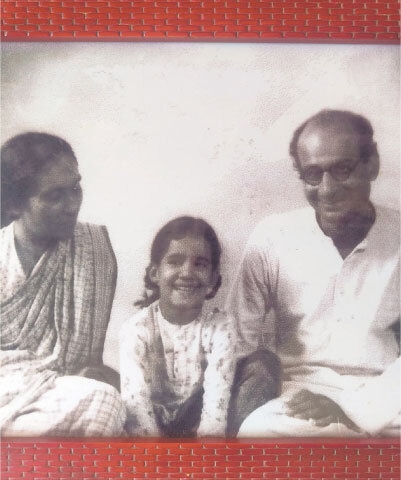
Their daughter Salima Raza (radio artist, theatre director, performer, writer) was born in 1939. In her interviews with Eos, she narrated that, till their move to Delhi — in the mid-1950s, when her father became a parliamentarian — the family could only afford a one-room apartment, with the storage room serving as the kitchen. Moreover, due to her parent’s political activity and absences, Salima attended 14 schools before she completed her matriculation in the mid-1950s, while staying in the homes of extended family members and strangers.
Salima also shared a story of when Hajrah Begum was arrested in Lucknow in 1949, when Nehru decided to crack down on all communist activities. Dr Ahmad was living separately and in hiding due to the radical leftward shift in CPI politics — under the influence of then-Secretary General B.T. Ranadive — as his party membership had been suspended.
One morning, Hajrah Begum asked her daughter to serve tea to the gentleman who was waiting for her to change. When she emerged, she gave the child five rupees and instructed the cycle rickshaw driver standing outside to take the girl to the house of Yashpal Sindh, the famous Hindi author. She instructed Salima that she should not cry when she saw her mother leave in the parked car and that she should keep on raising the slogan Inquilab Zindabad [Long Live Revolution].
Hajrah Begum would spend the next five months in jail, while her daughter lived with family friends. Salima remembers tears running down her cheeks, yet she continued to raise the slogan as long as she could see the car with her mother in it. This episode gives us a glimpse of the lives people like Hajrah Begum lived for the cause of a better future for all, sacrificing their personal comfort and family life.
Despite the hardships and separations, there remained a deep bond of affection and care within the family and between Hajrah Begum and Dr Ahmad. In the late 1940s, when the couple was living separately in Lucknow, a friend arranged for them to meet. There, Hajrah Begum — who was still under the party discipline — told Dr Ahmad that the party leader, Ranadive, had ordered her to divorce Dr Ahmad, as he was not considered a true communist, but a revisionist.
When Dr Ahmad asked what Hajrah Begum had decided to do, she answered, “Marrying you was my own decision. The party did not dictate me to marry you, and it cannot force me to divorce you either.” In his memoirs, Dr Ahmad writes that this might seem like a trivial issue today but, in those days, it was unthinkable not to follow the party directive.
Hajrah Begum, a person of immense courage, resilience, simplicity and sacrifice, passed away on January 20, 2003, after a prolonged period of illness. These few lines from a longer poem, My Nani Amma, by her maternal grandson Aamer Raza, capture her beautifully:
But how many nanis risked their lives for freedom and justice
And walked till the blood ran all over their feet?
How many nanis defied all tradition
With utmost respect for all those around them
How many nanis have lived their lives with absolute belief in the correctness of their convictions, yet never indoctrinated their children?
And how many nanis have done really cool stuff, like conquering the British Empire
And leading women’s movements
Not many, I imagine. I wouldn’t have known of those things
For you wouldn’t give the game away
All I knew was that I was lucky to have you.
The writer teaches anthropology at the University of Texas, Austin in the US.
He can be contacted
at: asdar@austin.utexas.edu
A longer version of this essay was
also published in The Wire
Published in Dawn, EOS, August 24th, 2025