• Top Chinese diplomat meets PM, president and army chief; Shehbaz terms CPEC central to country’s socio-economic development
• Chinese FM thanks Islamabad for support ‘at key junctures’, says China and S. Asian countries are ‘natural partners’
• Dar welcomes plan to expand economic, trade ties, underscores Pakistan’s alignment with Beijing on regional issues
ISLAMABAD: China and Pakistan “have a shared future”, said Foreign Minister Wang Yi as he separately met President Asif Ali Zardari and Prime Minister Shehbaz Sharif on Thursday during his visit to the federal capital.
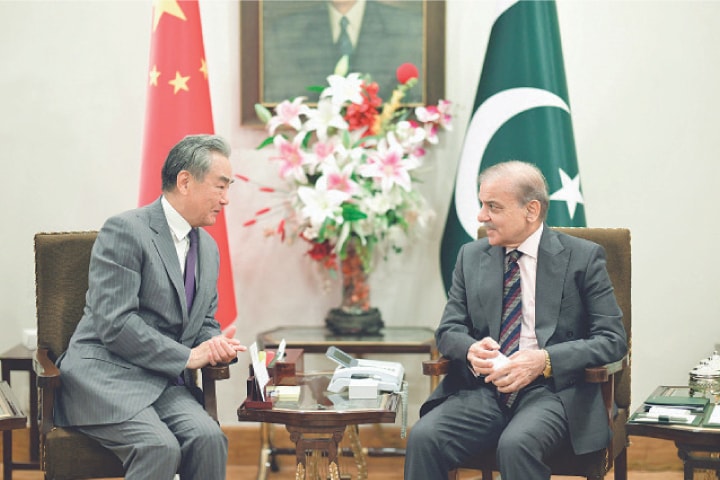
During his call on Prime Minister Shehbaz Sharif, Mr Wang was conveyed Islamabad’s desire to expand cooperation with Beijing in trade, investment, information technology, agriculture, industrialisation, and the minerals sector. Army chief Field Marshal Asim Munir also attended the meeting.
PM Shehbaz said the China-Pakistan Economic Corridor (CPEC) was central to Pakistan’s economic future.
“CPEC is vital for Pakistan’s socio-economic development and for enhancing regional connectivity,” he said, voicing satisfaction over the steady progress of projects under Phase II of the initiative. It may be noted that the PM would visit China later this month to mark the formal launch of the CPEC second phase.
Mr Wang responded that Beijing would “continue working jointly with Pakistan to promote regional peace, development, and stability”.
In a meeting with President Asif Ali Zardari, the Chinese foreign minister described the bilateral relationship as one forged over generations. “The friendship between China and Pakistan has lasted for generations and is based on good faith, credibility and a strong all-weather strategic partnership,” he said.
He said Chinese President Xi Jinping’s vision for the relationship was that “Pakistan and China have a shared future”, and also thanked Islamabad for consistently supporting Beijing “at key junctures.”
‘Ironclad partners’
Both sides also reaffirmed their “ironclad” strategic partnership amid new geopolitical developments, such as China’s thaw with India, Pakistan’s renewed outreach to the United States, and widening cracks in US-India relations.
The assurances were given during Chinese Foreign Minister Wang Yi’s visit to Islamabad for the sixth round of the Pakistan-China Strategic Dialogue, a mechanism to coordinate policy and advance the two countries’ wide-ranging partnership.
Islamabad was the Chinese FM’s final stop after earlier visits to New Delhi and Kabul, a tour that placed him at the heart of South Asia’s evolving power equations.
The remarks by Wang Yi and Foreign Minister Ishaq Dar reflected an effort to balance respective priorities of the two countries while keeping the bilateral relationship front and centre.
“It is because of the tense geopolitical situation that we now see more clearly the significance of China-Pakistan cooperation and the value of China and Pakistan as ironclad friends,” he said at a joint press briefing.
Calling Islamabad “the most important stop” on his three-nation trip, he stressed, “The China-Pakistan friendship has withstood the test of time, has been tempered through challenges, and today shows even stronger internal drive.”
China’s rapprochement with India after years of hostility, especially following their deadly 2020 Himalayan border clash, loomed large over Mr Wang’s South Asian tour.
“The China-India relationship is long-standing, and despite setbacks, it continues to follow a clear historical logic,” he said, acknowledging Beijing’s pragmatic interest in stabilising ties with New Delhi.
In a reassuring tone, he insisted: “China’s partnerships with India, Pakistan, and all neighbouring countries are not targeted at any third party, nor are they affected by any third party.”
He also underscored Beijing’s vision of an “amicable, secure, and prosperous neighbourhood,” citing China’s Global Development, Security, and Civilisation Initiatives.
“China and South Asian countries are natural partners, and we enjoy ample space for cooperation,” he added, signalling Beijing’s intent to deepen economic and political engagement across the region.
He framed South Asia as poised for “development and revitalisation” in the 21st century. “Despite different national conditions, all three countries I visited – India, Afghanistan, and Pakistan – have recognised that accelerated development is their top priority, and it is the biggest common denominator for all countries in the region,” he said.
Security of Chinese workers
The China-Pakistan Economic Corridor (CPEC), a $60 billion network of infrastructure, energy and transport projects, also featured during the discussions.
“We are confident that Pakistan will effectively protect the safety and security of Chinese citizens, projects, and institutions in Pakistan, while working with China to deepen counterterrorism and security cooperation and enhance our regional counterterrorism coordination,” Mr Wang said.
“We will support the development and operation of the Gwadar Port, promote the KKH realignment project in an orderly manner, and welcome third-party participation in the ML-1 project,” he added.
Published in Dawn, August 22nd, 2025