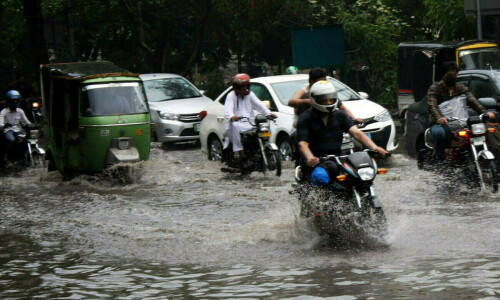
Displacement, crop devastation as Indus floods ravage South Punjab


LAHORE: Thousands of villagers in low-lying areas of Layyah, Taunsa, Dera Ghazi Khan, Rajanpur and Muzaffargarh are compelled to leave their homes after rising level of Indus River washed away all the protective guide bunds and dykes constructed to support the Layyah-Taunsa Bridge as heavy rains continue to lash several many parts of Punjab.
The severe flooding destroyed earthen homes and agricultural fields in Sumra Nashaib, Dulu Nashaib, Lohanch Nashaib, Mirani Paka, Loni, Darkhan, Chadhar, Mohana, and Mosan Shah, leaving families displaced and without shelter. Many struggle to save livestock amid the rising floodwaters.
In Taunsa, several villages such as Bait Lakho, Jarh Leghari, Jarah, Urra, Bodu Manaan, Thulla Chaki, Eida Arain, Basti Habib, Lal Shah, and Kotla Miran have been submerged, with houses reduced to rubble. Thousands of acres of crops in these areas are underwater and entirely ruined, leaving the displaced population without shelter or livelihood, forced to live under the open sky.
In Muzaffargarh, hundreds of residents in villages of Tehsils Jatoi and Alipur were also compelled to evacuate as floodwaters from the Indus inundated their areas.
In Tehsil Jatoi, the villages of Laskani and Kehal saw mass evacuations after a breach of 10 to 15 feet occurred in a Zamindara bund. Locals attempted to fill the breach on their own, receiving no assistance from district or divisional authorities.
Similarly, in Alipur tehsil, the villages of Bait Dewan, Mouza Shahpur, Mouza Thehri, Mouza Phul Sanjra, Basti Gishkori, Basti Faizu Mandoos, Basti Allah Bachaya Gopang, Basti Kolachi, Basti Bosan, Basti Turk, Basti Lashari, and Basti Noor Mand Gopang have also been inundated. Cotton, sesame, mung beans, and other crops have been destroyed.
In the Langarwah area of Alipur tehsil, the rising level of Indus River breached a flood protection bund on Wednesday, inundating hundreds of homes and vast agricultural lands.
Wazir Khan Gopang, a resident of Bait Dewan, said that his 20 acres of sesame and 10 acres of cotton had been destroyed. He lamented the government’s failure to take preventive measures. He and his family had to relocate, and he was struggling to save his livestock amid the rising floodwaters.
PDMA warning
As rivers swell and dams near maximum capacity, the Provincial Disaster Management Authority (PDMA) has issued a red alert across Punjab. With rainfall expected to continue until August 24, district administrations have been instructed to stay on high alert, and citizens are urged to exercise extreme caution.
The PDMA issued a comprehensive alert following widespread monsoon rains and warned of a worsening flood situation in several districts.
Over the past 24 hours, Narowal recorded the highest rainfall at 94mm, followed by Sargodha (54mm), Joharabad (39mm), Sheikhupura (36mm), and Faisalabad (31mm), with significant precipitation also reported in Lahore, Gujranwala, Rawalpindi, and other major cities.
Heavy rains are expected to continue in most districts of Punjab until August 24, with concerns over thundershowers and potential cloudbursts in the upper regions.
PDMA Director General Irfan Ali Kathia said the current monsoon spell was a bit more intense than the previous ones and directed all district administrations to remain on high alert.
The Indus River is experiencing medium-level flooding at Taunsa and Chashma, while low-level flooding has been reported at Tarbela and Kalabagh.
The Sutlej River is also at a low flood level at Ganda Singh Wala and Sulemanki.
Critical water storage levels indicate that Tarbela Dam is at 98pc capacity and Mangla Dam at 74pc, while Indian dams are reportedly around 70pc full.
Authorities have warned of a likely increase in water flow in the Jhelum, Chenab, Ravi, and Sutlej rivers and their tributaries due to the anticipated heavy rains.
The alert has been issued to all commissioners, deputy commissioners, and relevant departments including local government, agriculture, irrigation, health, and transport.
Punjab Relief Commissioner Nabeel Javed has instructed Wasa officials and district administrations to take preventive measures and ensure full emergency preparedness.
Citizens have been advised to exercise extreme caution during the rainy season, particularly keeping children away from rainwater drains, low-lying areas, rivers, and canals.
Rescue and relief agencies have been directed to maintain their presence in the field during periods of rainfall.
Published in Dawn, August 21st, 2025