0
0

WASHINGTON: The White House has signalled a balancing act in South Asia, saying President Donald Trump wants to shrink the US trade deficit with India, while offering to work with Pakistan to develop what he has described as its “massive oil reserves.”
An article in the Washington Post described America’s recent thaw with Islamabad as unexpected, amid a sharp deterioration in relations with New Delhi.
When Trump won reelection in November, many in Pakistan braced for a rough ride. In his first term, he had openly favoured India, castigating Pakistan for “deceit” and sheltering “terrorists”.
Yet six months into his second term — and after the most serious India Pakistan flareup in decades — the tables appear to have turned.
Trade spats and a personal falling out with Narendra Modi have pushed US India ties into crisis, while Pakistan has edged into Washington’s good books, WaPo noted.
In August, a frustrated Trump criticised India’s oil purchases from Russia, slapping 50pc tarrifs on New Delhi and launching a fierce rebuke: “I don’t care what India does with Russia. They can take their dead economies down together, for all I care.”
Islamabad secured a 19pc tariff rate — low by regional standards, and far beneath the 50pc levy slapped on India.
Trump has also boasted of joint plans to explore Pakistan’s oil, while Pakistani officials have pitched cryptocurrency ventures and access to rare minerals.
Behind the scenes, Islamabad has hired Javelin Advisors, led by longtime Trump associates George A Sorial and Keith Schiller, and cultivated family networks.
World Liberty Financial, a crypto firm backed by the Trump family, signed a letter of intent with Pakistan’s Crypto Council in April; the visiting US delegation included Zachary Witkoff, son of real estate developer Steve Witkoff, now Trump’s special envoy to the Middle East.
But some former officials worry that Pakistan’s leadership has been blinded by its recent successes and is not attuned to the risks. “Flattery is not a strategy — it’s not long-term,” warned Maleeha Lodhi, a former Pakistani ambassador to the United States.
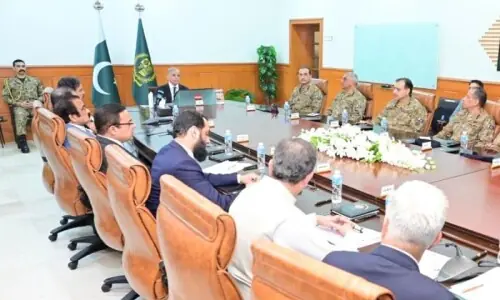
According to WaPo, the army, widely viewed as Pakistan’s ultimate power broker, took charge of the outreach, dispatching Interior Minister Mohsin Naqvi to Washington during inauguration week to soothe Congress.
Still, there are ambitions in Islamabad to lock in gains — notably access to American defence kit from attack helicopters to naval hardware. “We can’t go back to the golden years of the 1950s,” said former ambassador Masood Khan, “but we can build a paradigm that benefits both the United States and Pakistan.”
Published in Dawn, August 21st, 2025