Footprints: DC holds its breath under National Guard’s watch
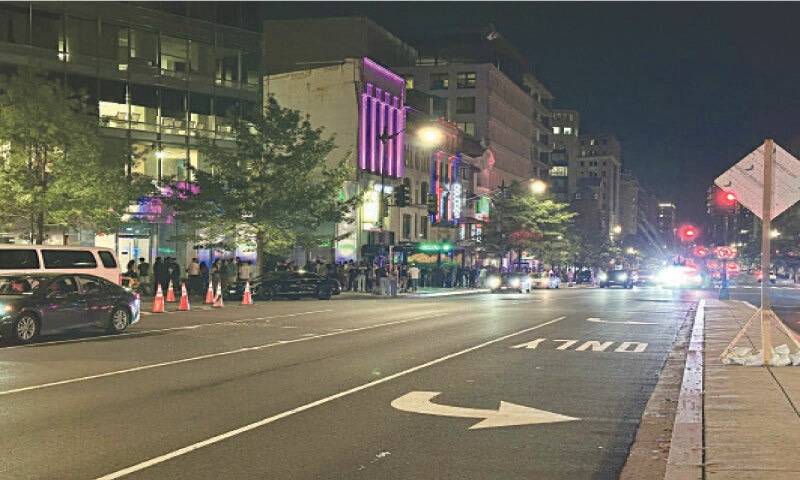
THE American capital was unusually silent over the weekend. In many areas, the familiar hum of late-night traffic and crowds spilling from bars and restaurants was replaced by the steady crunch of boots as National Guard troops and police patrolled shuttered storefronts and darkened sidewalks.
Nearly a week after President Donald Trump ordered troops into Washington, the city seems like its still in shock. Roadblocks, searches, and soldiers on city streets are unusual here. While some parts of the city have long struggled with violent crime, drug trafficking, prostitution, and murders, these problems had mostly been confined to poorer neighborhoods.
Recent incidents in middle- and upper-middle-class areas, however, caught the president’s attention, reminding him of his election promise to “cleanse” America’s major cities.
Some nights ago, at Logan Circle, Guardsmen stopped cars, demanded IDs, and questioned drivers. Pedestrians were pulled aside. From a nearby porch, a white-haired woman shouted, “Get off our streets!” while her younger neighbor yelled, “Democracy, not kingdom!”
In Dupont Circle, several hundred protesters marched with drums and bells, holding handmade signs reading “Trump Must Go Now” and “No ICE (Immigration and Customs Enforcement)! No National Guard!”
One woman carrying a candle said, “I grew up in Poland. I know what it feels like when soldiers replace police. This is not America.” A young man filmed troops on his phone. “We record everything,” he said, “otherwise no one will believe this is happening in Washington, D.C.”
President Trump paints a starkly different picture. At a recent rally, he said Washington had become a haven for “violent gangs and bloodthirsty criminals.” To respond, he sent hundreds of National Guard troops from Ohio, West Virginia, and South Carolina to assist local law enforcement — and sought broader authority over the city’s police operations.
Supporters describe this as decisive action to protect residents. Critics warn it undermines local governance and risks intimidating residents. In the United States, the National Guard is usually deployed for emergencies, such as natural disasters or civil unrest, not for routine policing —making this intervention highly unusual.
Mayor Muriel Bowser, a Democrat, has strongly challenged Trump’s depiction of the city. “Yes, we saw a spike in crime in 2023,” she said, “but it has since come down sharply. The president’s claims about rampant crime do not reflect the reality of our city.”
Police data supports her position: homicides dropped 32 per cent between 2023 and 2024, reaching the lowest level since 2019. Violent crime overall is down 26pc so far in 2025, while robberies have fallen 28pc.
Bowser has also made visible gestures in support of racial justice. In 2020, she had a section of 16th Street near the White House painted with “Black Lives Matter” and renamed it Black Lives Matter Plaza, but this was undone when President Trump took over.
Divided, but restless
On Capitol Hill, lawmakers are split along predictable partisan lines. Republicans support Trump, arguing extraordinary times require extraordinary measures. Democrats accuse him of trampling the rights of DC residents, 92pc of whom voted for Vice President Kamala Harris in 2024.
Senator Chris Van Hollen (D-MD) criticised the deployment as a “total abuse of power” and a “manufactured emergency.”
The American Civil Liberties Union (ACLU) issued a warning that, regardless of the uniform, federal and military officials are bound by the U.S. Constitution and local law.
Quoting a Wall Street Journal report, the ACLU noted that troops “may be allowed to start carrying weapons in the coming days,” and said: “Sending heavily armed federal agents and National Guard troops from hundreds of miles away into our nation’s capital is unnecessary, inflammatory, and puts people’s rights at high risk of being violated.”
Last week, the DC government sued the Trump administration to block its order asserting federal authority over the city’s police department, citing the Home Rule Act.
Later, the attorney general issued a revised directive that removed the provision giving federal authorities full control over the DC police, instead specifying certain “services” they could perform.
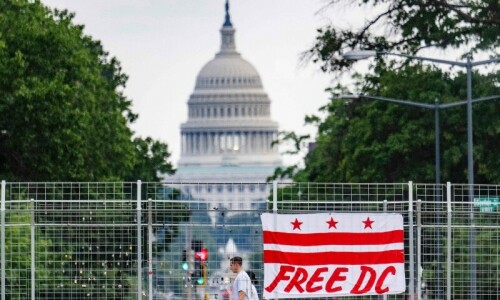
Meanwhile, the streets tell their own story. Residents are unsettled, some angry, others resigned. Candlelight vigils have appeared in neighborhoods from Columbia Heights to Capitol Hill. At one vigil, soft chants rose into the humid night air: “Free D.C.! Free D.C.!”
Local journalists who have covered Washington for decades have witnessed protests large and small — anti-war marches, immigration rallies, women’s rights demonstrations. The city has always carried tension, but even to them this feels different.
Published in Dawn, August 19th, 2025