0
0

An Islamabad research institute is set to host Afghan leaders and women activists this week to discuss the regional peace and stability, organisers said on Monday.
Pakistan and Afghanistan have witnessed an improvement in bilateral relations after taking steps to improve ties, such as the revival of the Joint Coordination Committee and upgrading diplomatic ranks.
The South Asian Strategic Stability Institute (Sassi) University will organise the dialogue on August 25 and 26, according to Dr Maria Sultan, the think tank’s chairperson and director general.
While both neighbouring countries have held bilateral engagements at the government level, this will be the first such Pak-Afghan dialogue since the 2021 Taliban takeover of Kabul.
Some Afghan TV channels and media run by Afghan journalists in exile contended that Pakistan has invited anti-Taliban leaders. However, the Sassi University chairperson denied that the dialogue was against the Taliban or other Afghan political parties.
Sultan said, “The main purpose is to discuss peace and stability. This will also provide an opportunity for Afghans to discuss the situation in Afghanistan and adopt a joint stance.”
The two-day conference will be a closed-door event, which will also mark the beginning of the Islamabad Process, according to Sultan. To a question, she said that the Taliban and other political parties have not been invited, but they would be in future meetings.
Former United States special representative for Afghanistan Zalmay Khalilzad termed the meeting “unwise” due to the participation of some who oppose the Taliban. “Afghan citizens are entitled to their political views, but Pakistan’s seeming support of them by hosting their conference is hugely unwise and an intended provocation,” he wrote on X.
However, Afghan leaders slammed Khalilzad for opposing the gathering to discuss the situation in their country.
Former Afghan parliamentarian Fawzia Koofi, who confirmed to Dawn.com that she has been invited to the dialogue, noted: “Engagement with regional countries is key in influencing the situation in Afghanistan.
“If regional countries, including Pakistan, are willing to provide a space for such dialogue, this should be welcomed as a positive step towards building trust between the people of both countries.”
Responding to Khalilzad’s remarks, she said, “Some former diplomats object; is it because they want to be the Arctic of our country’s destiny forever? Isn’t it time to let us craft what is good for us?”
Koofi further said women’s groups, as well as political and civil society representatives, must be able to meet and discuss the future of their country and its women.
“Women and girls in my country are enduring one of the most repressive realities in the world today. We must collectively support any initiative that leads to a peaceful settlement and restoring women’s rights in Afghanistan,” Koofi stressed.
Sultan evaded questions about Khalilzad’s comments but highlighted that the former envoy had led the US in talks with the Taliban in Qatar, but now he opposes a meeting of Afghans to discuss the future of their country.
“The meeting would be Afghan-owned and will be attended by various segments of the society,” she said, adding that a meeting should not be a matter of concern for anyone.
Ambassador Asif Khan Durrani, Islamabad’s former special representative for Kabul, told Dawn.com that Pakistan should not take sides on Afghanistan’s matters.
“If it’s an academic exercise, then it’s okay. The purpose should be to appraise yourself with the overall political scenario in Afghanistan without taking sides. Since it’s an open event, the public should know its findings,” Ambassador Durrani noted.
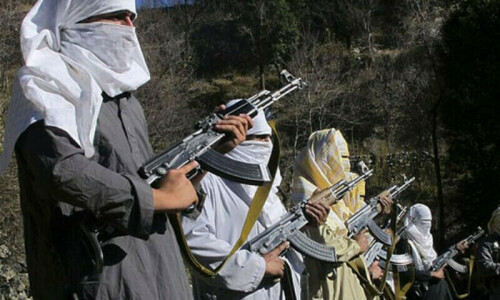
When asked about the impression that Pakistan will host anti-Taliban leaders, he said, “As regards anti-Taliban composition, then the Tehreek-i-Taliban Pakistan (TTP) are anti-Pakistan and enjoying the Afghan Taliban’s hospitality. So, any objections to the above lines are uncalled for.”
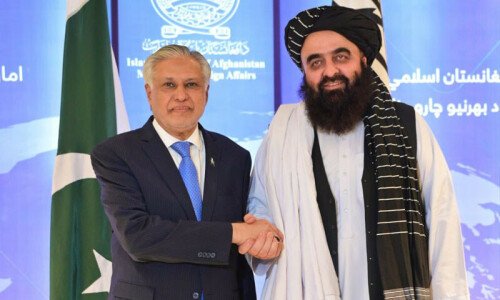
Deputy Prime Minister and Foreign Minister Ishaq Dar visited Kabul in July, where an agreement was signed for the Pakistan, Uzbekistan and Afghanistan railway project to boost regional connectivity. Later that month, Dar said Pakistan received “recent assurances” from Afghan authorities that the neighbouring country’s soil would not be used for terrorism.
Islamabad has repeatedly demanded that Kabul take action against the banned TTP. In January, Chief of Army Staff Field Marshal Asim Munir noted that the only point of contention between the two countries was the presence of the TTP and cross-border attacks.