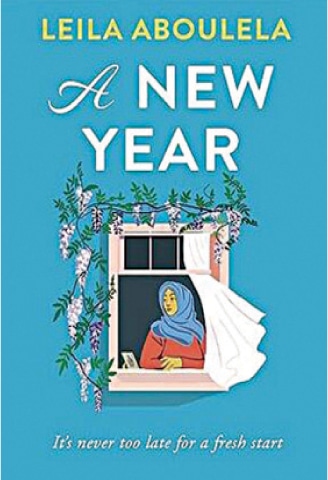
A New Year
By Leila Aboulela
Saqi Books
ISBN: 978-1849250733
128pp.
Sudanese origin, Scotland based Leila Aboulela’s latest novella A New Year (2025) is a compelling addition to the remarkable body of work she has produced over the years — work that has garnered her numerous accolades, including this year’s PEN Pinter Prize. Her novels include The Translator (1999), Minaret (2005), Lyrics Alley (2010), The Kindness of Enemies (2015), Bird Summons (2018), and River Spirit (2023), along with two short story collections, Coloured Lights (2001) and Elsewhere, Home (2018).
A recurring thread in Aboulela’s works is the focus on displacement, faith, and the lives of Muslim women. Another prominent motif that emerges across her fiction is the exploration of of the experience of loss. In The Translator, we encounter that grief through the protagonist Sammar, in mourning for the death of her husband. In Minaret, similarly, Najwa grapples with the passing of her parents. Both women are relatively young, and the way they cope with their sadness suggests that the hope of finding alternative families or new partners is what allows them to resist the all-consuming darkness of loss.
Sammar eventually finds peace in new love, while Najwa continues to struggle. In Aboulela’s fiction, grief is often intimately tied to displacement. For instance, in Bird Summons, the characters experience the sorrow of migration and the loss of familiar spaces. We watch as the novel’s female characters — Salma, Iman and Moni — struggle to navigate their respective terrains of grief and ultimately arrive at some semblance of peace.
Even more so in her most recent work, A New Year, grief takes centre stage, to the extent that all other narratives revolve around it. Here, the grieving figure is an older woman, Suad, a retired nurse whose husband, Sherif, suffers a heart attack at his workplace. Suad and Sherif had been married for 46 years and have three adult children: Hamza, Nesrine, and Mazen — the youngest of whom is unmarried and studying medicine at university.
Leila Aboulela’s portrayal of a woman coming to terms with the loss of her spouse in an unfamiliar culture in her latest novel is subtle, honest and unflinching and refuses the comfort of false promises
As an emotion, of course, grief is not only complex but also confusing and full of surprises. Writers explore it in a myriad of ways, trying to trace the lineaments of its profound impact on human life. Yiyun Li, for example, a Chinese-born writer and professor based in the United States, offers reflections on grief that resemble — as she explains in her recent interview with The Guardian’s Sophie McBain — Joan Didion’s accounts of losing her husband and daughter.
Both writers focus more on thoughts than feelings. One could argue, though, that neither thoughts nor feelings can exist independently of each other. Thinking of them as separate might be conceptually possible, but perhaps not practically achievable — at least not for everyone. Indeed, the attempt to deal with thoughts and feelings as distinct may end up hampering the meaning-making process that grieving individuals often undergo. However, it may be the case that grief permits no standard conversation, not even whispers; it defies all external templates and fixed methods for making sense of what life has taken away.
At any rate, Aboulela in A New Year delicately explores the feelings and thoughts of both Suad and her children during the grieving process, shedding light on harsh realities often left unspoken. One such reality is that, while the lives of adult, married children move on after the loss of a parent, the parent left behind endures a different kind of grief. Supporting the bereaved parent can sometimes become burdensome, even for loving children.
In A New Year, Suad rotates between staying with each of her children: with Nesrine and her husband Mo in Indonesia to help with the birth of their first child; with Hamza, his wife Zahra, and their children Yousef and Maha in Scotland; and with Mazen in the cramped student flat he shares with two housemates. There, Suad takes on the role of caregiver — cooking, cleaning, and supporting his studies. Yet, in each home, she feels like an intruder.
Her overwhelming sense of motherhood clashes with the lives of her children and their spouses, causing tension and emotional disconnect. She begins to feel like “a poor relation, a charity case”, even “a difficult teenager” in her children’s eyes. Eventually, she returns to her own home in London.
Aboulela uses Suad’s visits to her children’s homes to demonstrate that the trauma of losing a spouse cannot be healed simply by leaning into motherhood — especially when the children are adults with lives of their own. Suad, an immigrant who fled Sudan during wartime, lacks an extended family network. Though geographically displaced, she remains culturally tethered to Sudanese expectations of motherhood and familial duty. Yet, as she observes, her children “had been brought up in another culture. They were not patient enough to put up with her. And she was not flexible enough, not grateful enough.”
So what is a grieving spouse to do? Grief demands conversation. It seeks sympathetic listeners. But exile is a cruel companion. Suad “found herself repeating stories. She spoke too long until she noticed that the person she was speaking to was eager for her to stop.”
In Aboulela’s fiction, the central figure is often — like her — a displaced Sudanese woman navigating life in a predominantly secular and unfamiliar environment — typically London or Scotland. These women rely on inner strength to confront physical, emotional and psychological challenges, and that strength is often rooted in faith. In the absence of a community grounded in shared history, language and culture, Islam helps Suad make sense of her grief.
However, A New Year also acknowledges that Islam does not offer Suad all the answers. What it does provide is a sense of solace through an Islamic framework of rituals, which initiates a process of meaning-making. Suad finds peace in her daily prayers and in caring for her friend Najla, whose husband Bilal has been suddenly diagnosed with dementia. Her vibrant relationship with her husband Sherif also enables her to be grateful for the time they shared.
According to Deborah Carr, the grieving processes of older widows and widowers are shaped by various factors, including the nature of their marital relationship, the circumstances surrounding their spouse’s death, the difficulties faced during their partner’s final days, and the presence of other social roles and relationships that may either alleviate or intensify their sense of loss. The crippling situation of Bilal and his constant fights with Najla make Suad grateful that she “would always remember [Sherif] loving her and trusting her. Nothing had happened to soil this picture of him.” This, in turn, helps Suad navigate her grief.
Grief, then, as Aboulela shows, is a process. Through faith, reflection and quiet acts of care, Suad reaches a point where grief no longer dominates her life. When she finally enters the bedroom she had abandoned after her husband’s death, she finds that grief is no longer there. Instead, “the room looked beautiful. A room that was full of happy memories. Full of the warmth and love they had shared. Full of lively conversations and the times they prayed together. Tears flowed down her face, but she did not feel sad.”
Later, when all three of her children surprise her on Eid by visiting her new apartment, the moment is filled with forgiveness and love. When they give her a gift — a picture of her and Sherif — she realises that grief may not have vanished, but it no longer dominates.
Across 16 mostly linear chapters, Aboulela’s portrayal of loss in A New Year is subtle, honest and unflinching. It refuses the comfort of false promises and instead situates grief as a universal, inevitable but, at the same time, highly subjective and personal part of life. If we choose to confront grief rather than flee from it, we may learn to live with it — even if begrudgingly.
Suad finds her peace not by chasing motherhood, but by returning to the home she shared with Sherif. Her children still love her, undoubtedly, but they also love other people and other things. Love remains — but its intensity and relevance have changed.
The reviewer is assistant professor of English and African literature at Lums, Lahore. She can be reached at sadia.zulfiqar@lums.edu.pk
Published in Dawn, Books & Authors, August 17th, 2025