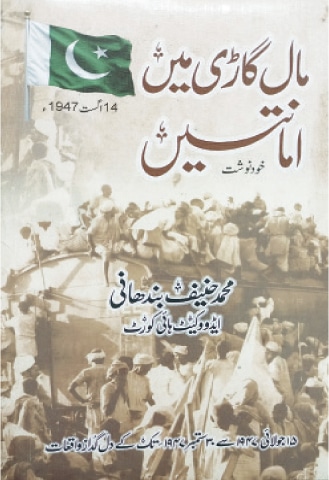
Maal Gaarri Mein Amanatain
By Advocate Hanif Bandhiani
Qalam Foundation
ISBN: 978-9697463220
196pp.
The Partition of the Subcontinent was not just a historical event — it was a deeply personal tragedy for millions. For those who lived through it, it often meant tearing themselves away from the soil they called home, leaving behind memories, loved ones and generations of belonging. It wasn’t just a journey, it was heartbreak wrapped in uncertainty.
While many of us have heard the stories and are aware of the surface-level struggles of migrants, a new book, Maal Gaarri Mein Amanatain [Keepsafes in a Cargo Train], delves deeper, honouring the silent sacrifices of those whose courage history often forgets. The railcar, once a symbol of travel and connection, becomes in this book a poignant metaphor for shattered lives and quiet bravery. It carried more than just people and luggage — it held hope, memory and trust. And if it weren’t for the kindness and courage of many unnamed souls, the outcome of this painful exodus might have been far more tragic.
The 196-page book tells the story of Chaudhry Muhammad Ismail, a contract carrier entrusted with the enormous responsibility of relocating government property, confidential records, and other valuable ‘amanatain’ via rail amid the chaos of Partition.
Despite securing the tender a month before Partition, life was not easy for Chaudhary Ismail. Maal Gaarri Mein Amanatain is a vivid recollection of his son, Advocate Hanif Bandhiani, that truly bring the past to life — transporting readers back 80 years to an era ruled by the Viceroy, when the Congress and Muslim League were fiercely battling to end British colonial rule and financial transactions relied on cheques, deposits and receipts.
A new book documents an untold story of courage and unwavering commitment during one of the most turbulent periods in the Subcontinent’s history
The incident when Chaudhary Ismail — who had previously undertaken contracts for the British government — fell ill, speaks volumes. His brief two-day absence from duty was enough to prompt the Viceroy himself to visit his home and order immediate medical treatment. It wasn’t just an act of concern; it reflected how deeply the British valued and relied on their trusted associates.
Returning to the book, though its primary focus is on the period from July 15 to September 30, 1947, the story truly begins on June 3, 1947, with Quaid-i-Azam Mohammad Ali Jinnah’s historic address on the radio. What followed was chaos: families were uprooted, lives were lost and a nation was thrust into upheaval. Amid this turmoil, Chaudhary Ismail was robbed of 20,000 rupees in cash — payment he had received for a transport tender — during the violent unrest of Partition.
Ismail’s family, except for his mother who was tragically killed in the violence, was relocated to a refugee camp — a harsh departure from their once-settled life in Multani Dhaanda, Pahar Ganj, Delhi. The journey they endured — from crowded camps to eventual resettlement in Lahore and later Sukkur — stands as a powerful testament to the immense sacrifices made in pursuit of the ‘land of the pure.’
Despite the surrounding chaos, Ismail never wavered in his sense of duty. He assembled a team of 25 workers and sent them ahead to Karachi, with clear instructions to receive the goods he was transporting. In a time of minimal communication infrastructure, his ability to organise and execute such a complex operation was nothing short of extraordinary.
The train’s journey to Lahore reads like a thriller. Along the route, ambushes awaited on the Bhatinda-Amritsar railway tracks, as did heavy rains. But Ismail, who was in his 40s, never faltered in his duty... Ever wondered how a settee from Lucknow or a cupboard from Bombay made it safely to a home in Karachi, even as bloodthirsty mobs roamed the streets during Partition? It was thanks to trusted individuals like Chaudhary Ismail — men of grit and unwavering integrity — who risked everything to ensure that what was entrusted to them arrived intact.
Long before professional moving services existed, contract carriers like Ismail were the lifeline of displaced families — transporting entire households for less than a rupee per mann (40 pounds) — 11 annas to be exact. Their work was driven not by profit, but by responsibility, resilience and sheer will.
Set during one of the most turbulent periods in the Subcontinent’s history, this is ultimately a story of courage and commitment. After the signing of the extraordinary Carriage Contract on August 14, 1947, between the railway authorities of Delhi and Karachi, Chaudhary Muhammad Ismail was entrusted with a mission of national importance. His former colleagues — Iskandar Mirza, then Assistant Secretary of Defence (later President of Pakistan) and Chaudhry Muhammad Ali, then Assistant Secretary of Finance (later Prime Minister) — placed their trust in him to transport personal libraries, treasured heirlooms, and confidential government documents, safely across newly drawn borders.
The train’s journey to Lahore reads like a thriller. Along the route, ambushes awaited on the Bhatinda-Amritsar railway tracks, as did heavy rains. But Ismail, who was in his 40s, never faltered in his duty.
Bureaucratic red tape delayed the payment and Ismail, who firmly believed in paying his workers on time, bore the brunt of it. His health declined under the weight of mounting pressure and, like many who dreamed of building a better future, he was ultimately left behind to suffer in silence. However, the book contains over 90 pages of documents that itself reveal how such stalwarts were treated.
At a time when many gave in to opportunism, Ismail’s refusal to profit beyond his modest fee stands out as a rare example of ethical public service. Despite lending just 5,000 rupees to the then Assistant Secretary of Defence — on the promise it would be returned in Pakistan — Ismail declined the offer of government housing when the loan was eventually repaid by President Iskandar Mirza himself.
Ever wondered how a settee from Lucknow or a cupboard from Bombay made it safely to a home in Karachi, even as bloodthirsty mobs roamed the streets during Partition? It was thanks to trusted individuals like Chaudhary Ismail — men of grit and unwavering integrity — who risked everything to ensure that what was entrusted to them arrived intact.
His story is not merely one of transport, but of trust, sacrifice and quiet resilience during one of the most turbulent chapters in the Subcontinent’s history. When Hanif Bandhiani’s repeated efforts to archive the material were dismissed, he turned to others for help and Qalam Foundation came up with a book-cum-memoir. Had the Ministry of National Affairs accepted the documents — rather than refusing them — the public might never have seen this powerful work, which now stands as a significant contribution to Partition literature, particularly for historians and archivists.
More than a son’s tribute to his father, it is a moving reminder that nations are not shaped by politicians alone, but also by those who quietly uphold their commitments — often at tremendous personal cost.
The reviewer writes on old films and music and loves reading books. X: @suhaybalavi
Published in Dawn, Books & Authors, August 17th, 2025