Ever since its passage by the Balochistan Assembly, the Mines and Minerals Act, 2025 has stirred considerable uproar. Opposition is not limited to Baloch nationalists, who have historically resisted the exploitation of their province’s resources by the central government; even the Jamiat Ulema-i-Islam (JUI-F) — a right-wing religious party led by Maulana Fazlur Rehman — has challenged the legislation in the high court, calling it “detrimental to the people of Balochistan.”
Interestingly, JUI-F lawmakers had supported the Act in the provincial assembly. Following this, the party leadership issued show-cause notices to them for backing the legislation.
Awami National Party’s Balochistan president, Asghar Khan, echoed similar sentiments. Speaking at the Quetta Press Club, he urged his party leadership to take disciplinary action against members who supported the Act. “The party leadership should act against our assembly members who voted for the Act,” he stated. “This legislation is not in the interest of the people of Balochistan.”
Like other nationalist leaders, Ghulam Nabi Marri of the Balochistan National Party-Mengal (BNP-M), led by Sardar Akhtar Mengal, has opposed too. “Balochistan’s mineral resources have been exploited without the consent of the Baloch people since day one by Islamabad,” he told Dawn. “This new legislation is simply a continuation of that same policy by the federal government.
Minerals legislation or legal and political challenges to it: what will really be a game-changer for locals?
Rights over resources
Following the 18th Amendment, provinces were granted control over their natural resources, alongside other discretionary powers. For Balochistan, a region long plagued by insurgency, one of the core grievances of nationalist groups remains federal control over local resources.
Inayat Mengal, a Quetta-based geologist, noted: “There is no shortage of mineral wealth in Balochistan. The province is blessed with a wide variety of minerals, including valuable critical elements.”
The province’s mineral potential was highlighted during the Pakistan Minerals Investment Forum 2025 held in Islamabad, a two-day event attended by over 2,000 participants — including 300 international delegates from the US, China, Saudi Arabia, the UK, and other countries.
At the forum, Prime Minister Shehbaz Sharif expressed optimism, claiming that Pakistan’s vast mineral reserves could help the country break free from its dependence on the International Monetary Fund (IMF).
Shahid Rind, spokesperson for the Balochistan government, was upbeat about the outcomes of the forum. Speaking to Dawn, he noted that Chief Minister Sarfraz Bugti and the governor of Balochistan both participated, with the provincial government also setting up a dedicated stall.
“Five MoUs were signed during the forum,” he said, emphasising that the event aimed to attract investors. “The provincial government also plans to invest in future projects. A recent example is the renewal of the Sui Mining Lease (Sui ML) Agreement between the Balochistan government and Pakistan Petroleum Limited (PPL).”
He added that under the new agreement with PPL, scholarships will be awarded to 15 engineers and seven diploma holders. He also highlighted a major upcoming project in the province, and pointed out that Balochistan holds a 25pc share in the Reko Diq project.
Regarding the Mines and Minerals Act, 2025, he clarified: “The legislation was passed with a majority vote in the assembly. A proper legal process was followed. Ironically, those who are now challenging it in court had their own assembly members vote in its favor.”
A blow to provincial autonomy?
Syed Fazle Haider, a development analyst and author of The Economic Development of Balochistan, argued that the Act strengthens federal control over Balochistan’s mining sector at the cost of provincial autonomy.
Speaking to Dawn, he stated: “Under this Act, federal authorities can make recommendations on mining-related matters in Balochistan. This is a blatant violation of the 18th Amendment, which gives provinces full control over their natural resources.”
He added, “Balochistan is a conflict-ridden and sensitive province, where feelings of deprivation and alienation have deepened over decades. Allowing federal interference in resource management only intensifies these resentments. The province should have the sole authority to draft laws and policies that align with local needs.”
Although the Act was passed in March, public backlash remains strong. From media debates to public seminars, the legislation continues to generate heated discussion. Some political activists in Quetta even allege that the Act is a veiled attempt to undermine the 18th Amendment.
Abdullah Shahwani, Director General of Mines and Minerals in Quetta, countered this claim. “Constitutionally, mines and minerals were already a provincial subject even before the 18th Amendment,” he said. “The new law is meant to regularise the mining sector in Balochistan. It has nothing to do with repealing the Amendment. We have been collecting revenues even before the Amendment was introduced.”
Voices from the ground
Despite these assurances, many in resource-rich Balochistan remain skeptical. One of them is Javed Baloch, an unemployed graduate. “Sui gas was discovered in 1952 in Dera Bugti. Yet, even the local residents haven’t benefitted from it, and now the gas reserves are depleting,” he said.
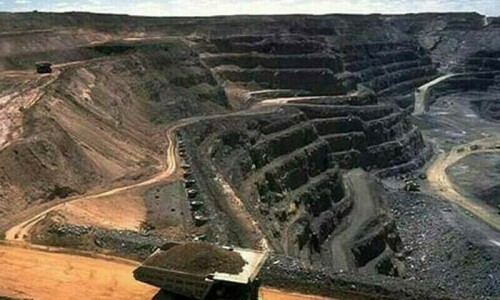
He added, “Balochistan already hosts hundreds of coal mines, as well as mega-projects like Reko Diq, Saindak, and Duddar Lead-Zinc. But none of these have improved our lives. This new Act is just another step to take over our resources without offering us any real benefit.”
Fateh Shah Arif, secretary general of the All Pakistan Mines and Minerals Association (APMMA), sought to simplify the debate. “If the Act addresses public grievances, it should be welcomed. But if it doesn’t, it must be challenged,” he told Dawn.
He added, “We need long-term planning for the province’s mineral wealth. A well-thought-out plan is half the job done. Unfortunately, political leaders plan only for their tenure, while resource-based businesses need planning based on the lifespan of the minerals.”
Whatever the eventual outcome of the Act, Mr Arif concluded with a note of realism: “The chances of ordinary people benefitting from this legislation are slim.”
Published in Dawn, August 11th, 2025