Fair stimulates young science buffs’ imagination
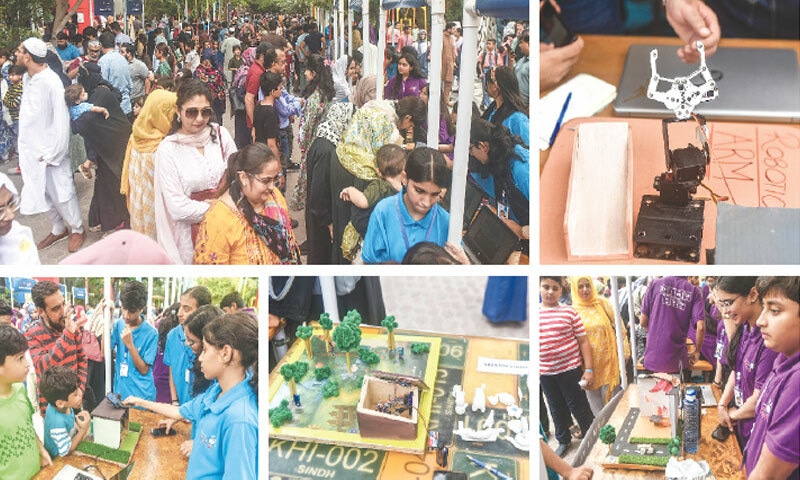

KARACHI: Science experiments, interactive exhibits and brilliant ideas were brought to life by young science buffs at the Science Fair 2025 at the MagnifiScience Centre on Saturday.
The Science Fair follows a month-long Junior Internship Programme (JIP) designed for children aged 12-18, offering them early exposure to science, teamwork and real-world skills, while also filling the gap between summer camps for younger children and internships for university students.
Aimed to spark curiosity, build confidence, and help students explore future career paths, the programme is also part of MagnifiScience Centre’s mission to inspire and empower youth through science.
This summer, 137 interns successfully completed the programme. Broken into various teams for each project, they showcased their work at the Science Fair at their designated stalls. Some teams had as many as eight members, some had four or five and some even had two.
Robotic vehicle, facial ID, and laser security systems capture attention at MagnifiScience expo
Mohammed Murtaza, Waniya Aamir, Akshay Kumar, Ayyan Zeeshan and Zaid Fawaz of the Sustainability team had a robotic vehicle that followed a line. About where they got the idea for such a vehicle, the team lead Murtaza told Dawn that when they were brainstorming about the ideal vehicles for cities, they thought of this. “A vehicle that follows a path will also remain safe from accidents,” he said.
“It will also not lose its way and avoid hazardous areas,” said Waniya.
Akshay Kumar said following a line or path was like giving their vehicle a railway track.
Fatima Amir of the Facial Recognition Software team of around seven members said that they came up with a software which stores facial features of individuals to not allow anyone else to enter their homes. “Besides providing basic security, our software also recognises age, gender and also whether anyone is happy or sad,” Fatima explained.
The Smart Bin team had Syed Shamraiz Abbas explaining how the smart bin could be used in government buildings, public spaces, schools, hospitals, etc. “Our smart bin has sensors that make it open up itself for the garbage,” he said.
Asrosh Aftab and Manahil Sameer, also from the same team, had their own project. They said that they were focusing on a zero waste strategy. “We want organic waste to not leave the kitchen,” said Asrosh.
Therefore, they had prepared jam from overripe mangoes, carrot crackers from carrot pulp, facial scrub from coffee, sugar and olive oil and air freshener from used tea leaves and dried flowers.
The six-member Laser Security team had brought a transparent vault with money. Ammarah Abdul Qadir and Uzair Amin from the team challenged everyone to try and take the money from the vault. But try as much as you may, it was impossible with the laser security system to reach the money as the vault door would close the moment your hand came near it.
Meanwhile, the two-member Cipher and Encryption team of Maria Zeeshan and Ayra Misbah had researched how ciphers started and evolved to current times when we have computer-based ciphers.
Published in Dawn, August 10th, 2025