Jim Lovell, commander of unlucky Apollo 13 moon mission, dies at 97
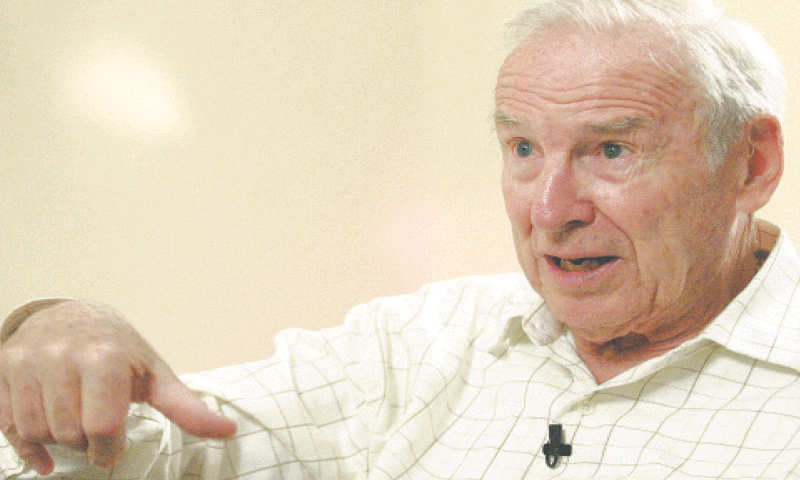

WASHINGTON: American astronaut Jim Lovell, commander of the failed 1970 mission to the moon that nearly ended in disaster but became an inspirational saga of survival and the basis for the hit movie Apollo 13, has died at the age of 97, Nasa said on Friday.
Hollywood superstar Tom Hanks played Lovell in director Ron Howard’s acclaimed 1995 film. It recounted Nasa’s Apollo 13 mission, which was planned as humankind’s third lunar landing but went horribly wrong when an onboard explosion on the way to the moon put the lives of the three astronauts in grave danger.
Lovell and crew mates Jack Swigert and Fred Haise endured frigid, cramped conditions, dehydration and hunger for three days while concocting with mission control in Houston ingenious solutions to bring the crippled spacecraft safely back to Earth.
“A `successful failure’ describes exactly what (Apollo) 13 was _ because it was a failure in its initial mission _ nothing had really been accomplished,” Lovell said in 2010 in an interview marking the 40th anniversary of the flight.
The outcome, the former navy test pilot said, was “a great success in the ability of people to take an almost-certain catastrophe and turn it into a successful recovery”.
The Apollo 13 mission came nine months after Neil Armstrong had become the first person to walk on the moon when he took “one giant leap for mankind” during the Apollo 11 mission on July 20, 1969.
There was drama even before Apollo 13’s launch on April 11, 1970. Days earlier, the backup lunar module pilot inadvertently exposed the crew to German measles but Lovell and Haise were immune to it.
Ken Mattingly, the command module pilot, had no immunity to measles and was replaced at the last minute by rookie astronaut Swigert.
The mission generally went smoothly for its first two days. But moments after the crew finished a TV broadcast showing how they lived in space, an exposed wire in a command module oxygen tank sparked an explosion that badly damaged the spacecraft 200,000 miles from Earth. The accident not only ruined their chances of landing on the moon but also imperiled their lives.
“Suddenly there’s a `hiss-bang. And the spacecraft rocks back and forth’,” Lovell said in a 1999 Nasa oral history interview.
“The lights come on and jets fire. And I looked at Haise to see if he knew what caused it. He had no idea. Looked at Jack Swigert. He had no idea. And then, of course, things started to happen.”
‘Houston, we have a problem’
Swigert saw a warning light and told mission control: “Houston, we’ve had a problem here.”
In the movie, the line is instead attributed to Lovell and famously delivered by Hanks _ slightly reworded as: “Houston, we have a problem.”
With a dangerous loss of power, the three astronauts abandoned the command module and went to the lunar module _ designed for two men to land on the moon. They used it as a lifeboat for a harrowing three-day return to Earth.
The astronauts and the US space agency experts in Houston scrambled to figure out how to get the crew safely home with a limited amount of equipment at their disposal.
Electrical systems were turned off to save energy, sending temperatures plummeting to near freezing. Water was drastically rationed, food was short and sleep was nearly impossible.
The crew had to contrive a filter system to remove high levels of carbon dioxide that could have proven deadly.
“The thought crossed our mind that we were in deep trouble. But we never dwelled on it,” Lovell said in the Nasa interview.
“We never admitted to ourselves that, `Hey, we’re not going to make it’. Well, only one time _ when Fred looked at ... the lunar module and found out we had about 45 hours’ worth of power and we were 90 hours from home.”
People worldwide were captivated by the events unfolding in space _ and got a happy ending. The astronauts altered course to fly a single time around the moon and back to Earth, splashing down in the Pacific Ocean near Samoa on April 17, 1970.
Published in Dawn, August 9th, 2025