
KARACHI: Chief Justice of Pakistan (CJP) Yahya Afridi on Monday highlighted ongoing efforts to automate the country’s justice sector and stressed that the development of judicial infrastructure must follow a citizen-centric approach.
The chief justice is in Karachi to head a three-member larger bench of the apex court, which is hearing cases from Aug 4 to Aug 7 at the Supreme Court Karachi Registry.
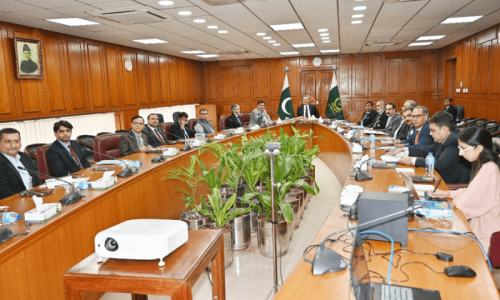
CJP Afridi made the remarks during a visit to the Sindh High Court, where he was briefed on the proposed construction of a state-of-the-art judicial complex in Karachi.
During a meeting, Sindh High Court (SHC) Chief Justice Muhammad Junaid Ghaffar told the CJP that the proposed complex would comprise 125 fully equipped courts with all requisite amenities.
Reforms should be citizen-focused, Justice Afridi tells SHC top judge
The project, intended to address the growing needs of the city’s judicial system, is expected to commence shortly.
The CJP lauded the initiative and underscored the importance of sustainable, scalable and forward-looking infrastructure planning.
According to a statement from the apex court, he “also emphasised that future forecasting must be integrated into the design to ensure long-term viability of the complex”.
CJP Afridi recommended that structured consultations be held with all relevant stakeholders, including judges and members of the district bar, to gather practical input.
The goal is to produce a refined proposal for the government for timely execution of the project.
Underscoring the need to focus on citizens, The CJP called for “the inclusion of a modern facilitation centre within the judicial complex to assist litigants and the public at large”. He said this would ensure improved access to information and services focused on helping litigants, lawyers and the public.
CJP was accompanied by SHC Chief Justice Ghaffar and senior judges Justice Zafar Rajput and Justice Mohammad Iqbal Kalhoro.
The court statement said the visit “reaffirmed the judiciary’s commitment to institutional development, participatory planning and the delivery of accessible and efficient justice”.
Nasir Iqbal in Islamabad also contributed to this report
Published in Dawn, August 5th, 2025