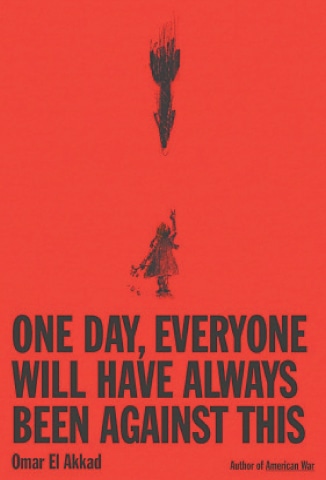
One Day, Everyone Will Have Always Been Against This
By Omar El Akkad
Knopf
ISBN: 978-0593804148
208pp.
As we collectively witness the Gaza genocide in its third year, the world solemnly commemorated another genocide which took place 30 years ago, at the end of the Bosnian War — the Srebrenica massacre of July 11, 1995, where 8,000 Bosniak men and boys were killed and buried in mass graves by Serb forces as Dutch UN peacekeepers were forced to stand aside.
Today, once again, as the International Court of Justice (ICJ) rulings stand ignored, the United States slaps sanctions on the UN Special Rapporteur, and media headlines (depending on what news you follow) scream out the statistics, it is important to take a moment. Since October 2023, at least 59,000 Palestinians have been confirmed dead and thousands more remain buried under the rubble. It is important to take a moment and let this horrifying number sink in before the inundation of news converts human life into mere statistics.
The Bosnian genocide, just like the ones before it, was to be the last one and yet, here we are again. Israel continues its assault on Gaza unabashedly with the support of its allies, although the excuses blurted out by Western leaders in its defense are increasingly wearing thin, like that fig leaf trying to hide the last few vestiges of perceived moral high ground claimed by the West.
It is in tumultuous and despairing times such as these that Omar El Akkad’s book One Day, Everyone Will Have Always Been Against This serves as a beacon that will give words to our frustration. It is a comfort to read because, despite the many uncomfortable truths it points out, it is a reminder that you are not the one going mad — in fact, it is quite the opposite.
A book of searing honesty by an Arab journalist gives words to the frustration felt by millions around the world at the lopsided coverage reserved for the victims of empire, particularly Palestine
Journalist and author Omar El Akkad was born in Egypt and spent his early years in Qatar before moving to Canada as a teenager. He has covered the various wars waged upon the Middle East by successive Western governments. The book is partly autobiographical. El Akkad’s reader walks with him as he remembers his father’s journey from an increasingly hostile and dictatorial Egypt, on a quest for a better life that eventually brought them to Canada.
As a journalist, one of El Akkad’s first foreign assignments was Afghanistan in 2007, where he soon discovered the many privileges he was afforded as a journalist. In Kandahar, he was quick to realise that Afghan deaths were casually peppered into conversations — statistics that were used to highlight the gravity of the situation by Western forces. He saw the disparity between foreign military personnel and Afghan forces.
El Akkad writes with an honesty that is often lost within columns of newsprint: “Language is never sufficient. There is not enough to make a true mirror of living. In this way, the soothing or afflictive effect of the stories we tell is not in whether we select the right words but in our proximity to what the right words might be. This is not some abstraction, but a very real expression of power — the privilege of describing a thing vaguely, incompletely, dishonestly, is inseparable from the privilege of looking away.” There is a profound understanding in what El Akkad carries with him during his time in Afghanistan.
El Akkad is very familiar with the semantics involved in weaponising and manipulating language to the point where a human is reduced to nothing. He continues to reflect upon his own life, growing up in Canada, consuming American movies filled with bravado and justice being thrust upon the great American hero battling the Soviets and what would later morph into Arabs in the 2000s. He writes about the growing disconnect that he sees between cultural self-image and reality. This allows him to write honestly as he navigates the lopsided coverage reserved for the Middle East, particularly Palestine.
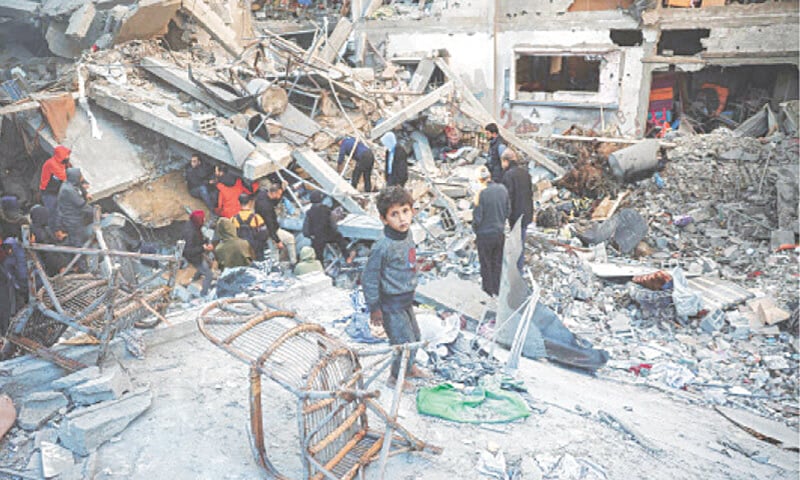
He is not surprised by the insensitivity and reductive reporting by leading news publications as they report on the Israeli assault of Gaza. Palestinian civilians are reported to die because of airstrikes seemingly originating from nowhere. Even whilst Israel declares it open season for Palestinians, in particular medics, first responders and journalists who are targeted and massacred along with their families, Western news carries reports on these killings as the sad but predictable cost of war.
Years of warped media narratives have led to a dehumanising of Muslims — the ‘angry Arab man’ is the ultimate stereotype. Even today, as entire Palestinian blood lines are wiped out, the lame response of the Western world is only elicited when the body count of children starts going up. El Akkad points out the disparity in the use of language in the media as it reports on a live-streamed genocide, grasping at straws trying to call it anything but that. He identifies the perverse morphing of language by Western media outlets into the exact opposite of its purpose, an “unmaking of meaning.”
El Akkad writes with clarity as he explores the rot that has set in liberal intellectual thought and which was exposed after October 2023. Literary awards are rescinded, only lip service is offered and base self-interest is the only motivating force behind a system that was created to uphold a particular set of rules-based order, one where Europe and the West makes sure that they never feel the flames that may arise from the global South. Nothing has demonstrated this more than the aftermath of South Africa’s case at the ICJ against Israel.
In words devoid of drama, El Akkad clearly dispels all notions of redress. Yes, the flames will eventually reach the West but “if the people well served by a system that condones such butchery ever truly believed the same butchery could one day be inflicted on them, they’d tear the system down tomorrow… [but] by the time such a thing happens the rest of us will already be dead.”
Perhaps the most powerful aspect of El Akkad’s phenomenal book is his ability to ask himself and other writers, poets and journalists, “What is this work we do? What are we good for?” It is an existential question, forcing writers to look within and ask themselves what is the point of our work if it ignores the hundreds and thousands of mutilated, burnt bodies, and starved, screaming eyes of Palestinian men, women and children?
How can we write about anything in the face of such injustice? Western liberal thought is no longer a set of tangible beliefs, “…everything is reverse engineered. Being seen as someone who believes in justice — not the messy, fraught work of achieving it — is the starting point of any conversation on justice.”
If that is the case, then what is the purpose of any literary endeavour, when it fails to address the grotesque perversion of a world that refuses to see a child’s body riddled with bullets, a father carrying his child’s mangled body in a plastic bag, a mother confronted by the loss of her 11 children in one night?
Omar El Akkad’s book is a sharp reminder of the passive hypocrisy of the supposed upholders of justice and freedom — how they twisted the narrative to suit their needs even when confronted by a conversation as damning as the one five-year-old Hind Rajab had with the Palestinian Red Cross medic: “Hind, why aren’t you speaking?” Hind: “I’m not talking because every time I talk, blood comes out of my mouth and makes my clothes dirty and I don’t want my mom to have to clean it.”
And the World Food Programme reports that one in three people has not eaten for days in Gaza. This is the legacy of empire and, as Western leaders start waking up to the tides of discontent amongst their own populations united by love and humanity in support of Palestine, El Akkad reminds us, “One day, when it’s safe, when there’s no personal downside to calling a thing what it is, when it’s too late to hold anyone accountable, everyone will have always been against this.”
The reviewer is a freelance writer with a background in law and literature.
Published in Dawn, Books & Authors, August 3rd, 2025