States can sue one another for climate crisis: UN top court

• ICJ judge admits challenges remain to assess who caused which part of climate change
• Non-binding ruling terms climate change ‘an existential threat’
THE HAGUE: The United Nations’ top court, in a landmark decision on Wednesday, cleared the way for countries to sue each other over climate change, including over historic emissions of planet-warming gases.
However, the judge at the International Court of Justice admitted that untangling who caused which part of climate change could be difficult.
The ruling, which is non-binding though legal experts say it could have wide-ranging consequences, underlined “the urgent and existential threat posed by climate change”.
The non-binding opinion by the International Court of Justice, also known as the World Court, is likely to determine the course of future climate action across the world as it gave its opinion on the legal obligations of states to take action.
This UN court’s opinion can make it easier for states to hold other states to account over climate issues like pollution or emissions.
“Greenhouse gas emissions are unequivocally caused by human activities which are not territorially limited,” judge Yuji Iwasawa said.
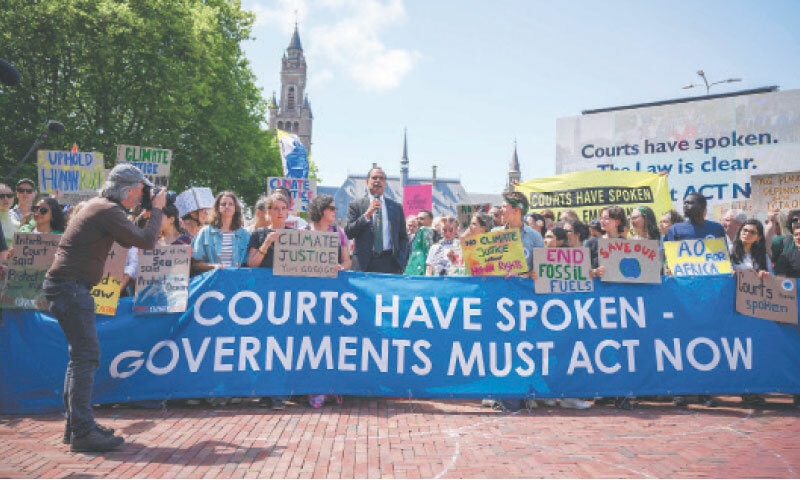
Ahead of the ruling, supporters of climate action gathered outside the ICJ, chanting: “What do we want? Climate justice! When do we want it? Now!”
The deliberations of the 15 judges of the ICJ in The Hague nevertheless carry legal and political weight and future climate cases would be unable to ignore it, legal experts say.
“It is so important, it could be one of the most consequential legal rulings of our times because of the scope of the issues that it touches, which run to the very heart of climate justice,” said Joie Chowdhury, senior attorney at the Center for International Environmental Law.
The two questions the UN General Assembly asked the judges to consider were: what are countries obligations under international law to protect the climate from greenhouse gas emissions; and what are the legal consequences for countries that harm the climate system? In two weeks of hearings last December at the ICJ, wealthy countries of the Global North told the judges that existing climate treaties, including the 2015 Paris Agreement, which are largely non-binding, should be the basis for fixing responsibilities.
Developing nations and small island states argued for stronger measures to curb emissions and for the biggest emitters of climate-warming greenhouse gases to provide financial aid.
Paris agreement
In 2015, at the conclusion of UN talks in Paris, more than 190 countries committed to pursue efforts to limit global warming to 1.5 degrees Celsius.
The agreement has failed to curb the growth of global greenhouse gas emissions.
In the most recent “Emissions Gap Report,” which takes stock of countries’ promises to tackle climate change compared with what is needed, the UN said current climate policies would result in global warming of more than 3 degrees Celsius above pre-industrial levels by 2100.
Turning point
Campaigners say the UN’s top court opinion should be a turning point, even if the ruling itself is advisory.
As campaigners seek to hold companies and governments to account, climate-related litigation has intensified, with nearly 3,000 cases filed across 60 countries, according to June figures from London’s Grantham Research Institute on Climate Change and the Environment.
“The court can affirm that climate inaction, especially by major emitters, is not merely a policy failure but a breach of international law,” said Fijian Vishal Prasad, one of the law students that lobbied the government of Vanuatu in the South Pacific Ocean to bring the case to the ICJ.
Published in Dawn, July 24th, 2025