• Document envisions 100pc of all new vehicles sold by 2050 will be electric
• Stakeholders say conflicting policies, anomalies in tax, tariff structures will hamper govt’s objectives
• Complain locally assembled vehicles currently facing higher tariff than imported cars
KARACHI: Auto sector stakeholders believe the government may not achieve an electric vehicle (EV) revolution through the New Energy Vehicle Policy (NEVP) 2025-30, due to lingering uncertainty over allowing commercial imports of used cars up to five years old from September 2025, along with 40 per cent additional import tariffs.
Launched earlier this year, the NEVP aims to see 30 per cent of new sales comprising new energy vehicles (NEVs) in two- and three-wheelers, passenger cars, light commercial vehicles (LCVs), buses and trucks by the year 2030.
It also targets 50pc NEV sales by 2040 and aspires to reach a net-zero transport fleet by 2060. As per the policy, Pakistan aims for 100pc of new vehicle sales across all segments to be NEVs by 2050.
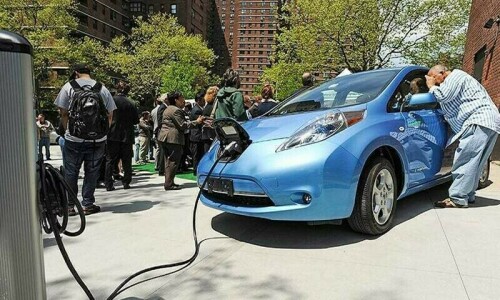
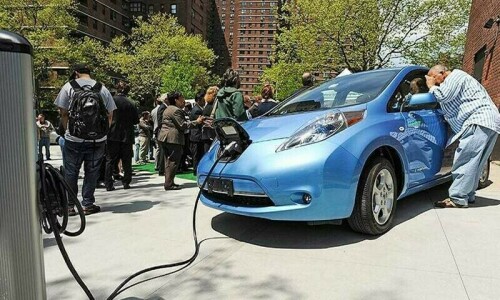
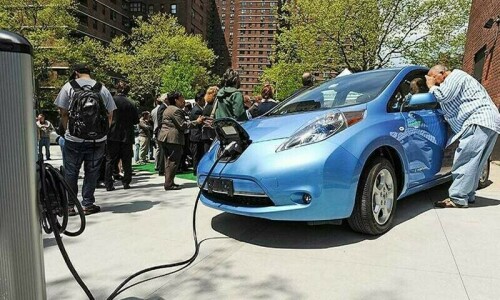
The NEVP also envisions the establishment of 3,000 charging stations by FY30, including Level 3 fast chargers and Level 2 chargers while the target for FY26 is 240 charging stations.
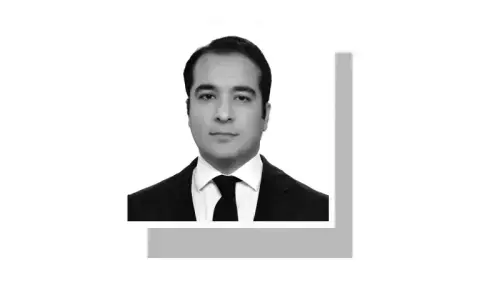
“We welcome the NEVP. It is a timely initiative and a much-needed step in the country’s efforts to address the urgent challenge of climate change. The policy is comprehensive and covers several key areas critical to the growth of the EV sector,” said Babar Saleem Khan, Chief Strategy Officer at Lucky Motor Corporation.
But while the policy direction is encouraging, it leaves some important questions unanswered, he said.
For any industrial policy to succeed, especially in a nascent and capital-intensive sector like electric mobility, clarity and consistency in the taxation and incentive regime are paramount, he said. “Unfortunately, these essential elements are currently missing in the NEVP policy, making it more aspirational than actionable,” he added.
He urged the government to provide a clear roadmap for Completely Knocked Down (CKD) EV tariffs for the next five to 10 years. Without this long-term visibility, it is nearly impossible for investors to commit to local EV assembly or manufacturing projects, he added.
Mr Khan highlighted a longstanding and critical anomaly in the current tax structure: the import bias embedded in the GST regime.
Currently, imported Completely Built-Up (CBU) EVs benefit from a lower GST rate of 18pc, while locally assembled CKD EVs with a battery capacity above 50kWh are taxed at a higher rate of 25pc. This disparity encourages imports and penalises local manufacturing — clearly not the intent of policymakers. This disparity needs to be addressed on a priority basis, he urged.
Another area requiring urgent clarification is the mechanism for subsidy disbursement, Mr Khan said.
Tecno Auto Glass CEO Aamir Allawala, who is also a former chairman of the Pakistan Association of Automotive Parts and Accessories Manufacturers (Paapam), said the government appears unclear about its objectives.
“Does the government aim to promote industrialisation through local production of auto parts and components, or is its objective to encourage import of 3-5 year-old cars disposed of by Japanese users? Or does it want to reduce duties and taxes on CBUs to expose the domestic industry to unfair competition?” he asked.
He said the government was sending confusing and conflicting signals to the local industry by simultaneously reducing duties on vehicles, allowing the misuse of baggage and gift schemes for importing used cars, and contemplating the commercial import of used cars.
Another auto parts maker and exporter, Mashood Ali Khan, noted that a gap between policy design and on-ground implementation continues to plague governance in Pakistan.
This issue is again visible in the NEVP, which sets ambitious targets, which risk being derailed by conflicting priorities and lack of execution planning.
While India, Vietnam, and Thailand are advancing in automotive volume growth and technology localisation, Pakistan is lagging due to weak policy support for EV manufacturing to reduce oil dependence and environmental pollution.
On the other hand, Mr Khan said the government has allowed commercial imports of used cars from September 2025 with 40pc additional tariff, thus contradicting and sending mixed signals to local and foreign investors.
He argued the policy should initially focus on two and three-wheelers and public transport — segments where electric mobility can realistically scale in Pakistan, given its urban traffic patterns, affordability concerns, and infrastructure readiness.
Shankar Talreja, deputy head of research at Top Line Securities, believes that the measures announced by the government are very encouraging for both the consumer and manufacturer. However, before rolling out the subsidy amount, the government should strongly work on the infrastructure development i.e. installation of charging stations, he suggested.
Bike sector expert, Mohammad Sabir Sheikh, was satisfied said the NEVP 2025-30 appears satisfying, especially an initial subsidy of Rs9 billion has been allocated for FY26 under which 116,053 electric bikes and 3,171 electric rickshaws will be facilitated.
Published in Dawn, July 21st, 2025