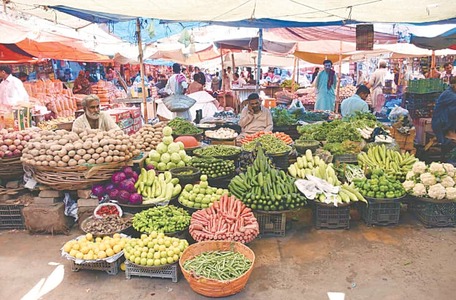
High production in the two most sought-after crops (onions and potatoes) has resulted in an all-time high vegetable export of 1.395 million tonnes ($353m) in July-May FY25, breaking the record of 1.336m tonnes ($300m) achieved in the full fiscal year of FY23.
However, higher exports could not fetch a handsome foreign exchange in 11MFY25 compared to the 1.192m tonnes that earned $409m in the same period last fiscal. The average per tonne price in the above period has plunged to $253 from $343.
Vegetable exports from FY18 to FY24 remained in the range of $234m to $430m based on the quantity hovering between 825,257 tonnes and 1.336m tonnes. Pakistan’s vegetable exports are mainly led by potato and onion via sea trade in containers and by roads, while green vegetables like carrot, green chillies, bitter gourd, sweet gourd, apple gourd and lady finger are shipped via air.
Consumers witness a steep price fluctuation in the main staple food items owing to low/high production and the rise and fall in exports. The import of onions is undertaken when supplies from the local crops face any serious production issues. Much also depends on the international rates of onion. We’ve seen that imported onions become scarce in the market as traders hold the supplies to make a quick buck.
‘With higher potato production, efforts should be made to further increase exports to Common Independent States where people’s love for potatoes is akin to Pakistanis’ love for wheat’
Due to a lack of effective price-checking mechanisms, limited official staff strength of the price regulating body and its unrealistic price list, consumers feel the pinch of paying higher prices; the situation tends to get alarming during Ramazan when demand outpaces supply.
As per data from the Pakistan Economic Survey FY25, Pakistan produced 2.67m tonnes of onion in FY25 as compared to 2.3m tonnes in FY24, while potato production also rose to 9.4m tonnes from 8.4m tonnes in the above period.
Higher productions of onion and potato have kept the prices of these items mostly under control in the past year. As per the Sensitive Price Index, the national average price of potatoes and onions in various cities has dropped to Rs60–120 and Rs40–90 per kg from Rs70–140 and Rs80–160 per kg prevailing in the first week of July 2024.
Patron in Chief, All Pakistan Fruits and Vegetable Exporters, Importers and Merchants Association, Waheed Ahmed, said out of nearly 1.4m tonnes of total vegetable exports in July-May FY25, potatoes hold the share of over 1m tonnes followed by 0.1–0.2 tonnes of onions and 40,000-50,000 tonnes of green vegetables shipped by air mainly.
“We could not find new markets for vegetables, but the Commonwealth Independent States (CIS) have emerged as one of the most promising markets for Pakistani potatoes, where shipments have been made via road,” Mr Ahmed said. He added that potato exports can increase manifold if the quarantine issues are resolved in markets like Indonesia, Thailand, European countries, the Philippines and China, and the government needs to hold talks with these countries regarding their requirements relating to quarantine issues.
Mr Waheed said as Pakistan has been achieving higher production of potatoes, efforts should be made to further increase exports to CIS countries where people’s love for potatoes is akin to Pakistanis’ love for wheat. There is a need to improve road infrastructure in both Pakistan and CIS countries besides increasing the export through reefer containers, he said.
Furthermore, According to Mr Waheed, potato consumption has seen a marked improvement in the last few years owing to the rising number of potato-chip-making companies both in the organised and unorganised sectors. Organised sector potato chip makers offer different varieties and tastes of potato chips, and some of them have developed their own production facilities in the country for producing potatoes with low sweetener.
A number of roadside chip makers, especially French fries, have emerged, also signalling rising consumption of big potatoes.
Onion holds the second spot in overall vegetable exports, but for the last three to four months, its export has been dwindling due to the entry of cheaper Indian onions in foreign markets, thus posing a stiff challenge for Pakistani onions, Mr Waheed explained.
Pakistani consumers have been familiar with imported onions, especially Afghani and Iranian varieties. In October 2024, Iranian and Afghani onions had landed in Pakistan at the rate of Rs160–200 per kg as rains had damaged Sindh’s crop — but they cannot match the quality of the Pakistani onion.
Published in Dawn, The Business and Finance Weekly, July 21st, 2025