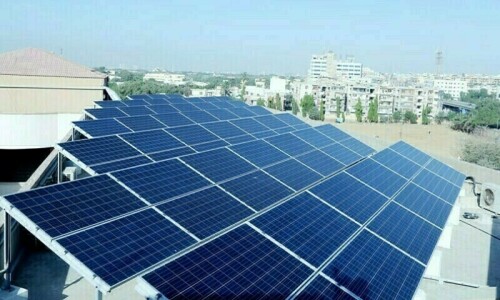
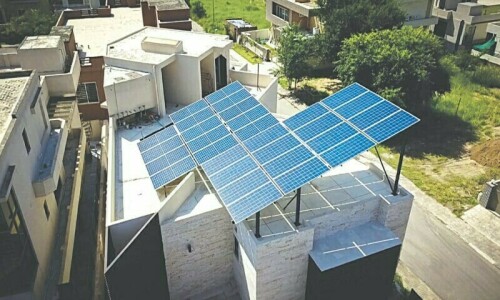
Against the odds, a solar revolution has unfolded in an economically unstable and climate vulnerable country. Pakistan’s ‘bottom-up’ solar revolution gained international recognition when a highly exponential peak in solar panel imports was achieved, proportional to the equally persistent rise in electricity prices and inflation.
Pakistan was the third-largest importer of solar panels in 2023 that has continued to grow in 2024, reaching 17 GW in direct imports from China. After decades of enduring power outages and price hikes in electricity, citizens — driven by despair and necessity — finally took control of their electricity needs.
The surge was only possible by the fact that solar photovoltaic (PV) technology is now the most inexpensive source of electricity. Amid this solar rush, thought leaders and experts have begun invoking the term ‘Energy Democracy’, a concept rooted in the empowerment of citizens to become active players in the energy market. Just as Germany transformed its electricity sector via energy democracy, could this grassroots energy movement be the beginning of Pakistan’s own ‘Energiewende’ (energy transition)?
About 25 years ago, Germany launched its Renewable Energy Act, introducing democratic energy reforms. It offered fixed feed-in tariffs for 20 years, often above retail rates, to incentivise renewable energy production. This policy played a key role in accelerating the adoption of renewables. Another aspect to achieve Energiewende was made possible largely through ‘citizen energy cooperatives’ that empowered individuals to own and invest in renewable energy assets, making them a core of energy transition. It was a successful approach to democratise energy transition by legally and financially empowering citizens.
As for Pakistan, customs data shows that the country imported 36 GW capacity of solar panels (78 per cent of the total installed electricity generation capacity of 46.5 GW). So, if all imported solar PV capacity were brought online simultaneously, it could generate an estimated 56.4 TWh of electricity (18pc capacity factor) annually which is roughly one-third of the electricity produced in 2024.
Energy democracy’ demands that citizens lead the way, guided by the best practices in implementation
But why the big solar import spree by Pakistan? The answer lies with its long-term ally, China — the world’s leading solar PV manufacturing hub, accounting for over 80pc of global production capacity for PV panels. China has an aggressive, export-oriented industrial policy, which massively scaled up solar PV manufacturing and drove down global prices by achieving rapid economies-of-scale. It is worth mentioning that it has made solar technology remarkably affordable for developing countries. Pakistan also benefited from strong trade relations and a business-friendly environment, both of which played a key role.
Pakistan’s solar surge is gargantuan when compared to its predominantly fossil fuel-based centralised electricity mix that produces merely 4pc of its electricity from renewables. Historically, the country has grappled with chronic mismanagement of electricity resources and a lack of strategic planning. For years, recurring power outages, commonly known as load shedding have been a normal feature of life highlighting the unreliability of the grid.
In recent times, repeated failures of mass scale projects such as ‘fast-track solar auctions of 600 MW’ and delays in launching the Competitive Trading Bilateral Contract Market (CTBCM) aka the country’s intended wholesale electricity market, highlights the urgent need to reassess the proposed electricity reforms. Though the CTBCM did receive positive response from the businesses, activities around it remained sluggish.
With citizens now taking charge, a few challenges will emerge for both consumer and the authorities. First, the ramp-up of solar PV installations need to be ensured so that there is no hoarding of solar panels. It is being suggested that mostly the household sector is being solarised, but there is a difference of opinion. Some analysts suggest the capacity may be off-grid, but the volume of imported battery storage remains significantly lower than that of solar panels ie 1.65 GWh till January 2025.
Second, the aging transmission and distribution infrastructure, which already experiences transmission losses of 15-20pc, might not be able to cater the capacity if it comes live. Revamping the grid is becoming increasingly important, as it may soon need to accommodate up to 35pc more renewable energy.
Thirdly, consumers tied exclusively to the central grid are at risk of higher electricity costs — a consequence of expensive Power Purchase Agreements with other generation sources, mostly thermal.
In response to current circumstances, the government plans to tighten net-metering regulations and has introduced import duties on solar panels. While these measures may aim to manage short-term fiscal concerns, they risk undermining citizen-led solar adoption.
Imposing import duties serves as a disincentive for private investment in renewable energy, potentially stalling the solar uptake. Such reforms may further reinforce public perception that the government lacks genuine commitment to resolving the country’s electricity challenges, particularly when it seems to be progressing democratically.
The writer is a research fellow at the Energy and Climate division at the German think tank, Öko institute
Published in Dawn, The Business and Finance Weekly, July 14th, 2025