0
0

KARACHI, May 14: The State Bank has asked scheduled banks to share profits with depositors as the banking spread has gone up to 7.75 per cent and increase the real return to depositors.
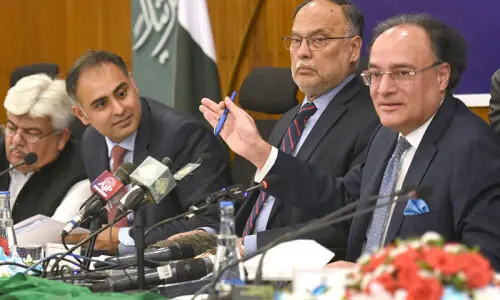
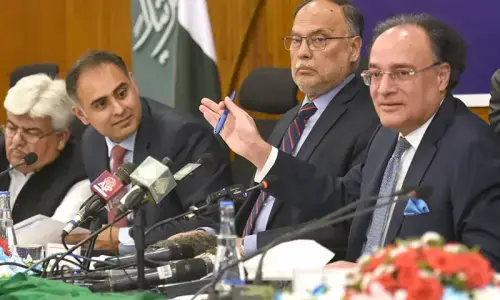
Speaking at the two-day Asia Finance Conference which concluded here on Sunday, SBP Governor Dr Shamshad Akhtar said the central bank would not take regulatory action but persuade banks to increase returns on deposits. She also mentioned that banks did not tell customers about the range of products they offered with higher returns.
The concluding session of the conference discussed the state of banking industry in Pakistan.
Bankers participating in the discussion complained that most of customers keep their money in current saving accounts which offered low returns and did not opt for time deposits which offered better returns. This was the reason for low returns to depositors, they said.
The governor said it was because of financial constraints which forced people to keep their money in current accounts.
National Bank of Pakistan president Ali Raza justified the high banking spread and held depositors responsible for low returns. “Who stops depositors to shift from current saving accounts to time deposits which offer much better rate? There is no justification for complaints,” he said.
He said banks were providing heavy subsidy regarding service charges to customers. He said banks’ service charges were very high in Western countries.
Habib Bank president Zakir Mahmood said returns on deposits would increase in a few months. He was firm that the high banking spread was a temporary phenomenon and rates would be normalising in a few months.
Muslim Commercial Bank president Aftab Manzoor endorsed the views of the NBP head but said the high banking spread would come down and depositors would get more returns in months to come.
Country Manager of Citibank Zubyr Soomro said the banking spread was very high and it was not normal.
Munir Kamal, president of the KASB Bank, blamed the monetary policy of the central bank for the higher banking spread. He said that to curb the inflation, the SBP had adopted a monetary policy which had resulted in high lending rates but returns to deposits had remained stagnant.
Dr Shamshad said banks alone were not responsible for low returns to depositors.
She said the high banking spread was a source of concern for the SBP and it had been addressed in the second quarterly report of the central bank.
She disclosed that the share of consumer financing in the banking business was not 10 per cent but 21 per cent.
Consumer financing brings very high returns for banks.
Most of the bankers said the banking industry lacked skilled workers to handle sophisticated banking products and tackle new banking demands.
Ali Raza said his bank had been hiring hundreds of MBAs to train them for latest banking demands and products.
The governor said electronic banking in Pakistan was still at infancy and she used to receive complains against it. Banks again showed their inability because of lack of skilled workers in the new field.
The governor said it was serious that Sindh and Balochistan had very low absorptive capacity of agriculture loans while credit lending to farmers had gone up by many times during five years. She said commercial banks were playing a key role but still there was a need to target small farmers.
The bankers pointed out that the cost of disbursement of agriculture loan was high because reaching farmer to farmer by a bank was practically impossible. The HBL suggested that there should be cooperative houses so that the bulk of loans could be given to them.
The bankers said the livestock sector was ignored in the past which was equally important because in terms of value, the sector was no less than agriculture production. They said more credits would be given to livestock.
The governor also expressed concern over personal loans, saying the loans were used in the real estate which should not be allowed.
Talking about low saving rates, she said: “We have low income and high consumptions.”
She said implementation of Basel-11 reforms was a challenge for banks. Basel-11 is basically banking reforms to identify new risks involved in credit lending and measurement of risks.
Dr Shamshad said it was not mandatory but the implementation would bring the banking industry at international standard. She said the central bank had already taken an initiative to implement Basel-11 but very few experts were available who knew the subject well.
Zakir Mahmood said Basel-11 should not be underestimated because it was a difficult task. He said that even in American, only 12 banks had decided to implement Basel-11, where the number of banks was over 1,000.
Ali Raza asked the SBP to extend the deadline for implementation of Basel-11 but the governor said it would not be discussed now.