The use of text in paintings has been incorporated in the arts since the early days of visual expression. Normally, the image was there to serve or elaborate the meanings of a particular script, whether that text was part of a story, a gospel or a poem. The same practice has been in fashion in the miniature tradition of Persia and that of the Mughals — encompassing various popular literary, mythological and religious concepts and views.
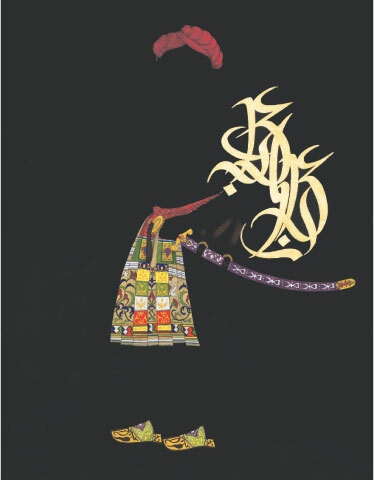
The exhibition ‘Brown Sahib’ at the Tanzara Gallery in Islamabad, by Shoaib Mahmood, rejuvenates the assimilation of visual imagery of traditional miniature motifs with deconstructed text, blended to carry the visual, as well as conceptual entanglement, of the pre-colonial, colonial and postcolonial dogmas in South Asia.
Through this intentional practice, Mahmood questions postcolonial South Asian identity by presenting the silhouette of a Mughal emperor, curled around with creeping Urdu, Persian and Arabic text extracted from the anthropological depths of this very land.
The epithet ‘Brown Sahib’ is not new at all. It serves as satirical, social commentary on the people who geographically and culturally were Indians but were British in their social and psychological behaviours, and had issues concerning their original identity. Khushwant Singh, the acclaimed Indian writer, has also used this term to describe superficial and imitative behaviours of indigenous people — specifically after the British colonial rule.
An artist explores the narratives and themes that have echoed across the region from the time of the Mughals till today
As a visual artist, Mahmood might be placed among the very few art practitioners in Pakistan who are acutely socially aware. The artist relies upon a traditional genre of visual arts to excavate social disposition among the shallow and frivolous, yet powerful, individuals of our society. He showcases a unique blend of historical visual dialect and theoretical analysis in an intricate but aesthetically enchanting approach, without denying the basic requirements of a frame that has to adorn the wall of a house, gallery or a museum.
The imperial Mughal image of the emperor, often rendered in the miniature paintings of the post-Humayun period, amalgamated with the stylised, rather deconstructed text, offers an investigation into the postcolonial identity of the South Asian populace. Mahmood uses text as the carrier of constantly shifting meanings under the ever-changing socio-religious and socio-cultural patterns.
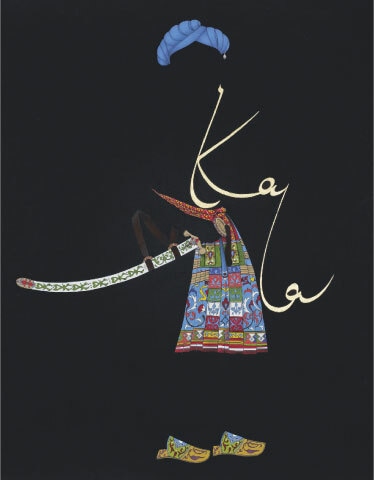
In this particular show, the recurring silhouette of the Mughal emperor is a symbol of privilege and prestige that many earthbound dreamers longed for, specifically during the course of monarchies and tyranny. The ornate and embellished yet hollow image of the monarch in bright paints against the jet-black vasili and wrapped with text — precisely rendered with 24 karat gold — reflects the socio-economic interplay associated with royal and colonial capitalism that squeezed the resources of this land and the hard work of its inhabitants.
This imperial figure also refers to the hereditary political power, which prevailed over this land in the post-colonial period as well — glorified with the slogans of political supremacy, propagated bravery and theocratic dominance. The illegible and stylised writing advocates the inability of text to carry original meanings and possibilities of deconstructed and simulated realities that create the power knowledge nexus in every walk of life. Hence, the artist tries to decipher the imperial dynamics, cultural intensities and psychological complexities through a unique signature style of his own.
Mahmood explores postcolonial tropes such as the “babu” — a colonial-era figure of bureaucratic mimicry — which has also surfaced in his earlier works, as a character bearing satire and shadows. He further extends this critique into the realm of religious and mythological discourse, exploring how sacred symbolism has been manipulated again and again over centuries.
Mahmood’s work is not didactic — it is layered, provocative and steeped in irony. His visual language, rooted in miniature of contemporary nature, demands viewers to read between the lines, the visual archive of dissent, resilience and reclamation.
Nevertheless, as a socially conscious artist, Mahmood’s standing in Pakistani art will depend upon his perseverance to question social, cultural and religious paradigms through his visual practice.
‘Brown Sahib’ was on display at Tanzara Gallery in Islamabad from June 25-July 10, 2025
The writer teaches Art History and Criticism at the University of Punjab in Lahore
Published in Dawn, EOS, July 13th, 2025