President Asif Ali Zardari and Prime Minister Shehbaz Sharif urged awareness on responsible parenthood and family planning to address population growth on the World Population Day on Friday, state-run Radio Pakistan reported.
Established by the then-Governing Council of the United Nations Development Programme in 1989 and observed on July 11 every year, World Population Day seeks to focus attention on the urgency and importance of population issues, including their relations to the environment and development.
The president, in his message to the nation, said that the challenge of population growth continued to hinder the country’s national development process which necessitated a comprehensive, and inclusive approach, state-run Associated Press of Pakistan reported.
“When community leaders, elders, and civil society organisations promote the benefits of responsible parenthood and support access to family planning, societal attitudes begin to change. The media also has a central role to play in raising awareness and promoting healthy practices, and can significantly influence public behaviour,” he said.
The president said that this year’s theme — which was to empower young people to create the families they want in a fair and hopeful world — captured the essence of Pakistan’s demographic reality.
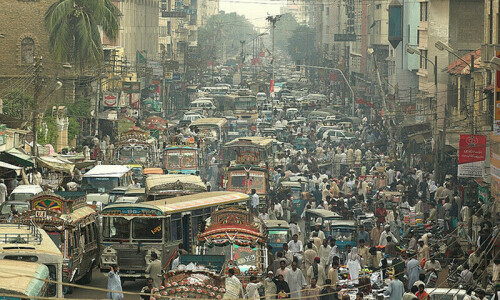
“With our population exceeding 242 million, the urgency to adopt forward-looking, evidence-based population policies has never been greater than it is at present. We have a huge youth bulge — our greatest strength, if nurtured through access to education, healthcare, opportunities, and agency.”
Highlighting the pressure of population growth on the country’s national resources, health and education infrastructure, and public services, he said that the rising unemployment, environmental degradation, deforestation, and overstretched health and education systems were symptoms of the imbalance between population size and available resources.
President Zardari called to expand access to quality family planning services, particularly in rural areas, with a focus on women’s education and employment who should be given equal opportunities, as their empowerment directly influences family choices.
He also called for the government to enhance its focus on a comprehensive population agenda, guided by the principle of tawazun (balance) — achieving harmony between population growth and resource availability.
“This approach is supported by stakeholders across sectors, including religious leaders, policymakers, and development partners. It reflects our shared commitment to securing a healthier, more equitable, and resource-efficient future.”
He also stressed the need for adopting international best practices including integrating family planning into primary healthcare systems, promoting reproductive health through community-based outreach, deploying trained female health workers at the grassroots level, and using mass media to promote public education and behavioural change.
“Such strategies can help stabilise population growth,” he added.
Pakistan’s youth can become a dynamic force: PM
In his message, PM Shehbaz said that his government was fully committed to a comprehensive, rights-based population agenda with a focus on equitable access to healthcare, informed family planning, and strengthening systems allowing individuals to make choices about their future with dignity and autonomy, according to APP.
“These efforts are fully aligned with Pakistan’s commitments under the Sustainable Development Goals and Family Planning 2030 targets. The stability of population growth requires a coherent, multi-sectoral approach,” he said.
“With a population of 242 million, approximately 65 per cent of whom are under the age of 30, Pakistan stands at a critical juncture in its history. This huge youth population represents both an extraordinary opportunity and a significant challenge,” he remarked.
PM Shehbaz said that Pakistan’s young population could become a dynamic force driving innovation, productivity, and national development if attention was given to their good upbringing and empowerment.
“However, managing such a large and growing population also places immense pressure on public resources and governance systems,” he added.
He urged all stakeholders, including federal and provincial governments, development partners, civil society, the private sector, religious leaders, and local communities, to fulfil their shared responsibility and commitment to address these population challenges and build a healthier, more prosperous future for Pakistan.