US ‘satisfied’ with Lebanon’s action to disarm Hezbollah
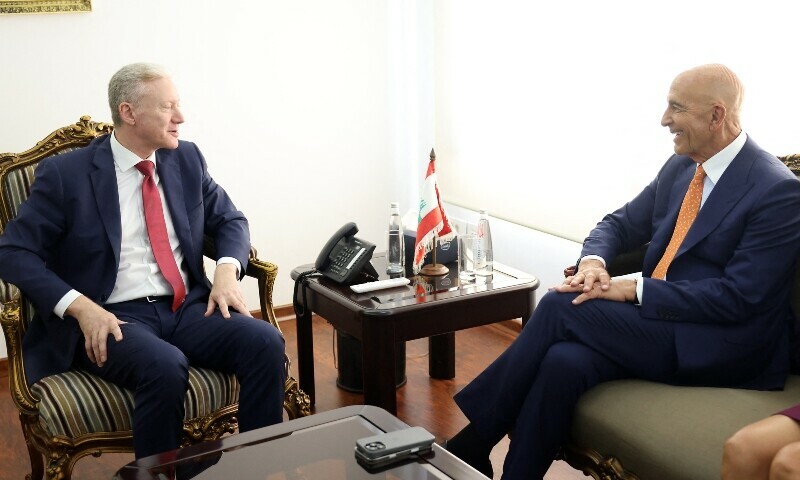

BEIRUT: US envoy Thomas Barrack said on Monday he was satisfied by the response of Lebanon’s authorities to a request to disarm Hezbollah, although warned Lebanon risked being left behind as change sweeps other countries in the region.
Lebanese leaders who took office in the aftermath of more than a year of hostilities between Israel and Hezbollah have vowed a state monopoly on bearing arms, while demanding Israel comply with a November ceasefire.
Israel has kept up strikes on Lebanon, with Lebanon’s health ministry reporting one dead in a raid on a vehicle in the country’s south on Monday. Israel has warned it will continue to strike until Hezbollah has been disarmed, while the movement’s leader Naim Qassem said his group would not surrender or lay down its weapons in response to Israeli threats.
“I’m unbelievably satisfied with the response,” Barrack, Washington’s ambassador to Turkiye and special envoy to Syria, told a press conference after meeting President Joseph Aoun. “It’s thoughtful, it’s considered. We’re creating a go-forward plan,” he said.
One dies in Israeli raid on a vehicle in the country’s south
“Now what it takes is a… thrust to the details, which we’re going to do. We’re both committed to get to the details and get a resolution,” he said, adding: “I’m very, very hopeful.”
‘Future for them’
Last month, Barrack asked Lebanese leaders to formally commit to disarming Hezbollah, the only group that retained its weapons after Lebanon’s 1975-1990 civil war, doing so in the name of “resistance” against Israel which occupied southern Lebanon at the time.
Hezbollah was heavily weakened in the latest conflict, with Israel battering the group’s arsenal of missiles and rockets and killing senior commanders including longtime chief Hassan Nasrallah.
The presidency said on X that Aoun handed Barrack “ideas for a comprehensive solution”. Parliament speaker Nabih Berri, a Hezbollah ally, said his own meeting with Barrack was constructive and “considered Lebanon’s interest and sovereignty… and the demands of Hezbollah”, according to a statement.
Barrack said that Hezbollah “needs to see that there’s a future for them, that that road is not harnessed just solely against them.” He warned that “the rest of the region is moving at Mach speed, and you will be left behind”, adding that “dialogue has started between Syria and Israel, just as the dialogue needs to be reinvented by Lebanon.”
On Friday, Syria said it was willing to cooperate with the United States to reimplement a 1974 disengagement agreement with Israel, nearly seven months after Islamists ousted longtime ruler Bashar al-Assad, a Hezbollah ally who was also backed by Iran. Syria has also admitted to holding indirect talks with Israel to reduce tensions.
Strikes
A Lebanese official said that late last week, Beirut submitted an initial response to Washington, which requested modifications, then officials worked through the weekend to develop the final version.
Under the ceasefire, Hezbollah was to pull its fighters back north of the Litani river, some 30 kilometres from the Israeli frontier. Israel was to withdraw its troops from Lebanon, but has kept them deployed in five areas that it deemed strategic.
The truce was based on a United Nations Security Council resolution that says only Lebanese troops and UN peacekeepers should bear arms in south Lebanon, and calls for the disarmament of all non-state groups.
Published in Dawn, July 8th, 2025