WIDE ANGLE; THE DARK STATUS-QUO UPHOLDER


 0
0
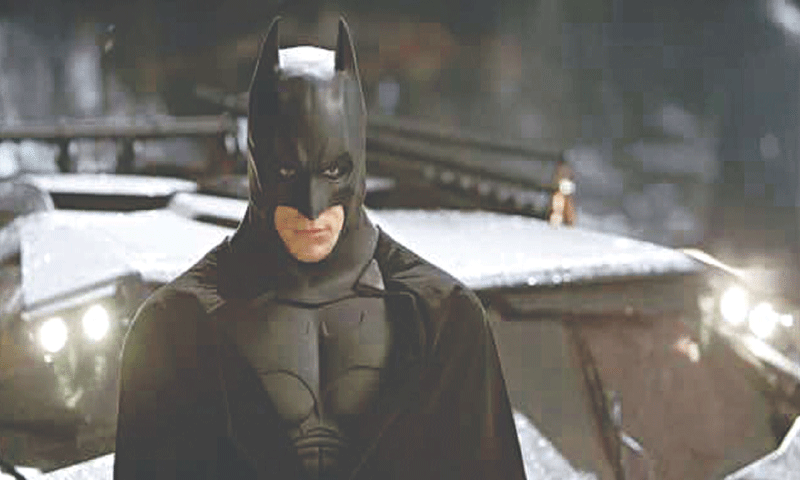

Christopher Nolan’s Dark Knight trilogy is often praised for bringing gritty realism and deeper political themes to superhero films. When Batman Begins premiered in 2005, it reimagined Gotham as a city undone by corruption, inequality and institutional collapse.
The trilogy may feature masked villains and high-tech gadgets but, at its core, it grapples with what happens when the systems meant to protect people start to fail. Throughout the trilogy, each of the central villains exposes a different aspect of Gotham’s dysfunction.
In Batman Begins, Ra’s al Ghul (Liam Neeson) sees Gotham as beyond saving, believing its destruction is the only path to renewal. In The Dark Knight, the Joker (Heath Ledger) reveals how fragile the city’s moral and social order truly is, pushing its citizens to the brink with chaos and manipulation. Then, in The Dark Knight Rises, Bane (Tom Hardy) harnesses class resentment to stage a violent revolution, blaming Gotham’s wealthy elite for systemic injustice.
While these antagonists raise serious questions about the city’s foundations, the films ultimately pull back from endorsing their challenges. Instead, they reaffirm that Gotham’s institutions, however flawed, must endure. Radical change, the trilogy suggests, is more dangerous than the corruption already in place.
As Batman Begins turns 20, it’s intriguing to look at how Christopher Nolan’s trilogy challenged power but still sided with the system
Batman (Christian Bale) is central to this message. He doesn’t work to change Gotham’s broken structures. Instead, he tries to keep them from falling apart completely. In The Dark Knight, he faces the Joker’s chaos using extreme measures, including mass surveillance. Though he’s troubled by it, the film still frames it as necessary.
In The Dark Knight Rises, Bane’s rebellion taps into real fears about inequality and corruption. But instead of taking those concerns seriously, the story presents them as a threat that Batman must shut down. Rather than offering hope for a better system, the film reassures audiences that the existing one, while imperfect, is still the best option.
While the trilogy appears to challenge authority and institutional power, it effectively offers a reassuring message rather than a radical one. Philosopher Slavoj Žižek argued that The Dark Knight transforms a lie into a stabilising force.
This is embodied in Batman’s decision to let the public believe he was responsible for Harvey Dent’s (Aaron Eckhart) crimes, preserving Dent’s reputation to maintain hope in Gotham’s legal system. As Batman tells Commissioner Gordon (Gary Oldman): “Sometimes the truth isn’t good enough. Sometimes people deserve more. Sometimes people deserve to have their faith rewarded.”
The implication is clear: some truths are too dangerous, and maintaining public faith is more important than exposing systemic failure. The films do question the status quo, but only within safe boundaries. They propose that society’s problems can be managed by exceptional individuals rather than through structural reform.
In doing so, they frame flawed institutions not as entities to be dismantled, but as pillars that must be upheld, even if only symbolically.
INDIVIDUAL HEROES OVER COLLECTIVE CHANGE
You can see the trilogy’s impact in later films such as Joker (2019) and The Batman (2022). Both explore the collapse of society and what happens to people caught in the middle.
But like Nolan’s films, they centre on lone characters, not collective solutions. They continue the pattern of showing that things are broken, while still trusting that a single hero can fix them.
Two decades after Batman Begins, the trilogy’s legacy feels more relevant than ever. As debates over truth, institutional trust and political extremism continue to dominate global headlines, Nolan’s films resonate with their portrayal of a society teetering on the edge.
In an era marked by public disillusionment and the growing sense that “the system” is broken, The Dark Knight trilogy explores the discomforting idea that institutions may be flawed but necessary — and that stability sometimes requires myth, not truth.
By positioning Batman as a lone moral figure who preserves order at great personal cost, the trilogy reflects a widespread longing for strong leadership amid institutional failure. Yet it also reveals a troubling tendency in popular culture to offer catharsis without change, examination without consequence. As viewers, we are encouraged to acknowledge the depth of societal problems — but not to demand solutions.
In that sense, The Dark Knight remains not just a compelling superhero story, but a mirror for our continuing struggles with power, truth and the difficult question of whether our institutions are worth saving, or simply the only ones we’ve got.
The writer is a PhD Candidate in Film Theory and Media Industries at the University of York in the UK
Republished from The Conversation
Published in Dawn, ICON, June 29th, 2025