0
0

CHAKWAL: Chakwal city is facing an acute water shortage as the underground water level has dropped to between 400 and 700 feet and the available water is brackish.
Meanwhile, the water supply scheme approved by the current prime minister in 2014 remains incomplete, even after 11 years. In Millat Chowk locality, water cannot even be fetched with a 700-foot bore.
“The more serious issue is that if we drill beyond 350 feet, we get saline water, which is undrinkable,” said Kamran Butt, who has been drilling water bores for the past 25 years.
Many other areas of the city, including Faisal Colony, Dhakku Road, Nishat Colony, Jhelum Road, Pindi Road, Madeena Town and Jafarabad are also facing severe water shortages, forcing residents to purchase water.
Water scarcity is not new to Chakwal, but it has now become unbearable for citizens.
According to documents obtained by Dawn from the Public Health and Engineering (PHE) Department, Chakwal, with a current population of 323,816, requires nine cusecs of water daily. However, the city receives only two cusecs.
During his election campaign in May 2013, Shahbaz Sharif promised a water supply scheme for Chakwal while addressing a public rally. After becoming chief minister following his party’s victory in the 2013 elections, he approved the water supply scheme on the recommendation of the late Member Provincial Assembly (MPA) Chaudhry Liaquat Ali Khan and his wife, Iffat Liaquat, who was then a Member of National Assembly (MNA).
The project was originally expected to be completed at a cost of Rs572.103 million.
Under this scheme, two cusecs of water were to be fetched from Khai Dam and four cusecs initially from tube wells, later to be sourced from Dharabi Dam under a revised plan.
As the dam was located far from the proposed tube wells, the project cost increased to Rs1,018.160 million.
In September 2017, PHE completed the first phase of the project at a cost of Rs330 million, initiating a supply of two cusecs from Khai Dam. However, the second phase — involving Dharabi Dam — remained stalled. As work failed to commence, the cost increased from Rs1,018.160 million to Rs1,375 million in 2020. Now, with Dharabi Dam water still out of reach, the project’s cost stands at Rs2,142.880 million and the Punjab Planning and Development Board has yet to approve it.
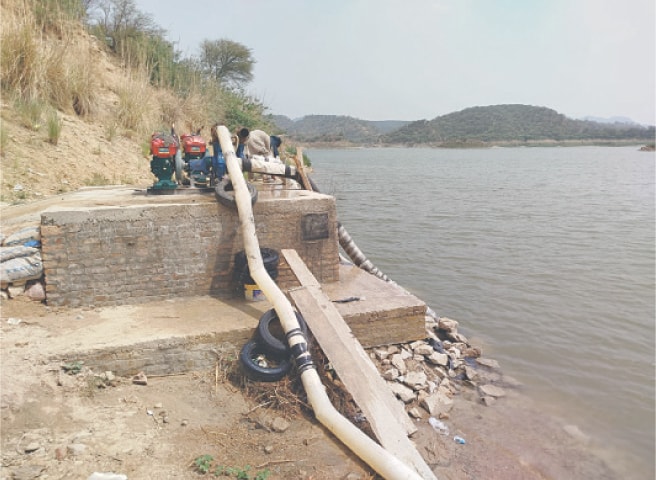
Chakwal has also suffered another blow as Khokhar Zer Dam, which provided two cusecs of water, has dried up.
Additionally, the water level in Khai Dam has fallen below the dead level, and gravity-based water supply to the city was stopped two months ago. The Municipal Committee of Chakwal installed two engines at the dam to pump water.
Currently, only one engine operates for ten hours a day, supplying just 1.5 cusecs to a city that needs nine.
“The major issue is that only 30 per cent of Chakwal city has water supply pipelines. The remaining 70 per cent lacks water lines, which were to be laid under the current project that has been stalled for 12 years,” said an official from the PHE.
Listing the main causes of underground water scarcity, the official cited concreted courtyards and streets, excessive boreholes, both in courtyards and streets, the commercial sale of potable water, water wastage and climate change.
When contacted, Executive Engineer Mohammad Gohar said his department is doing its best to get the revised scheme approved. Speaking to Dawn, Pakistan Muslim League-Nawaz (PML-N) MPA Chaudhry Sultan Haider Ali said he met with Chief Minister Maryam Nawaz during the budget session and requested her to prioritise Chakwal’s two major issues: the water supply scheme and construction of a hospital.
“She assured me she would approve both projects,” he said. “Unfortunately, the Pakistan Tehreek-i-Insaf (PTI) government did not bother to complete the scheme simply because it was initiated by our government,” he added.
Published in Dawn, June 28th, 2025