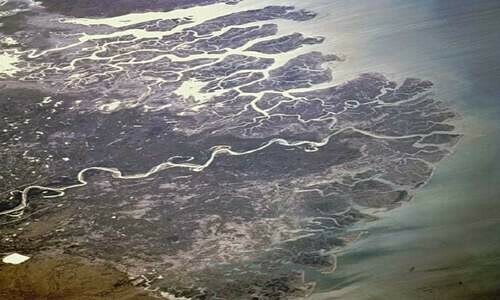
KARACHI: Senior environmentalists, academics and community activists sounded the alarm over the destruction of the Indus delta — mainly driven by a drastic reduction in freshwater flows downstream Kotri Barrage, leading to rampant sea intrusion and land erosion that has destroyed large tracts of agricultural land and caused a dramatic decline in fish stocks.
They said the destruction of the delta has intensified risks of flood and tsunami.
They called for integrated, climate-resilient development strategies, legal protection for freshwater flows and urgent institutional reforms to restore the ecological balance of the Indus delta.
The experts were speaking at a seminar — Climate Risks and Challenges in Sindh: Regional Vulnerabilities, Emissions Control, and Institutional Strategies for Sustainable Action.
Around 450 MGD of raw sewage is being discharged into mangrove habitats, moot told
The event was jointly hosted by Sindh Madressatul Islam University (SMIU) and The Knowledge Forum (TKF).
Ali Anjum of the World Wide Fund for Nature-Pakistan (WWF-P) noted that the delta, home to Asia’s seventh-largest mangrove forests, had been destroyed due to unchecked sea intrusion, overexploitation of forests, urban land reclamation and escalating coastal pollution.
“The consequences of these changes are stark. The Indus delta has shrunk by over 90 per cent in recent decades, millions of acres of fertile land have been lost to seawater intrusion and groundwater salinity has rendered much of the region’s water undrinkable and unfit for irrigation, leading to a continued human tragedy,” he shared.
Mentioning the land losses in three talukas — Keti Bandar, Khharo Chhan and Shah Bandar — Mr Anjum said that so far 263,272 hectares had turned barren.
“Agriculture losses are around Rs4.2 million, while fishery and forestry losses stand at Rs3.5m and Rs145m, respectively. If this trend continues for the next 25 years, we shall bear Rs4 billion in losses,” he said, adding that a WWF study revealed that 1.5 inches of mangrove land was being eroded daily.
Mr Anjum also raised concern over coastal pollution, stating that 450 million gallons daily (MGD) of untreated wastewater from more than 6,000 industrial units was being dumped into mangrove habitats, leading to growth retention and degradation of the marine ecosystem.
Fatima Majeed of the Pakistan Fisherfolk Forum reported a sharp drop in fish stocks and mangrove cover, with many fish species going extinct and new mangrove plantations failing due to insufficient freshwater.
“Once an ecologically rich and fertile area, the Indus delta is now destroyed and people are forced to migrate. The 17 creeks of the delta were once home to 450 beautiful islands. Today, only a few islands are left,” she said, adding that growing sea intrusion caused by a steep decline in freshwater flows was responsible for the tragedy that had destroyed around 4.2 million acres of coastal land.
Director TKF Zeenia Shaukat explained the Nationally Determined Contributions (NDCs) – climate action plans developed by individual countries as part of their commitment under the Paris Agreement (2015) to reduce greenhouse gas emissions and adapt to the impacts of climate change.
According to her, NDCs are critically important for Pakistan because they provide a strategic roadmap for low-carbon development, climate resilience and international collaboration.
She said effective implementation of Pakistan’s NDCs is essential not only for environmental protection but also for sustainable economic growth and the well-being of future generations.
Dean of Social and Development Studies Dr Jamshed Adil Halepoto stressed the need to tackle the environmental challenges effectively.
Dr Subhash, chairman of Department of Social and Development of SMIU, in his opening remarks, emphasised that Pakistan was grappling with severe climate change challenges, with the Indus delta among the worst affected.
Published in Dawn, June 12th, 2025