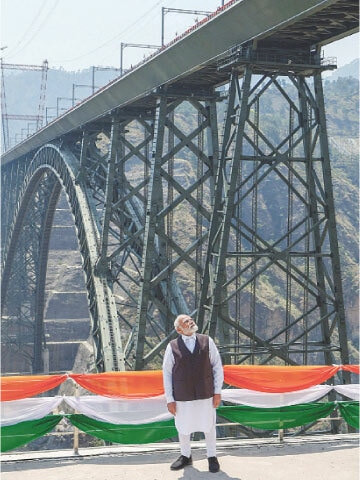
SRINAGAR: Indian Prime Minister Narendra Modi made his first visit to Kashmir on Friday since a conflict with Pakistan, opening a strategic railway line to the contested region he called “the crown jewel of India”.
Nuclear-armed India and Pakistan fought a four-day conflict last month, before a ceasefire was agreed on May 10.
“Friends, today’s event is a grand festival of India’s unity and firm resolve,” Modi said after striding across the soaring bridge to formally launch it for rail traffic.“This is a symbol and celebration of rising India,” he said of the Chenab Bridge, which connects two mountains.
With 36 tunnels and 943 bridges, the new railway spans 272 kilometres and connects Udhampur, Srinagar, and Baramulla. It is expected to halve the travel time between the town of Katra in the Hindu-majority Jammu region and Srinagar, the main city in held Kashmir, to around three hours.
Around 150 people protested against the project on the outskirts of Muzaffarabad, the capital of Azad Jammu and Kashmir.
“We want to tell India that building bridges and laying roads in the name of development will not make the people of Kashmir give up their demand for freedom,” said Azir Ahmad Ghazali, who organised the rally attended by Kashmiris who fled unrest on the Indian side in the 1990s.
FO slams Modi’s remarks
Pakistan has rejected Mr Modi’s remarks linking Islamabad to last month’s Pahalgam attack, calling the accusations baseless and an attempt to shift global attention away from the situation in occupied Kashmir.
“We are deeply dismayed that the Indian prime minister has once again chosen to accuse Pakistan of involvement in the Pahalgam attack, without presenting a single piece of credible evidence,” the Foreign Office said in a statement on Friday.
While addressing a rally in Katra, Jammu Kashmir, on Thursday, Mr Modi said Pakistan was targeting humanity, tourism and livelihoods in the disputed region.
The FO also criticised India’s claims of development in the region, saying they “ring hollow against the backdrop of an unprecedented military presence, suppression of fundamental freedoms, arbitrary arrests, and a concerted effort to alter the region’s demography in violation of international law, including the Fourth Geneva Convention.”
With input from AFP and Baqir Sajjad Syed in Islamabad
Published in Dawn, June 7th, 2025