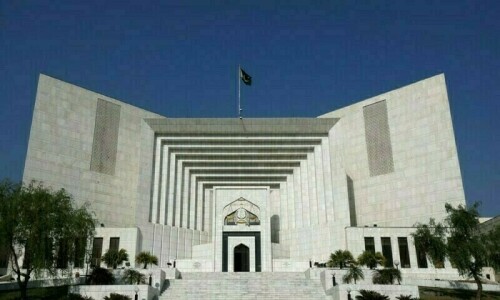
ISLAMABAD: A cloud of uncertainty has gripped Islamabad’s district judiciary as the controversy over the repatriation of scores of lower court judges to provincial high courts refused to die down.
The Islamabad High Court (IHC) has yet to announce its decision on a petition filed by 24 judges challenging their repatriation to provincial high courts, following a controversial tribunal ruling.
Justice Arbab Mohammad Tahir, who presided over the proceedings, reserved the judgment on May 2, 2025.
The petitioner judges, as well as other judicial officers of Islamabad’s subordinate judiciary and special courts, along with lawyers and litigants, are anxiously awaiting the decision.
Legal fraternity anxiously awaits announcement of judgement reserved on May 2
Sources in the judiciary told Dawn that the decision was finalised on May 17; however, it has not been announced for reasons best known to the presiding judge.
Judges of the district judiciary are perturbed over the delay in the announcement of the judgment.
There are also rumours that the delay is linked to the prevailing uncertainty in the Islamabad High Court (IHC) over the appointment of a regular chief justice.
At present, the IHC — like the Peshawar High Court and Sindh High Court — is being run by an acting chief justice.
The meeting of the Judicial Commission of Pakistan (JCP) could not be convened to consider the appointment of a regular chief justice for the IHC, as five senior judges challenged the transfer of three judges from other high courts and the revised seniority list, which made Justice Mohammad Sarfraz Dogar the acting chief justice for being the senior-most judge.
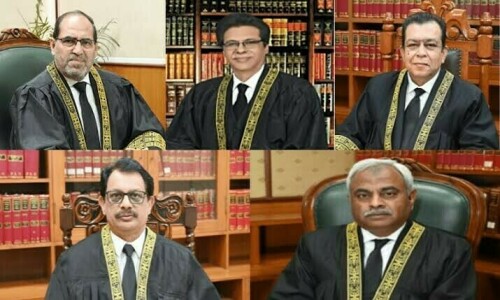
The five judges — Justice Mohsin Akhtar Kayani, Justice Tariq Mehmood Jahangiri, Justice Babar Sattar, Justice Sardar Ejaz Ishaq Khan and Justice Saman Rafat Imtiaz — challenged the transfer and the subsequent change in the seniority list in the IHC.
Initially, these five judges, along with Justice Arbab Mohammad Tahir, wrote a letter to the Supreme Judicial Council (SJC) against the alleged meddling of the Inter-Services Intelligence (ISI) in the IHC.
Justice Tahir later parted ways with the five judges, as — unlike them — he did not oppose the transfer of the three judges or the change in the seniority list.
The petition filed by the 24 judges of the district judiciary raised constitutional and legal questions regarding judicial service laws, the powers of the Subordinate Judiciary Service Tribunal, and the limits of presidential authority.
The petition was filed by a group of district and sessions judges, additional district and sessions judges and civil judges currently serving in Islamabad on deputation from Punjab, Sindh and Khyber Pakhtunkhwa.
The petitioners include Anti-Terrorism Court Judge Abual Hasnat Mohammad Zulqarnain, District and Sessions Judges Yar Mohammad Gondal and Nasir Javed Rana and several civil judges.
On March 21, the Islamabad Subordinate Judiciary Service Tribunal ordered the repatriation of these officers.
The ruling was issued shortly after a March 18 presidential notification reconstituted the tribunal — replacing Justices Tariq Mehmood Jahangiri, Babar Sattar and Sardar Ejaz Ishaq Khan with Justices Khadim Hussain Soomro, Mohammad Azam Khan and Raja Inaam Ameen Minhas.
The outgoing tribunal members declared the presidential notification null and void and continued to adjudicate cases, including issuing the ruling that is now under challenge.
The petitioners argued that the decision was made by a coram non judice (unauthorised forum), as the tribunal had effectively ceased to exist following its reconstitution.
Advocate General Islamabad Ayaz Shaukat told the court that the March 18 notification had legally dissolved the previous tribunal.
He argued that any decisions made after this date were without jurisdiction.
“The old tribunal, which ceased to exist, could not have made an order on March 21,” he stated.
Additional Attorney General Rashid Hafeez supported this position, noting that the tribunal lacked the authority to invalidate a presidential order or summon the attorney general without notice.
The IHC is examining 11 key legal questions, including whether the tribunal exceeded its jurisdiction under the Islamabad Subordinate Judiciary Service Tribunal Act 2016, whether it had the authority to declare the president’s notification unconstitutional, whether the rights of deputationist judges under Articles 4 and 10A of the Constitution were violated and whether the tribunal was empowered to rule on the validity of the Islamabad Judicial Service Rules 2011.
Published in Dawn, May 29th, 2025