Lower Sindh loses green cover thanks to illegal logging, encroachment of forests
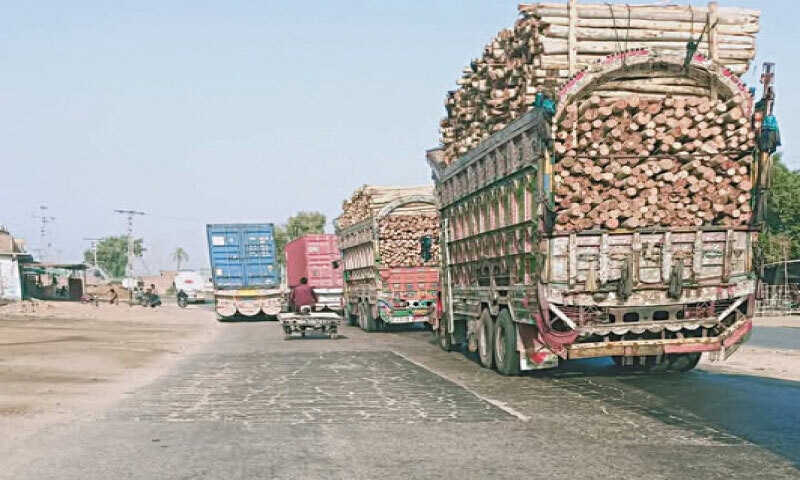

THATTA: Environmentalists have voiced deep concern over large-scale deforestation across Thatta, Sujawal, Badin and Tando Mohammad Khan districts thanks to unabated illegal logging by local timber mafias, conversion of forest land’s status into agricultural and failure of reforestation initiatives.
The situation has been further aggravated by natural factors such as recurring floods and soil erosion and widespread encroachments and unauthorised occupation of forest land that have continued unchecked for decades.
Experts warn that if action is not taken immediately, the region’s ecological balance and biodiversity may face irreversible damage.
Official data gathered by Dawn revealed that despite limited recoveries, only 800 acres in Thatta as of May 2013, thousands of acres of forest land still remained under illegal occupation.
Forest officials disclosed on condition of anonymity that influential individuals with large landholdings had long used vast tracts land for unleased agricultural purposes in Baao Puran Daas, Veeran, Mulchand, and other forests.
Two reports submitted to Supreme court in 2019 and 2023 showed Thatta accounted for 4,699 of Sindh’s 145,300 acres of encroached forest land and 1,343 acres of the 64,500 acres illegally allotted.
The Sindh government disclosed in a report that of 232,205.7 acres of encroached forest land across the province, 41,030.5 acres remained under illegal occupation, while 13,438.49 acres out of 34,713.05 acres of illegally allotted land remained unrevoked.
Masood Lohar, environmentalist and former National Coordinator for the UNDP-GEF Small Grants Programme, revealed that Thatta district had witnessed a drastic decline in forest cover, from 35.11 per cent in 1979 to just 2.23pc in 2010, marking an 89pc loss.
Forests had been particularly been affected, with 47,000 hectares lost between 1992 and 1997, and another 3,000 hectares between 1997 and 2001, he said.
He attributed the sharp decline to the diversion of Indus River water for agriculture and pressures of growing population. The riverine forests had suffered extensive depletion, with natural forests across Sindh covering only 0.60pc of the land by 2020. From 2001 to 2024, the province lost several hectares of tree cover, over half due to deforestation, he said.
He said that between 1979 and 2010, Thatta district experienced a drastic 89.07pc reduction in forest cover, with the most significant depletion observed in the riverine forests.
From a broader Sindh-wide perspective, the province had 84.8 thousand hectares of natural forests in 2020, covering only 0.60pc of its land. Overall, from 2000 to 2020, Sindh saw a net tree cover change of 15.0 thousand hectares, reflecting a 67pc change due to 22.0 thousand hectares lost, he said.
Nasir Panhwar, an environmentalist, said that diminishing water inflows and extreme weather were rapidly stripping Sindh’s riverine areas of forest cover, particularly affecting species like kandi and acacia.
He noted that the riverine forest cover had declined to just 5–10pc of its original extent but could be restored up to 70–80pc through community-driven plantation efforts.
Once dense forests stretched from Kashmore to Keti Bundar, but lack of replanting, climate change, and reduced freshwater flows had also accelerated deforestation across the Thatta region, he said.
Panhwar stated that the riverine forests along the Indus, locally known as Kacho forests, played a vital role in protecting riverbanks from erosion and supporting local livelihoods through the supply of wood and other natural resources.
However, he noted that the riverine forest area in Thatta district had drastically declined from 45,128 hectares in 1990 to 36,432 hectares in 2010, and further to 25,888 hectares by 2014.
He attributed this sharp decrease to human activities, particularly large-scale conversion of forest land into agricultural and warned the ongoing depletion of forests represented a significant loss to the natural ecosystem, as vast forest areas were transformed into wasteland or farmland due to both natural and anthropogenic causes each year.
He emphasised the need for strategic interventions by the government and conservation partners to safeguard forests and reclaim encroached lands from influential individuals.
He advocated raising awareness among local communities about ecological and economic importance of forests and wetlands and stressed the need for government-led initiatives for promoting alternative fuel sources, such as biogas, to reduce dependence on wood.
These measures, along with stronger forest governance and enforcement, were essential to halt deforestation and restore Thatta’s degraded forest ecosystems, he said.
Kamal Palari, a local environment activist, expressed concern over unchecked deforestation and encroachment in Thatta, Sujawal, Badin and Tando Muhammad Khan districts, where tree cutting continued unabated.
He noted that felled trees from these districts were routinely transported to nearby cities, while forest lands, including 35 major sites in Thatta and Sujawal such as Maro, Kotri, Gulel and Belo Veeran, were being unlawfully converted into agricultural land without proper leasing.
He said that forests like Bohrki and Rahri in Badin had completely vanished due to water scarcity and many of the 15 major forests in Tando Muhammad Khan, including Barham Shah and Budka, had nearly disappeared.
Palari linked the devastation caused by recent floods to climate change driven by rampant deforestation and criticised the government’s inaction in this regard.
He pointed out how timber mafia and influential encroachers continued to exploit forest resources, selling valuable wood at throwaway prices, resulting in significant losses to national exchequer.
He alleged that some Forest Department employees were complicit in illegal tree cutting and unauthorised transport of timber. Encroachers commonly converted forest land into agricultural, pastoral or residential, with some influential individuals even constructing embankments in riverbeds, disrupting natural flow of floodwaters.
Illegal logging, often linked to land clearing for encroachment, continued for profit, while the power and influence of encroachers made eviction efforts challenging, he said.
Zulfiqar Memon, Conservator of Forests Thatta, said that due to absence of a clear policy for lease since several years by the Sindh government and ongoing water scarcity downstream Kotri, forest cover had declined by 50pc.
He noted that the Forest Department had launched afforestation projects to improve carbon sinks and was actively working to reclaim encroached forest lands, with courts also taking notice of illegal occupations. Despite past deforestation, reforestation drives were under way in areas like Hillaya, Lallang, Shah Lunko, and Bao Purandas, he said.
Memon emphasised that halting deforestation in Sindh would require coordinated efforts by the government, communities and other stakeholders to ensure sustainable development and environmental protection.
Published in Dawn, May 29th, 2025