0
0

ISLAMABAD: The automobile assemblers and parts manufacturers have urged the government to announce a clear policy on reducing vehicle import duties before announcing the upcoming budget.
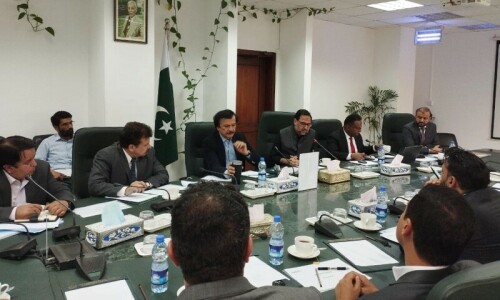
In a recent meeting with Special Assistant to the Prime Minister (SAPM) Haroon Akhtar Khan, the representatives of the Pakistan Association of Automotive Parts and Accessories Manufacturers (Paapam) and Pakistan Automotive Manufacturers Association (Pama) demanded clarity of policies from the government.
Officials from the Ministry of Industries and Production and the Engineering Development Board (EDB) also attended the meeting.
They have warned that if such a policy is implemented, they may shift their focus from local manufacturing to importing vehicles.
The meeting was part of the proposals related to the National Tariff Policy (NTP) for 2025-30, which the government plans to implement starting July 1.
It has been proposed that the policy would reduce trade barriers and simplify customs procedures, including the phased elimination of additional customs duties (ACDs) and reduction in regulatory duties (RDs).
Eventually, the duty on industrial and machinery imports would be around 15 per cent and the auto sector was in arms against the proposed reduction by 2030.
In an earlier meeting, the SAPM asked Paapam to present the breakdown of taxes and duties for auto parts manufacturers.
The Pama representatives informed that the Completely Built Units (CBUs) taxes range between 50 to 100 percent depending on the vehicle category.
The details presented by Paapam highlighted that the local part makers availed protection of 18pc against completely knocked down (CKD) car kits.
“We have clearly stated that if the cars are imported at 15pc, the parts would be imported at around 0-10pc duties,” Paapam chairman Abdul Rehman told Dawn.
“Our presentation clearly stated that the high cost of electricity, import of steel and plastic raw material, financial cost, etc., was making the local manufacturing costlier compared to key competitors like Thailand, India, China, Indonesia, and Vietnam.”
Paapam has said that under these conditions, maintaining the manufacturing facilities in the country was not viable.
“But we have demanded the government to clearly state a policy as such matters become subject of discussions after every 2-3 years,” he added.
Published in Dawn, May 27th, 2025