NON-FICTION: Understanding the West’s racism


 0
0

The World After Gaza
By Pankaj Mishra
Penguin Random House
ISBN: 979-8217058891
304pp.
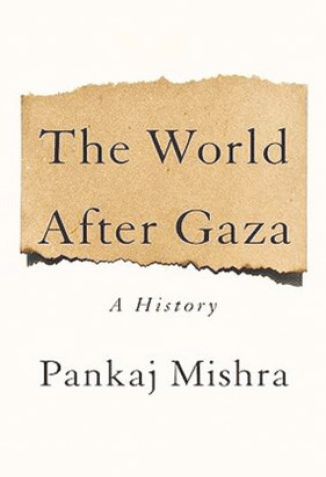
Pankaj Mishra draws on his strength as an academic and takes a scholarly deep dive into the literary thought that has shaped Western political and moral imagination post-World War II. He believes that the modern-day global order was created as a response to the Nazi Holocaust. In the West, the Shoah has been the benchmark of atrocity, the memory of which served to create Israel’s settler colonial state.
The World After Gaza examines the many aspects of Jewish statehood, the sanctified position of the Holocaust and how the West never really evolved when it came to equity for the ‘other’. However, as we know, the Holocaust was not the first and most certainly not the last display of human cruelty.
Mishra begins his book on a personal note, where he describes growing up in a Hindu-nationalist household in the 1970s. India was the first non-Arab country to recognise the Palestine Liberation Organisation (PLO) as the sole representative of the Palestinian people in 1974. He describes how most Hindu nationalists (especially upper-caste Hindus) were happy to break away from the government-mandated official consensus, as set up by Nehru.
Hindu nationalists felt a natural affinity with the Zionist cause, “a similar experience of marginality and humiliation.” He perceives their radical ideology as a longing “to overcome what they perceived as a shameful lack of manhood among Jews and Hindus.” Mishra provides context as he traces the cruel, exploitative route of two centuries of British colonial rule in the Subcontinent. He is acutely aware of the insidious racism of the West as he confronts the magnitude of the ghettos, the death squads, and the concentration camps littered across Europe. The callousness on display is familiar to Mishra, where his ancestors have felt the trauma of colonisation.
Pankaj Mishra’s latest book is a personal coming to terms with his pro-Zionist upbringing as well as the roots of the Western ideology that not only led to colonialism and the Nazi Holocaust but the impunity that Israel enjoys in the West
This is why he admits to finding Zionist logic hard to resist. A logic that dictates that the safety of the Jewish people can only be guaranteed by the creation of an exclusively Jewish state. It is this conviction that helps him “explain Zionist violence against local Palestinian fighters and invading Arab armies, the expulsion of hundreds of thousands of Palestinians, the occupation of their lands and homes, and the destruction of Palestinian identities of Arab villages and towns.”
Mishra is honest in his evaluations and, if history is anything to go by, he knows “That yesterday’s victims are very likely to become today’s victimisers is the lesson of organised violence in the former Yugoslavia, Sudan, Congo, Rwanda, Sri Lanka, Afghanistan… [But] I was still shocked by the dark meaning the Israeli state had drawn from the Shoah...”
Mishra’s primary observations come from after his visit to the occupied West Bank in 2008. “Still, nothing prepared me for the brutality and squalor of Israel’s occupation… nothing in scholarship about the Israeli occupation matched the experience of witnessing its profit motive in action: the plunder of Palestinian natural resources by Israeli companies… and their exploitation of low-wage Palestinian labour.”
Mishra describes his eyewitness account with tangible incredulity that leaps off the page. He is familiar with the playbook and recognises the nature of Israel for what it is: a ruthless, settler colonial occupation. Mishra admits his failing as a writer as he admits that he succumbed to “aggrieved self-censorship”, coupled with purposeful external suppression of any narrative that might compete against the one perpetuated by the West.
Mishra’s self-accountability is evident throughout the book and, whilst he does not fixate on his trip to the Occupied West Bank, the reader is aware of the effect it has on him as he comes to terms with the unsettling reality of the West’s former victims now enjoying complete and utter impunity, safety and ease that comes with support from Western powers.
Perhaps one of Mishra’s most astute observations is how the Holocaust is perceived differently by the Global South, most of which has suffered at the hands of the West’s colonial and racist legacy. He highlights how opinion-makers and liberal American intellectuals were “united in refusing to consider that the most consequential event of the 20th century might not be the First or Second World War, the Shoah, the Cold War, or, for that matter, the collapse of communism, but decolonisation.”
Mishra highlights this profound, seismic shift that has impacted not only economic power but also acted as a catalyst for intellectual and cultural revolutions. It is this realisation that lays the groundwork for understanding the reaction of the Global South towards Israel’s utter impunity, as it ruthlessly carries out what can only be described as a live-streamed genocide in Gaza.
There can be no greater image that illustrates this disconnect than the one from November 2024, when the United States representative to the United Nations Security Council casts the sole vote against the Gaza ceasefire resolution for the fourth time. The remaining 14 countries voted in favour of the resolution, calling for an end to the war.
Mishra continues to unpack this perceived exceptionalism of Israel. “…Yuri Slezkine writes in the Jewish Century, ‘the Chosen people of the postwar Western world.’ And Israel became its exceptional nation.” It is a lesson in history for the reader. Mishra identifies American intellectuals in a post-Cold War world, where propaganda and discourse that served the United States at that time also made them fixate on the crimes of dictatorial regimes of Hitler, Stalin, Mao, eventually leading them to believe in the idea that they alone were the “custodians of liberalism and democracy.”
There is a cruel irony in this, as it allowed the West to remain oblivious “to the long centuries of genocidal violence and dispossession that made Europe and the United States uniquely powerful and wealthy…” He exposes the weakness of Western intellectual thought as it discounted much of the Global South, dismissing its economic and global force.
Mishra’s strength as an essayist is obvious whilst describing the deeply entrenched American-Israeli symbiosis — despite questionable moral and ideological standing. The Zionist disdain for weakness and its obsession with race politics, coupled with feverish Evangelical Christian support and the flow of money in American political discourse, has actively promoted a false narrative that includes the dehumanisation of Palestinians at an unprecedented rate. Mishra puts to bed any argument that might present an excuse for the deep ties that Israel nurtures with dictators and fascist rulers around the world.
His book is deeply personal as it mirrors his own journey towards an awakening of sorts. However, I beg to differ from his point of view where he equates the creation of Israel with Partition and the subsequent creation of Pakistan and India, calling it, “imperial skullduggery, nationalist opportunism, clumsy partition…” Despite the many failings of the haphazard creation of Pakistan and India, the circumstances at the end of the British mandate over historical Palestine and the end of the British ‘Raj’ were not the same.
The subsequent ‘handover’ of historical Palestine to the Zionist Federation in the neatly typed out Balfour Declaration that essentially approved “the establishment in Palestine of a national home for the Jewish people...” was inequitable and the ashes of the Palestinian villages of Tantura, Deir Yassin and others stand as testament to the violent nature of land-grabbing, subjugation and exploitation of the coloniser, in this case Zionist militias armed to the teeth by the West.
Such is the nature of historical fact; it can never be disregarded. Why were the Palestinians, living thousands of miles away from Germany, expected to pay for Europe’s ‘atonement’ for the Holocaust? Mishra mentions his admiration for Jewish enterprise in the form of kibbutzes and socialist farming communities. But what of the existing Palestinian communities — the olive tree-growers and farmers — that existed before the state of Israel came into being? No amount of intellectual gymnastics can rebuke historical fact. These are questions that will always demand answers.
That said, The World after Gaza is an important book. It is incredibly well-researched and provides imperative historical context. It traces the root cause that always stays the same — “…all Western powers worked together to uphold a global racial order, in which it was entirely normal for Asians and Africans to be exterminated, terrorised, imprisoned and ostracised” — even if the victims keep changing.
The reviewer is a freelance writer with a background in law and literature. X: @ShehryarSahar
Published in Dawn, Books & Authors, May 25th, 2025