Data shows sea intrusion in Sindh’s coastal areas gathered pace over years
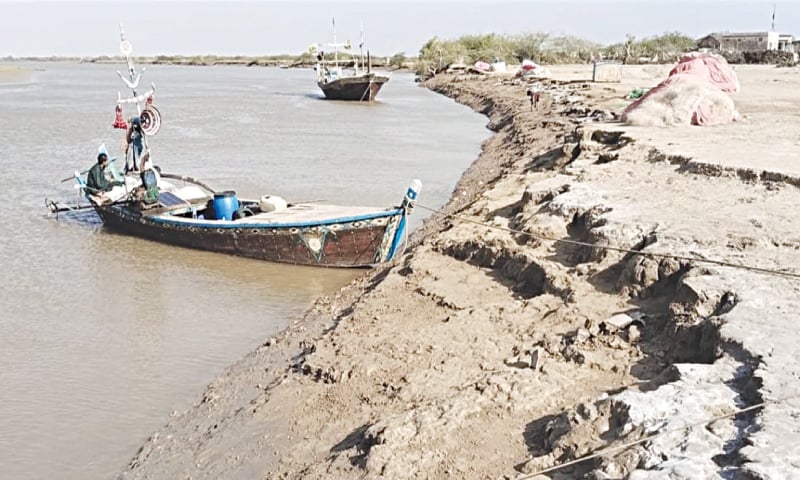

THATTA: A deep sense of trepidation is fast gripping residents of Thatta district as experts, civil society leaders and farmers report seawater intrusion into the region’s fertile belt at an alarming rate corroborated by official data.
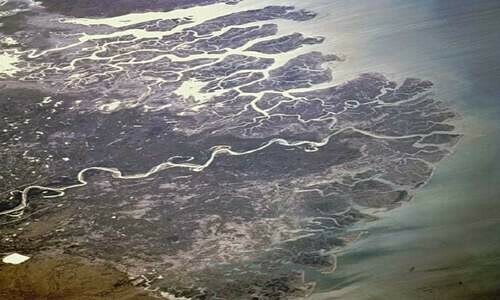
The stoppage of freshwater flows downstream Kotri has allowed seawater to steadily encroach inland, undermining ecological balance of the Indus Delta, displacing communities and crippling rural livelihoods.
A study conducted by Dawn shows that over past decade, more than 124 dehs across six coastal talukas of Keti Bundar, Ghora Bari, Mirpur Sakro in Thatta district, and Kharo Chhan, Shah Bundar and Jati in Sujawal district, have submerged in seawater, rendering the farmland infertile.
Official data provided by Sindh revenue department reveals the significant impact of seawater intrusion across several talukas in the province’s coastal region. In Sujawal district, 85 dehs are submerged out of 257 dehs and Kharo Chhan taluka is particularly hard hit with 29 out of 32 dehs, and a staggering 400,000 acres out of 595,091 acres now under the sea, representing 67 per cent of its landmass.
Similarly, Shah Bunder taluka has seen 43 of its 92 dehs and 518,895 acres out of 735,706 acres swallowed by the sea, accounting for 46 pc of its land. The situation is critical in Jati, where 13 out of 133 dehs and 405,000 acres out of 879,373 acres are now under seawater, equating 47pc of the land.
The revenue data reveals that in Thatta district, a total of 170,199 acres have submerged, severely impacting local livelihoods and the region’s agricultural output.
The data highlights the extent of the devastation in different talukas. In Mirpur Sakro, a total of 14 dehs have witnessed the submergence of approximately 23,930 acres.
The situation is equally dire in Ghorabari, where seven dehs have lost a combined 32,060 acres to the encroaching sea. The most substantial impact has been felt in Keti Bunder, where a staggering 31 dehs have been affected, with 114,208 acres now underwater.
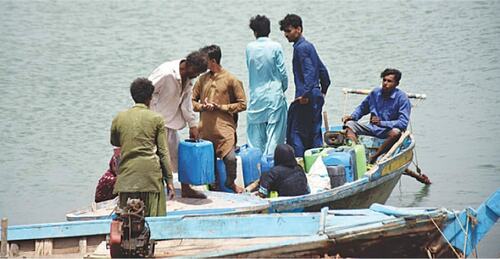
As per the study, this brings the total area of inundated land to 1.2 million acres, with a significant portion being agricultural land. “Our lands, where our fathers and grandfathers grew rice and vegetables, are now salty swamps,” said Shafi Murghar, a local fisherman from Keti Bundar.
“The sea has swallowed our farms, old ports, lakes, and lagoons. We can no longer survive off land. Many have left for Karachi to find work,” he said.
He said that the drastic decline in freshwater flow downstream Kotri was directly linked to the accelerating intrusion of seawater into the delta. This reduced flow had left the region vulnerable to rising sea levels and coastal erosion, exacerbating the crisis, he said.
Syed Gulab Shah, a local representative of the Pakistan Fisherfolk Forum, highlighted the social costs. “The forced migration of families is tearing apart the social fabric of the district. We’re not just losing crops - we’re losing our culture, our identity, and our way of life. Immediate support for displaced families is essential,” he said.
Former MPA Sassui Palijo described the situation as a “humanitarian and environmental catastrophe,” calling on the government to urgently address the root causes by restoring adequate freshwater flows to the delta.
Dr Karim Khwaja, former Senator, warned of the long-term implications. “Salinisation of land is often irreversible. We must urgently invest in sustainable agricultural practices and water management strategies to protect what remains of the delta’s productive land.”
Environmentalist Nasir Panhwar proposed a multi-pronged response by Improving freshwater flows downstream Kotri through coordinated efforts by federal and provincial governments, besides providing immediate relief and long-term rehabilitation packages for displaced families, including housing, livelihood support, and skill development, promoting research into salt-tolerant crops and resilient farming practices tailored to the changing environment.
He said that by engaging local communities in planning and decision-making and restoring mangrove forests to serve as natural coastal barriers against seawater intrusion, the economy could somehow be improved of coastal communities.
He said that research on the Indus Delta showed a clear link between reduced freshwater discharge and seawater intrusion. Experts estimated that for every kilometre of seawater advance onto land, significant amounts of fertile land became unusable, he said.
Therefore, Satellite data from agencies like SUPARCO could provide valuable insights into the changing landscape and scale of destruction, he said.
Abdul Aziz Lashari, a landlord from Gharo town, revealed that the growing threat of brackish water intrusion was more than an environmental issue it was a full-blown socio-economic crisis.
Published in Dawn, May 20th, 2025