Trump touts trade incentives as ‘peace-building tool’


 0
0


• Insists one of his biggest successes is persuading Pakistan, India to ‘step back from the brink’
• Describes his Gulf tour as ‘a major, major success’, issues another warning to Iran
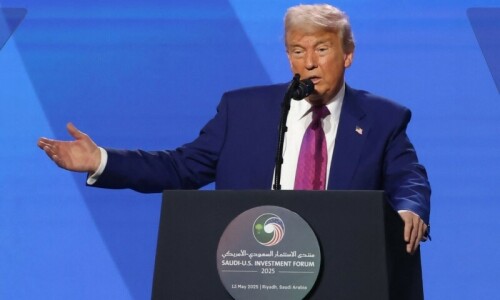
WASHINGTON: President Donald Trump has said the United States intervened to prevent a possible “n-war” between India and Pakistan after the two nuclear-armed neighbours had already begun targeting each other with missiles and drones.
Discussing the May 10 ceasefire between the two nations with Fox News anchor Bret Baier, President Trump described the situation as intensifying.
“They were angry, and the next phase was probably — did you see where it was getting? It was tit-for-tat. It was getting deeper and more, I mean, more missiles. Everyone was stronger, stronger, to a point where the next ones are going to be you know what: the n-word.”
The Trump administration’s decision to mediate was reportedly influenced by remarks from Vice President James David Vance. In a previous Fox News interview, Mr Vance commented that the conflict was “fundamentally none of our business”. According to The New York Times, this statement “caused alarm in the administration that things could get out of hand if the US sat on the sidelines”.
As the situation escalated, the US recognised that public statements urging de-escalation were insufficient, the reports added. Contrary to his earlier statement, VP Vance then called Indian Prime Minister Narendra Modi, whom he had met during a trip to India the previous month, stating that the US believed the conflict could lead to a full-scale war between the two nations, according to The New York Times.
Secretary of State Marco Rubio contacted top Pakistani officials before the two sides established the foundations for a ceasefire.
Following the agreement, Pakistan commended President Trump “for his leadership and proactive role for peace in the region”. India did not acknowledge the US role in the ceasefire.
This is the fourth time President Trump has highlighted his administration’s role in defusing tensions between India and Pakistan, clearly ignoring India’s policy against third-party mediation. His remarks contradict PM Modi’s claim that the ceasefire was enacted on Pakistan’s request.
President Trump, who wrapped up his high-stakes Middle East tour on Friday, covered a sweeping range of subjects in his interview, ranging from the tour itself to a $400 million personal gift from Qatar and record-breaking investment commitments totalling an estimated $2 trillion.
But he insisted that “one of (his) biggest successes no one ever gives me credit for” was calling both Indian and Pakistani leaders by phone and persuading them to “step back from the brink” of a potential nuclear clash mere hours before his departure to the Gulf.
President Trump, who wants to be seen as a man of peace, said this was a “bigger success than I’ll ever be given credit for”.
India and Pakistan, he said, “are major nuclear powers. Those are not like a little bit. And they were angry. And the next phase was probably… you know what the ‘n’ word is, right?”
He then lauded his use of trade incentives as a peace-building tool. “I’m using trade to settle scores and to make peace,” he said, pledging to reduce tariffs by “100 per cent” for US exports to India once full calm was restored.
President Trump described his three-nation tour of Saudi Arabia, Qatar, and the United Arab Emirates from May 13 to 15 as “a major, major success” in strengthening US engagement with the energy-rich Gulf Cooperation Council (GCC) states. He attributed the success of the trip to his personal friendships with the leaders of the three countries.
In the interview with Fox News, the network noted that Mr Trump created geopolitical shockwaves by lifting decades-old sanctions on Syria. His meeting in Saudi Arabia with Syrian interim President Ahmed al-Sharaa was described by his officials as a turning point for the war-torn nation.
Mr Trump also issued another warning to Iran, claiming that his sanctions policy had prevented Tehran from acquiring a nuclear weapon.
President Trump again defended his decision to accept a luxury jet worth hundreds of millions of dollars from the Qatari government to replace Air Force One, while also dismissing bipartisan criticism as a “radical left story”.
Published in Dawn, May 18th, 2025