0
0

! The first tendril appears on a three-week-old seedling | Photos by the writer
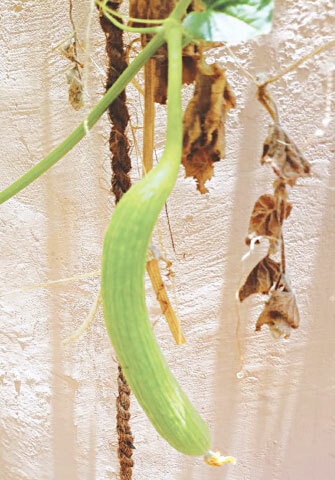
The Armenian cucumber, also known as snake cucumber or yard-long cucumber, is a type of melon (Cucumis melo). Locally known as kakrri, it is extremely popular among kitchen gardeners, with one reason being that it is a heat-tolerant vegetable that produces a bumper crop. The humble requirements of the plant make it ideal for those living in areas with high temperatures, such as Karachi.
In favourable conditions, the pot or seedling tray with the sown seeds are likely to start the germination phase in five to ten days after the sowing of the seeds. Favourable conditions include many simple yet critical aspects. The temperature and climate should remain constant. The plant shouldn’t be exposed to overwatering or drought-like conditions. Before germination, the container should be kept away from direct sunlight. The ideal germinating temperature for the seed is in the range of 23 to 30 degrees Celsius. The overall plant of the Armenian cucumber survives well in hot and dry conditions.
The first leaves to appear are the oval-shaped cotyledons. They are the basic first two leaves, which usually appear during the germination of melon or gourd seedlings. These leaves are not the true leaves and are relatively short-lived. However, the cotyledons play an important role before and during the germination stage, by providing the seed and the plant-to-be the required nourishment for sustained growth.
Soon enough, true leaves begin to appear. The true leaves are likely to start growing by the end of the first week of the germination phase of the seeds. Unlike cotyledons, these true leaves have their own unique pattern and characteristic shape.
While the Armenian cucumber is easy to grow, gardeners must ensure the balance between sunlight exposure and soil moisture at the seedling stage
The seedling container should now be shifted to a place where it is exposed to early morning sunlight. Gradually, the sunlight duration should be increased to at least four to five hours a day. With sunlight exposure, the water requirement of the young seedlings also changes, as the soil surface dries off quickly.
A religious watering schedule should be adopted. It should be ensured that the soil remains moist enough, but water should not accumulate over the soil surface, as it can result in root rot and drastically impact the growing seedlings.
Being a sun-loving plant, it can be tricky to strike the right balance. On the one hand, the seedling of the Armenian cucumber should be exposed to increased sunlight while, at the same time, the soil surface should not dry off. In this situation, the role of mulching grows in importance. Mulch not only helps to retain the moisture within, but it also provides nutrition to the growing plant.
Apart from mulching, during the early phase of true leaves growth, a mild fertiliser should be added to boost the soil. Although it is not mandatory to use any specific fertiliser but, if required, a diluted or mild form of any commercially available fertiliser can be used. At this stage, the quantity of the fertiliser should be decreased to half of what is being usually recommended for the plant by the fertiliser seller.
This is also a critical phase for the plant as it is vulnerable to attacks from pests and birds. The seedlings are also vulnerable to slugs, insects and birds. Regular monitoring of seedlings and covering them with a green net can go a long way in protecting the plant at this stage.

In about three weeks post-germination, when the number of true leaves increases to five or six, the first of the tendrils is likely to grow. Tendrils are the soft, coiling outgrowth that usually look for anything to grab on to. These tendrils cling to any nearby inserted sticks, trellis or even other neighbouring plants.
The goal of these tendrils is to help the plant grow quickly and in every direction. As the first tendril starts to grow, the seedling stage reaches its end. It is time now to shift the young Armenian cucumber plant to its new, permanent place.
Please send your queries and emails to doctree101@hotmail.com. The writer is a physician and a host for the YouTube channel ‘DocTree Gardening’ promoting organic kitchen gardening
Published in Dawn, EOS, May 18th, 2025