Plan to bring back non-practising Pakistani doctors enters new phase



KARACHI: Sharing how a telehealth project brought 1,500 out-of-practice Pakistani female doctors, living in the country and abroad, back into the practical field and helped them serve in other countries as well, especially during the Covid-19 pandemic, experts on Wednesday announced the launch of the programme’s second phase.
The project is a joint venture of the Dow University of Health Sciences (DUHS) and EduCast, a global educational technology platform, the eDoctor programme. Its second phase is being supported by Islamic Development Bank.
“It’s a movement to empower all female doctors who couldn’t practice their profession due to family reasons or societal circumstances,” Prof Jehan Ara Hassan, the project’s head and acting vice chancellor of DUHS, told a news conference here at the Karachi Press Club.
She recalled how the project was initially conceived and launched by former vice chancellor Prof Saeed Quraishy in 2018.
First round of telehealth project already brought 1,500 out-of-practice Pakistani women doctors back into field
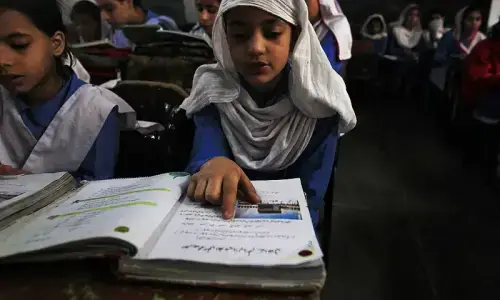
“Around 70 per cent of the medical graduates in Pakistan are girls. Of them, it’s estimated that 30pc of the girls fail to practice. It’s a huge loss of money and time,” she said, adding that the education and training of a single medical graduate costs the government around Rs10 million.
“Even in the private sector, a huge amount is spent on the professional training. Over the years, this situation has seriously affected the quality of our health services as the gap between patients’ burden and doctors’ numbers has grown dramatically and being filled by non-qualified people,” she said, while explaining the project’s needs.
According to her, the project would help bring back 30,000 female doctors who had quit the profession. Their inactivity has cost the national treasury more than Rs35 billion.
“This initiative is reconnecting Pakistani women doctors to their profession through technology, dignity, and purpose. The doctors trained through this programme did remarkably well during the Covid-19 pandemic by providing online consultations to over 500,000 patients residing in different countries, including Pakistan,” she said, hoping that the project would help transform the health system.
The team’s key members were also in attendance: Prof Asma Faisal, Prof Sumbul Shamim, Dr Anam Arshad Baig, Dr Maryam Fatima, Dr Ayesha Butt and Educast Chief Executive Officer Abdullah Butt.
The speakers stated that the current phase focusing on primary healthcare and the online education and training to doctors would be provided at their flexible hours. Most of the out-of-practice doctors who got trained in the first phase are still working, involved in research or pursuing their postgraduate studies.
The project, they said, would help Pakistan achieve multiple goals of the sustainable development agenda including women empowerment, improving healthcare and ending gender inequalities.
In Afghanistan, through EduCast’s support, services related to cancer, maternity care, and other diseases were provided across 20 provinces, and a new project to train 1,500 Afghan doctors was launched with funding from the Islamic Development Bank.
In Yemen, in partnership with institutions like Inciensa, healthcare services were delivered via the e-Doctor platform in areas where on-ground medical facilities were unavailable.
In Palestine and Gaza, refugees were provided mental health services through online platforms, improving their psychological well-being.
During Pakistan’s recent floods, the e-Doctor programme provided emergency tele-triage and digital assistance, enabling rapid medical intervention in affected areas.
Additionally, under the national elder care platform “Bridge,” e-Doctors were deployed to provide quality home-based consultations to senior citizens.
“These collective efforts prove that the e-Doctor programme has not only enhanced female doctors’ participation in healthcare within Pakistan but has also contributed significantly to global health responses in times of crisis,” EduCast CEO Abdullah Butt said.
Published in Dawn, May 15th, 2025