0
0


The 1972 concert film Pink Floyd Live at Pompeii, back in cinemas, remains one of the most unique concert documentaries ever recorded by a rock band.
The movie captured the band on the brink of international stardom, released seven months before their breakout album Dark Side of the Moon, which would go on to sell 50 million copies and spend 778 weeks on the Billboard charts.
The film was the first time a rock concert took place in the ruins of an archaeological site. This intermingling of art and archaeology would change the way many thought of Pompeii.
The amphitheatre of Pompeii
The amphitheatre of Pompeii has quite a history as a venue for spectacles.
Constructed around 70 BCE, it was one of the first permanent, constructed amphitheatres in Italy, designed to hold up to 20,000 spectators.
Half a century on, Pink Floyd: Live at Pompeii remains a masterstroke — a concert film with no crowd, just ruins, art and echoing soundscapes…
From graffiti and advertisements, we know it was used in antiquity for gladiatorial fights and displays, and hunts of wild beasts and athletic contests.
Famously, we are told by Roman historian Tacitus, in 59 CE a deadly brawl occurred between Pompeiians and residents of the nearby town of Nuceria during the games, resulting in a 10-year ban on gladiatorial contests at the venue. The amphitheatre was destroyed by the eruption of Vesuvius in 79 CE.
There is a long tradition of authors, artists, filmmakers and designers taking inspiration from the site and its destruction. A 13-year-old Mozart’s visit to the Temple of Isis at the site inspired The Magic Flute in 1791.
In the rock music era, Pompeii has inspired numerous artists, especially around themes of death and longing. Cities in Dust (1985) by Siouxsie and the Banshees was perhaps the most famous until Bastille’s 2013 hit Pompeii. In The Decemberists’ Cocoon (2002), the destruction of Pompeii acts as a metaphor for the guilt and loss in the aftermath of the September 11 attacks.
Since 2016, the amphitheatre has hosted concerts — with audiences this time. Appropriately, one of the first was a performance by Pink Floyd’s guitarist David Gilmour. His show over two nights in July 2016 took place 45 years after his first playing at the site.
But how did Pink Floyd come to play at Pompeii in 1972?
Rethinking rock concert movies
It was the peak era of rock concert documentaries. Woodstock (1970) and The Rolling Stones’ Gimme Shelter (1970), and other documentaries of the era, placed the cameras in the audience, giving the cinema-goer the same perspective as the concert audience.
As a concept, it was getting stale.
Filmmaker Adrian Maben had been interested in combining art with Pink Floyd’s music. He initially pitched a film of the band’s music over montages of paintings by artists such as Rene Magritte. The band rejected the idea.
Maben returned to them after a holiday in Naples, realising the ambience of Pompeii suited the band’s music. A performance without an audience provided the antithesis of the era’s concert films.
The performance would become iconic, particularly the scenes of Roger Waters banging a large gong on the upper wall of the amphitheatre, and the cameras panning past the band’s black road case to reveal the band in the ancient arena.
It was as far away from Woodstock as possible.
The performance was filmed over six days in October 1971 in the ancient amphitheatre, with the band playing three songs in the ancient venue: ‘Echoes’, ‘A Saucerful of Secrets’, and ‘One of These Days.’
Ancient history professor Ugo Carputi of the University of Naples, a Pink Floyd fan, had persuaded authorities to allow the band to film and to close the site for the duration of filming. Besides the film crew, the band’s road crew — and a few children who snuck in to watch — the venue was closed to the public.
In addition to the performance, the four band members were filmed walking over the volcanic mud around Boscoreale, and their performances in the film were interspersed with images of antiquities from Pompeii.
The movie itself was fleshed out with studio performances in a Paris TV studio and rehearsals at Abbey Road Studios.
Marrying art and music
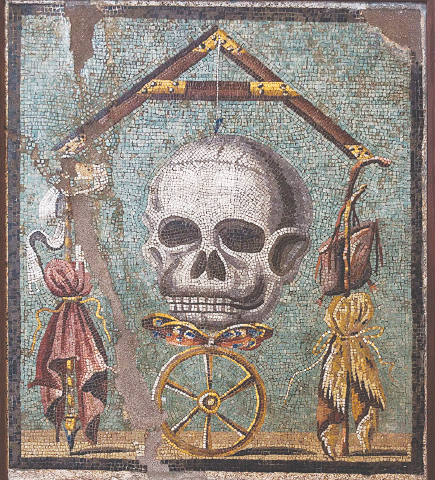
Famously, the Pink Floyd film blends images of antiquities from the Naples Archaeological Museum with the band’s performances.
Roman frescoes and mosaics are highlighted during particular songs. Profiles of bronze statues meld with the faces of band members, linking past and present.
Later scenes have the band backdropped by images of frescoes from the famed Villa of the Mysteries and of the plaster casts of eruption victims.
The band’s musical themes of death and mystery link with ancient imagery and it would have been the first time many audience members had seen these masterpieces of Roman art.
Pink Floyd Live at Pompeii marked a brave experiment in rock concert movies.Watching it more than 50 years later, it is a timepiece of early 1970s rock and a remarkable document of a band on the brink of fame.
Because of their progressive rock sound, sonic experimentation and philosophical lyrics, it was often said by Pink Floyd’s fans that they were “the first band in space.” They even eventually had a cassette of their music played in space.
But many are not aware of their earlier roots in the dust of ancient Pompeii. The re-release of the film gives an opportunity to enjoy the site’s unlikely role in music history.
The writer is Head of Public Engagement at Chau Chak Wing Museum at the University of Sydney in Australia
Republished from The Conversation
Published in Dawn, ICON, May 4th, 2025