0
0

In the film industry, true star-makers are rare. While talent often plays a key role in shaping destiny, more often than not, a star-maker is needed — someone who can recognise potential, nurture it, mentor it and guide it.
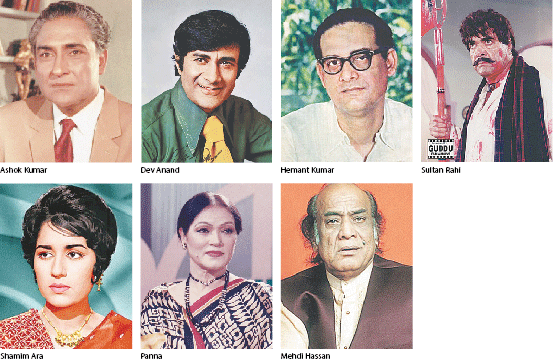
While both Bollywood and Lollywood have had their fair share of star-makers over the years, there’s an individual who helped launch the careers of more than a dozen Bollywood and Lollywood legends. In an industry as modest as Pakistan’s, one can hardly imagine a single individual being the driving force behind the transformation of talents such as Sultan Rahi, or the discovery of talent such as actress-producer Shamim Ara, actress-dancer-producer Panna, singer Mehdi Hassan and the person to groom director Laiq Akhtar, filmmaker M. Akram and ace editor Irshad Durani.
Even more astonishing, before migration to Pakistan, the same person had already played a pivotal role in introducing iconic figures such as Dev Anand, Raj Kumar, Pradeep Kumar, music director and singer Hemant Kumar, composer Rasheed Attre and the revered screenwriter K.A. Abbas.
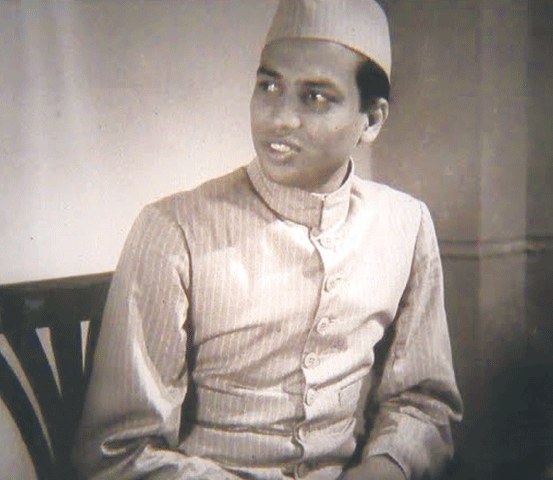
Najam Naqvi, a director and producer of immense command may not always be spoken of with the reverence he deserves but his extraordinary contributions to both Bollywood and Lollywood during the ’40s, ’50s and ’60s remain undeniable.
A film director and talent-spotter of remarkable ability, Najam Naqvi introduced a large number of acting and music legends to both pre-Partition Indian and post-Partition Pakistani cinema
Najam Naqvi began his cinematic journey as a protégé of the legendary Franz Osten — the German filmmaker who brought European sophistication and technical finesse to early Indian cinema.
Talkies began production in India in 1931, and India needed people who could make films. Bavarian film director Franz Osten had been brought to India by Himanshu Rai, the visionary producer who, along with his wife, the celebrated actress Devika Rani, established the iconic Bombay Talkies film studio. Devika Rani starred as the leading lady in most of the studio’s productions while Rai oversaw operations as producer.
It was around the time of an infamous scandal at Bombay Talkies that Najam-ul-Hasan Naqvi found his way into the studio’s ecosystem. The leading man of Bombay Talkies at the time, a certain Najam-ul-Hasan, had eloped with Devika Rani, causing a major uproar in the industry and a personal crisis for Rai.
In the fallout, Najam-ul-Hasan was swiftly sidelined, and to avoid association with the disgraced actor, Najam-ul-Hasan Naqvi dropped the ‘ul-Hasan from his name, emerging simply as Najam Naqvi. Born in Muradabad, United India, in 1913, Najam was in his early 20s and pursuing a master’s degree when fate brought him to Osten.
The German director asked for a group of young men who could help him understand the culture while he taught them the basics of direction, the importance of lighting, blocking and subtle performance. Najam was among one of his students and, although he was only the continuity assistant to Osten in Achut Kanya (1936) besides playing a side role, Najam gradually rose to assist the legendary director.
When Osten was arrested in 1939, at the start of World War II, on suspicion of being a German spy, Najam finished Kangan left incomplete by him. Najam Naqvi not only honed his technical skills during his time at the Talkies but also emerged as a keen observer of raw talent. His early exposure to future stars helped him develop a rare instinct — the ability to spot potential long before the world recognised it.
It is believed that it was Najam’s discerning eye that noticed the actor in a young lab assistant named Kumudlal Ganguly, impressed by his smile and distinctive hairstyle. On Najam’s recommendation, Ganguly was introduced to director Franz Osten and, after consultations with Najam and others, he re-emerged as Ashok Kumar — who would go on to become one of India’s greatest actors.
Throughout the ’40s, Najam directed movies such as Punar Milan, Raja Rani, Naya Tarana, Tasveer, Panna, Nateeja and Parai Aag, many for Bombay Talkies. He worked alongside Ashok Kumar, Renuka Devi (later known as PTV drama actress Begum Khursheed Mirza), Prithviraj Kapoor, Madhubala and Ajit.
In pre-Partition India, Najam Naqvi’s directorial and casting choices were synonymous with cinematic excellence. He was among the first to approve of struggling Dev Anand as a lead in Ziddi (1948). Actor Pradeep Kumar, who later became a romantic lead in historical epics, also owes a lot to Naqvi’s foresight.
After Partition, Bombay Talkies started to crumble and Najam made only two more films. In Rangili (1952), he introduced Raj Kumar as a lead actor. Raj Kumar was a police inspector before that and Najam was impressed by his personality when they met at a police station. He gave him his card and suggested that if he wanted to achieve something in life, he must come and meet him in the studio.
In his final film in India, Samrat (1954), he took the legendary Hemant Kumar as a music director. Equally notable was his support for Rasheed Attre, a music composer whose cross-border legacy still resonates. Not to forget Khwaja Ahmed Abbas, whose pen scripted some of Indian cinema’s most powerful social commentaries, was asked to join films after he made a name for himself in journalism.
After Partition, while many artists chose to remain in India, Najam Naqvi decided to move to Pakistan. It is rumoured that his film Rangili was subjected to brutal censorship. Najam Naqvi himself witnessed the then home minister Moraji Desai specially instructing the members of the committee to “cut the film and shoo the musalla [Muslim] away.”
Sensing the changing tides and the growing hostility, Najam understood the message clearly and, after completing his film Samrat, he decided to migrate to Pakistan. Despite being in his mid-40s, he was a workaholic and slept, dreamt and ate films. He had complete command of filmmaking and had a good sense of music and dance.
The industry changed but Najam Naqvi’s role as a star-maker did not. In Pakistan, too, he left a lasting legacy. His first film in Pakistan, Kunwari Bewa (1956), was shot and produced in Karachi. In it, he introduced a young girl named Putli Bai, who was rechristened as Shamim Ara.
She would go on to become a major star, acting for Najam in films such as Qaidi and Ek Tera Sahara. It would be impossible to imagine the iconic song ‘Mujh se pehli si mohabbat mere mehboob’ without Shamim Ara, and eventually the Pakistan film industry without her.
It was also in Kunwari Bewa that Najam Naqvi introduced the world to the ghazal maestro Mehdi Hassan and the country’s premier playback singer Ahmed Rushdi. His eye for talent didn’t stop there — he was instrumental in introducing Sultan Rahi to the silver screen, the actor who would go on to become the enduring face of Punjabi cinema.
Agha G.A. Gul of Evernew Pictures, who had known Najam Naqvi since pre-Partition days and was well aware of his talents, invited him to Lahore at a time when Karachi’s film industry was still in its infancy, and Lahore was striving to regain its footing in films. Gul signed Najam to direct three films: Naghma-i-Dil (1959), Qaidi (1962), and Ek Tera Sahara (1963).
Songs such as ‘Ae dil kisi ki yaad mein’, ‘Meray dil ke taar’, and ‘Husn ko chaand’ continue to resonate to this day, a testament to Najam’s refined musical sensibility. His song ‘Panay parcham talay’ from Ek Tera Sahara is regarded as one of the first indigenous patriotic songs of Lollywood. It was also the first film that brought the Kashmir issue to films.
Najam suffered an attack of facial paralysis during the production of Payal Ki Jhankar (1966), which gradually led to his withdrawal from the industry. After the death of his wife in 1969, he became even more reclusive, spending his last 13 years in complete solitude. Najam Naqvi passed away in January 1982, leaving behind a rich yet underappreciated legacy that continues to echo through the annals of South Asian cinema.
Najam Naqvi may not always be celebrated as loudly as some of his contemporaries, but his contributions to South Asian cinema — through his eye for talent, his technical skill and his passion for storytelling — have left a lasting impact.
His legacy continues to inspire, quietly reminding us that true pioneers often work behind the scenes, shaping the future in ways the world only realises much later. He lived up to his name — a star who illuminated the path for others.
Published in Dawn, ICON, May 4th, 2025