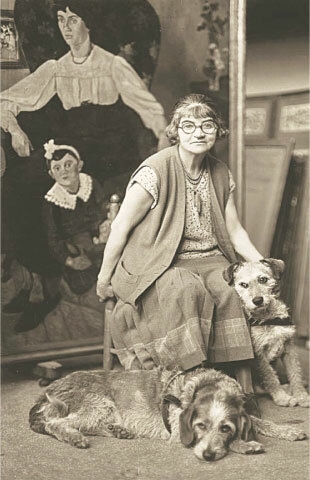
Regular visitors to the legendary Montmartre Museum in Paris never miss the opportunity, even when they are there to admire works by other artists, to walk into a specialised part of the establishment that houses the mythical atelier. Here, a number of artists, but most passionately Suzanne Valadon, used to work. Hence, many of Valadon’s enchanting art pieces are part of the permanent collection here.
This year, the Pompidou Centre museum, located at the other end of Paris, has taken the unusual step of holding an exhibition exclusively dedicated to Valadon’s works, brought together from a number of private collections and also from many other museums. The last time such a show was exclusively devoted to her creations was more than half-a-century ago, in 1967 at Paris’ Museum of Modern Art.
Valadon (1865-1938), had established herself as an emblematic but also daringly creative figure who had managed to keep her distance from the dominant artistic trends that every other painter of the time passionately followed — movements such as cubism and abstract painting. She ardently continued defending her own obsession with “painting the reality without any kind of artifice or voyeurism”, as she defined it.
The current exhibition highlights Valadon’s pioneering but often underestimated role in the birth of artistic modernity and reveals her obsession with her freedom to concentrate not on any celebrated movements of the time but holding on definitively to her personal artistic visions.
A retrospective exhibition in Paris highlights Suzanne Valadon’s pioneering but often underestimated role in the birth of artistic modernity
The Pompidou Centre’s organisers have been able to assemble Valadon’s art pieces on display at the current exhibition by temporarily bringing in her artworks from the Orsay and Orangerie Museums in Paris, from the Metropolitan Museum of Modern Art in New York, as well as from a number of private collections in many other countries.
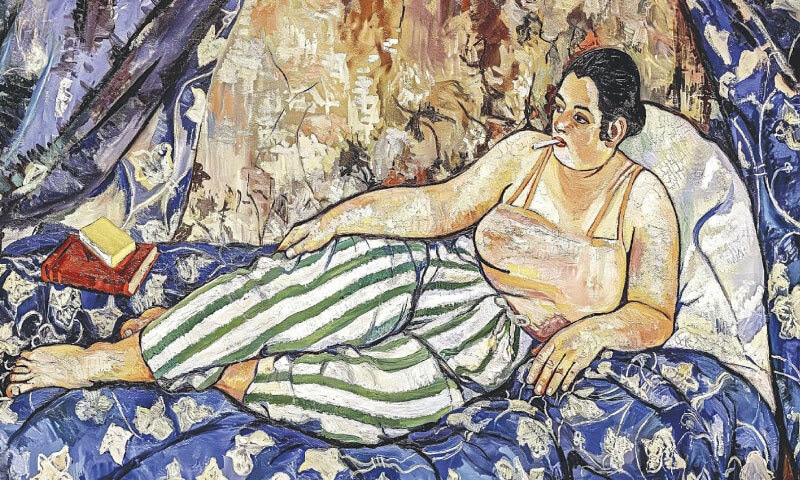
To add to this, the organisers have not forgotten the fact that paper drawings were also a part of Valadon’s artistic passion, and there are a number of these graphic pieces, largely unknown to the public, present in the current exhibition. The Bath, in particular, serves as a touching window into what daily life would have looked like in 1908. Conversely, The Blue Room (1923) is a riveting piece because it looks like it could have been painted today. Neither its setting nor its central character appear to be rooted in a particular time period.
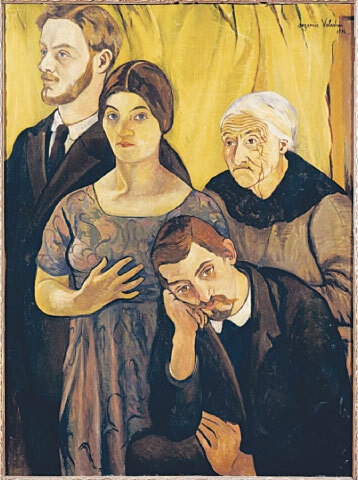
While viewing her creations, one also becomes aware of her unique artistic journey, from one era to the next. For instance, some of her works bring to life the Parisian fervour during the turn of the century, with its legendary cafés, dance halls and cabarets — a forgotten world that still lingers in Valadon’s singular creations.
‘Suzanne Valadon’ is on display at the Pompidou Centre in Paris from January 15-May 26, 2025
The writer is an art critic based in Paris. He can be reached at zafmasud@gmail.com
Published in Dawn, EOS, April 27th, 2025