0
0


• Accuse provincial rulers of ruining agriculture, reject incentive package
• Ministers highlight initiatives to support farmers
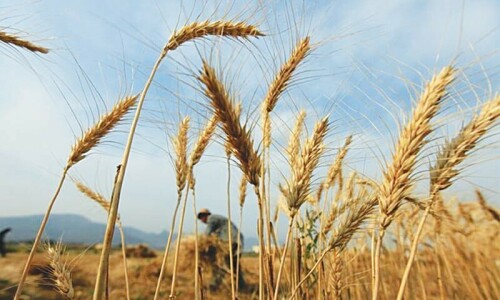
LAHORE: The agricultural sector in Punjab has become a battleground for conflicting narratives, with farmers expressing deep distress while the provincial government touts its efforts to support them.
Khalid Khokhar, President of the Pakistan Kisan Ittehad, held a press conference in Lahore, vehemently criticising the government’s handling of the agricultural crisis. “The throat of farmers and cultivators has been strangled,” he declared, emphasising the farmers’ love for their country and questioning their ability to meet basic needs like their children’s education.
He announced a protest measure, stating, “Next year we will cultivate less wheat in protest,” and rejecting the Punjab government’s aid package, asserted, “We do not want the package, you have ruined agriculture.”
Mr Khokhar also urged political parties to refrain from politicising the wheat issue, lamenting the lack of focus on national interests within the assemblies.
He regretted that while the PPP and PTI were criticising the PMLN government in Punjab, the situation was no different in Sindh and Khyber Pakhtunkhwa, where the PPP and PTI were in power, and the provincial governments, too, were not procuring wheat from the farmers during the ongoing harvesting season.
In a counter-response, Punjab Minister for Agriculture and Livestock Syed Ashiq Hussain Kirmani, alongside Information Minister Azma Bukhari, addressed a press conference. Mr Kirmani defended the government’s actions, stating, “Politics is being played in the name of wheat,” but insisted that the government is committed to supporting farmers.
He criticised the opposition, questioning their record in provinces where they hold power and highlighting Chief Minister Maryam Nawaz Sharif’s personal involvement in monitoring the wheat market in Punjab.
Mr Kirmani detailed the government’s initiatives, including a record budget allocation for farmers, substantial subsidies on fertilisers, seeds, and tractors, and the disbursement of Rs52 billion in interest-free agricultural loans through the “Kissan Card.”
He highlighted the increased urea usage and a record wheat sowing as evidence of the government’s success. He also criticised the previous government, referring to it as “Waseem Akram Plus,” for neglecting the farmers’ welfare.
A key focus of the government’s strategy is empowering the private sector, Mr Kirmani said, announcing Rs110bn in interest-free loans to the private sector and flour mills, mandating them to purchase 25pc of the wheat stock.
He also highlighted the implementation of Electronic Warehouse Receipts (EWR), enabling farmers to store wheat for up to four months and access immediate cash through bank loans using warehouse receipts.
The Punjab cabinet has further solidified its commitment by approving an amendment to the Food Grains Licensing Control Order 1957, mandating 25pc wheat procurement by flour mills, with the threat of license cancellation for non-compliance.
The cabinet also approved the implementation of EWR, with the government bearing storage costs, to provide farmers with greater flexibility and financial security.
Minister Kirmani concluded by stating that wheat procurement will commence from all locations to help stabilise prices and ensure farmers receive their due compensation.
Published in Dawn, April 24th, 2025